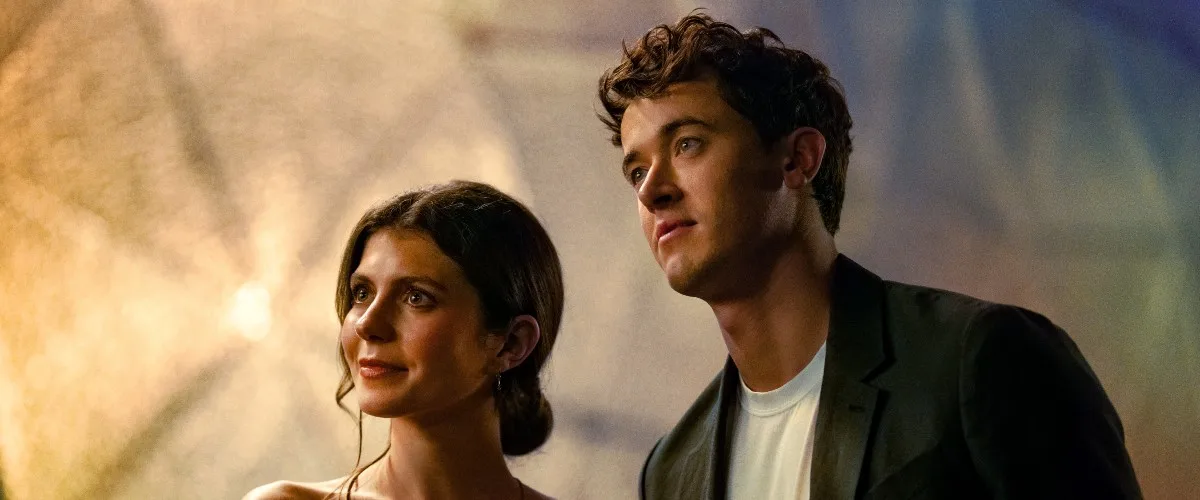
Adapted from Emily Henry’s wildly successful beach novel, People We Meet on Vacation arrives on Netflix as yet another glossy but hollow attempt to resuscitate the modern rom-com. The film unfolds through a fractured timeline, tracking the restless, high-energy travel writer Poppy (Emily Bader) as she realizes that the life she once dreamed of now leaves her strangely numb. Before long, it becomes clear that her creative block isn’t just professional, it’s deeply personal, rooted in the unresolved tension between her and Alex (Tom Blyth), her quiet, guarded college best friend.
Their story stretches back to a chance connection in college, when Poppy tagged along on Alex’s road trip from Boston College to their shared hometown of Linfield, Ohio. From that summer on, they established a tradition: one week-long vacation together every year. Year after year, city after city, they circled the truth neither of them could quite bring themselves to say out loud.
That unspoken bond reaches a breaking point when Alex finally ends things with his longtime on-again, off-again girlfriend, Sarah (Sarah Catherine Hook), shortly before his brother’s wedding. In a burst of impulsive hope, Poppy abandons her assigned work trip and flies to Barcelona for the wedding instead, determined that this might finally be the moment where she stops running from her feelings, from her past, from the possibility that the love she’s been denying has been right in front of her all along.
It’s the kind of setup that could have supported a genuinely engaging romantic drama. Instead, the finished film plays like a collage of better movies: When Harry Met Sally…, My Best Friend’s Wedding, One Day, with a dash of The Notebook but stripped of the character detail, emotional layering, and lived-in world-building that made those films resonate.
What makes this especially frustrating is the director behind the camera. Brett Haley has previously demonstrated a delicate touch with character and atmosphere in films like I’ll See You in My Dreams, The Hero, and Hearts Beat Loud, not to mention the visually expressive and emotionally sincere Netflix adaptation All the Bright Places. Here, though, he seems oddly disengaged. The editing lacks rhythm as the film jumps between timelines, never creating momentum or emotional contrast. The decision to shoot the entire movie in an ultra-wide aspect ratio feels arbitrary and often counterproductive. Frames feel empty, emotionally and visually. Haley rarely allows the camera to move in close enough to capture nuance, favoring bland medium shots that flatten the performances.
This is especially damaging in the case of Tom Blyth. He’s an expressive actor whose strength lies in subtle reactions, the flicker of hesitation, the micro-shift in emotion across his face. He’s capable of conveying entire emotional arcs without speaking. Yet the camera routinely positions him so distantly that his face becomes almost incidental, sometimes no more prominent than the back of Emily Bader’s head. In moments that should ache with intimacy, the visual language keeps us frustratingly removed.
The screenplay, credited to three writers (Yulin Kuang, Amos Vernon, and Nunzio Randazzo), doesn’t offer much help. Characterization is thin across the board. We’re told Poppy works as a writer for a travel magazine called R&R, but the film never clarifies what that actually means. Is she a critic? An essayist? A reviewer? The job exists mostly as an aesthetic rather than a lived profession. Her boss, Swapna, played by Jameela Jamil, is defined almost entirely by her British accent and her wardrobe, cinematic shorthand for “elegant and impressive,” without any deeper personality attached.
Poppy’s social world is similarly underwritten. She appears to have exactly one friend outside of Alex (played by Alice Lee), who shows up for a single scene in which they get reprimanded and then spiral into bad decisions during a SoulCycle class. That’s it. No name. No arc. No real presence. Classic rom-coms understood the power of the best-friend character the way someone like Judy Greer built an entire career embodying that role with wit and texture. Here, that essential dynamic is treated as disposable.
Alex fares no better. We’re told he once pursued a PhD, only to abandon it to teach high school back home after deciding to build a life with Sarah. But the film never bothers to tell us what he studied, or why it mattered to him. His inner life remains mostly theoretical. His family is sketched with equally light strokes. His brother David (Miles Heizer) claims Poppy is practically family, yet the film gives us only one shared scene between her and the family at the wedding, where that closeness feels forced rather than earned.
It’s impossible not to compare this to My Best Friend’s Wedding, where the history between Jules and Michael is communicated effortlessly through behavior, familiarity, and body language. The family dynamic in that film feels organic and specific, aided by vivid character actors like M. Emmet Walsh. By contrast, Alex and David’s father (Ian Porter) barely registers; his presence is so faint he might as well be a background extra. Poppy’s parents (Alan Ruck and Molly Shannon) are similarly underdeveloped, though they’re oddly given extra screen time to perform quirkiness without purpose. One scene has Shannon referencing Never Been Kissed, a moment that feels less like character writing and more like an inside joke designed to remind viewers that Molly Shannon once appeared in Never Been Kissed.
The cumulative effect is a movie that feels like a diluted echo of superior predecessors. More than anything, it resembles a product engineered for social media—something designed to be chopped into aesthetic clips for TikTok edits and looping GIFs on Tumblr. It also falls into another familiar trap: prioritizing picturesque international destinations over the emotional geography of its characters. Linfield, Ohio, is described as central to who these people are—beloved by Alex, painful for Poppy yet the film barely shows it. We glimpse a generic tree-lined street, but never feel the town’s personality, its warmth, its claustrophobia, its history.
That absence of specificity is what ultimately undermines everything. When nothing feels grounded, the emotions can’t land.
It’s especially disheartening to watch a filmmaker like Haley, who once showed such sensitivity, deliver something this disengaged. And it’s equally frustrating to see two promising actors like Emily Bader and Tom Blyth stuck in such saccharine, undercooked material when their previous indie work (Fresh Kills, Plainclothes) suggests they’re capable of far richer performances. The silver lining is that their careers can only improve from here.
People We Meet on Vacation Parents Guide
MPA Rating: PG-13 for sexual material, some drug references, brief nudity, and mild strong language.
Violence & Intensity:
There is no physical danger or violent content in the film. The tension is emotional rather than physical, centered on miscommunication, unresolved feelings, and interpersonal awkwardness. Conflicts tend to be subdued—more uncomfortable than explosive.
Language:
The dialogue includes occasional mild profanity typical of a PG-13 film, with words like “shit” and “fuck” appearing in casual or stressed moments. There are no slurs or hateful terms, and the overall tone remains conversational.
Sexual Content / Nudity:
Romantic and sexual content is handled subtly. Characters kiss and share intimate moments, with some dialogue implying sexual relationships. Any nudity is brief and non-explicit, without lingering shots or overt sexualization.
Drugs, Alcohol & Smoking:
Alcohol appears in social settings such as weddings, vacations, and nights out. Drug use is briefly referenced but not depicted in detail. These elements exist as background realism rather than narrative focus.
Age Recommendation:
Although the film stays within PG-13 boundaries, its themes career dissatisfaction, emotional inertia, regret, and romantic ambiguity will resonate more strongly with older teens and adults who have lived through similar experiences.
