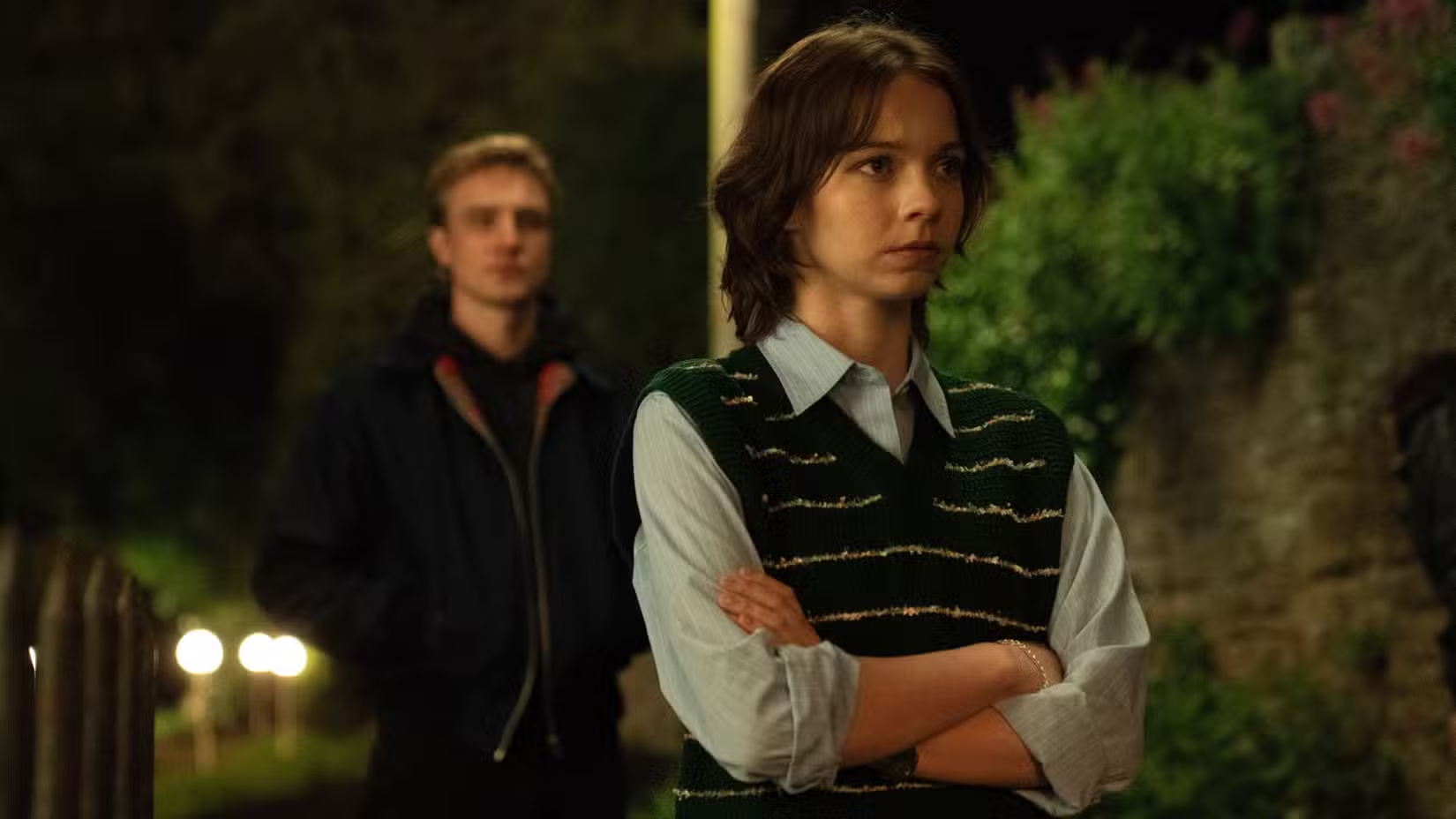
There’s a moment early in the second season where Pip Fitz-Amobi sits at a murder-mystery dinner party, wearing a costume, laughing on cue, playing the game. Emma Myers plays it with exactly the right kind of hollowness, Pip is performing normalcy the way someone recovering from surgery performs wellness. She’s upright. She’s smiling. She’s not okay. And you know, watching her that the show is going to pull that thread until something unravels.
That’s the promise of Season 2. Whether the show fully keeps it, is a more complicated question.
When we last left Little Kilton, Pip had done the thing teenagers in YA crime dramas always do: solved a murder no adult could. Andie Bell’s real killer is in prison. Sal Singh’s name is cleared. And Max Hastings, entitled, moneyed, the kind of predator who’s coasted his whole life on the assumption that money is a legal defense, is on trial for drugging and assaulting multiple women. Pip has a podcast now. She has a boyfriend in Ravi Singh (Zain Iqbal, warm and grounded in a role that could’ve easily been a prop). She has, theoretically, a future that doesn’t involve breaking into people’s houses.
Then Connor Reynolds knocks on her door, and his brother Jamie, a key witness in Max’s trial, has vanished.
“What it does with Emma Myers is criminal in its own way. She is too good for the material the show keeps handing her, and too committed to let it show.”
Season 2 adapts Holly Jackson’s second novel, Good Girl, Bad Blood, and the most notable thing about this adaptation is how much cleaner it runs than Season 1. The first season had a habit of grafting on subplots that went nowhere, like a contractor who couldn’t resist adding rooms to a house that already had enough. This season is tighter. Jackson herself co-wrote three of the six episodes, and you can feel that authorial presence, a hand on the wheel, keeping things from drifting.
Strongly Recommended: The Boroughs Tv Parents Guide
Three cases orbit the season simultaneously: the lingering fallout from Andie Bell’s murder, Max’s ongoing trial, and the disappearance of Jamie Reynolds. The writing is at its sharpest when it lets these threads pull against each other. One of the season’s better structural choices is making Jamie’s absence matter primarily because of what it does to the trial, his testimony is essential, which means his disappearance isn’t just a missing-persons story, it’s a threat to whether Max ever sees the inside of a courtroom. That’s a smart piece of plotting.
What’s less smart is that Jamie himself never quite becomes a person we care about independent of his usefulness to the plot. I kept waiting for the show to make me feel something about his safety beyond abstract concern, and it never quite got there. A scene in the premiere attempts to build their connection, Pip and Jamie, a conversation, the emotional stakes set in place, but it plays like a scene written to fill a gap rather than one that grew organically. You can almost see the narrative machinery underneath it.
The trial material is a different story. Henry Ashton plays Max with the particular unearned confidence of someone who has never been held accountable for anything, he’s smug, not in a cartoon-villain way, but in the way real people are smug when they’ve been shielded their entire lives by money and reputation. There’s a scene of Max sitting across a courtroom, watching proceedings with the faint amusement of a man who has already decided how this ends, and Ashton doesn’t oversell it. He just lets it sit there. It’s quietly infuriating in exactly the right way.
The season’s most honest thread is also its most uncomfortable one: that justice, particularly for survivors of sexual violence, is neither guaranteed nor clean. Pip wants a conviction. She gets something more complicated. The system doesn’t fail in the dramatic, corrupt way of legal thrillers, it fails in the bureaucratic, exhausting way real systems fail, and the show has the nerve to sit in that discomfort rather than resolve it with a satisfying last-act reveal.
Pip, meanwhile, is changing. Season 1 gave us a detective who broke rules. Season 2 gives us one who starts to lose track of where the rules were to begin with. Myers plays this with tremendous care, the creeping paranoia, the obsessiveness that’s no longer fully tethered to case logic, the moments where you genuinely can’t tell whether Pip is brilliant or unraveling or both. There’s an episode late in the season where she does something that would be unambiguously wrong if you stepped back far enough, and the show doesn’t entirely let her off the hook for it. That moral ambiguity suits Myers. She’s built for it.
The supporting characters fare less well. Cara (Asha Banks), whose friendship with Pip has curdled after last season’s revelations about her father, is given a resentment arc that makes sense on paper but never quite comes alive onscreen. Asha Banks is good when the script gives her something to do, but Cara spends too much of the season as a weather vane indicating how Pip is doing rather than a person navigating her own wreckage. Ravi remains the show’s most reliable emotional anchor, partly because Iqbal brings a steadiness that the show rewards but partly because the writing gives him less room to fail.
This is a show that knows what it is and mostly delivers on it. It’s not trying to be prestige television. It’s trying to be the best possible version of a YA mystery series compulsively watchable, emotionally engaged, pointed in its social critique without being preachy about it. On those terms, Season 2 is a genuine improvement over Season 1. The engine runs cleaner. The themes land harder.
But what it does with Emma Myers is its own kind of problem. She is too good for the material the show keeps handing her, and too committed to let it show. She carries every scene she’s in, including the weak ones, and makes you feel the weight of a character who started this story wanting to do good and is slowly discovering that goodness is a more fragile thing than she imagined.
You leave Season 2 not quite satisfied and not quite frustrated. Which, come to think of it, is exactly how Pip leaves it too. Maybe that’s the point.
A Good Girl’s Guide To Murder Season 2 Review For Parents Guide
Violence & Intensity: Moderate. Physical confrontations, threat sequences, and the psychological intensity of investigation. A character is shown in peril. Crime scene references are present but not graphically depicted. The season’s tension is primarily psychological rather than visceral.
Language: Mild to moderate. Some profanity throughout, including occasional stronger language in moments of high emotion. Nothing gratuitous or sustained.
Sexual Content & Nudity: No nudity. Teen romance between Pip and Ravi includes kissing and some intimacy, tastefully handled. The rape trial is a major storyline, sexual assault is discussed explicitly and frankly, including the act of drugging victims, testimony about assault, and institutional failures to prosecute. The tone is serious and non-exploitative, but the subject matter is unavoidable and may be distressing for younger or more sensitive viewers.
Drugs, Alcohol & Smoking: The trial’s entire premise involves Max drugging and assaulting women, discussed throughout the season. Underage teens drink alcohol in social settings. A teen character drinks excessively in one scene. No glamorization of substance use, though parental conversation about consent and spiking may be warranted.
Positive Elements: Strong themes of justice, loyalty, and the cost of truth-telling. Pip’s moral complexity is portrayed honestly, she’s shown making questionable choices with real consequences. The show doesn’t reward vigilante behavior uncritically. Diverse cast and a genuine, caring teen relationship modeled between Pip and Ravi.
Best suited for mature teens aged 15 and up. The sexual assault storyline, moral ambiguity, and psychological darkness make this a show worth watching with a conversation partner, a parent, older sibling, or trusted adult, particularly for younger or more sensitive teens.