They Fight — A Sharp Left Hook That Never Quite Connects
The best fifteen minutes of “They Fight” happen before anyone throws a punch. Walt Manigan, three years into a five-year sentence, sits across from a parole board that wants to know if he’s ready to express contrition. André Holland plays that moment with a stillness that tells you everything, the calculation behind his eyes, the practiced humility of a man who’s learned exactly what answer keeps him locked up and exactly what answer gets him out, and the genuine uncertainty underneath both about which one is actually true. It’s the kind of scene that makes you sit up. It’s also, unfortunately, close to the high point of the whole picture.
Sheldon Candis, adapting Andrew Renzi’s 2018 documentary of the same name, has real material here, a formerly incarcerated man in Southeast D.C. trying to rebuild a life by teaching kids to box, wrestling with his own unresolved guilt while attempting to convince a room full of skeptical adults he’s not the man who went in.
Watching Holland navigate Walt’s first stumbling weeks out of prison, humiliating himself in front of people who knew him before, flinching at small kindnesses like he doesn’t trust himself to accept them, is the kind of specific, lived-in character work Holland can apparently do without breaking a sweat, and it’s genuinely moving in isolation.
The trouble is that “in isolation” is exactly the problem. The film keeps cutting away from Walt just as it’s building momentum, and by the midpoint I found myself missing him in scenes he wasn’t even supposed to be the point of.
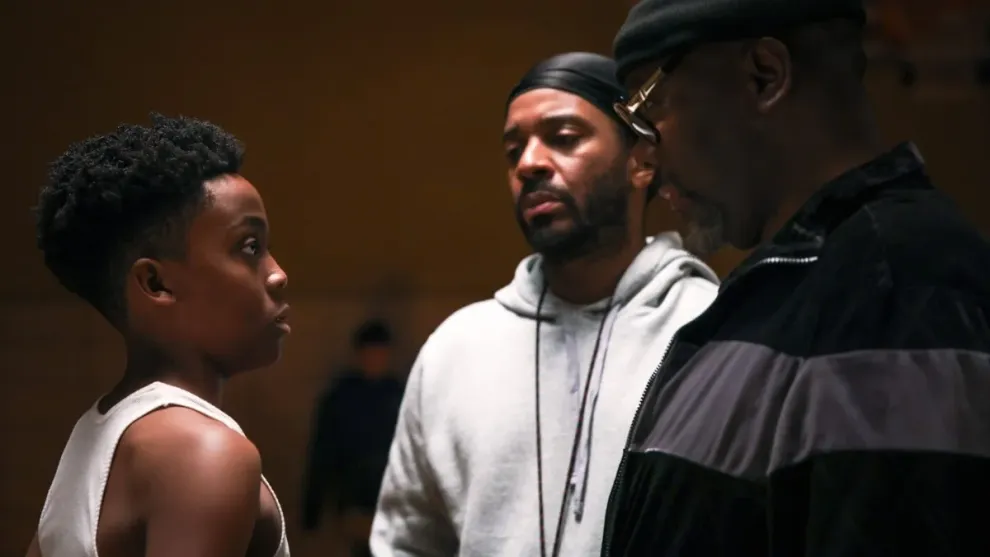
That’s because Candis has decided this movie also needs to be about Peanut, a teenage boy who joins gym owner Slim’s operation to learn to box, played with real warmth by young Anthony B. Jenkins. On its own, Peanut’s story, an absent father, a search for structure, the specific way a boxing gym can function as makeshift family for a kid who needs one could carry a movie. Andre Royo shows up for a single devastating scene as that absent father and nearly steals the whole picture in the process, which tells you the raw material for something genuinely affecting was sitting right there.
But Candis never picks a lane. He’s got Walt’s reintegration story, Peanut’s coming-of-age story, a whole gym’s worth of underdog-sports-movie beats, and a runtime of ninety-eight minutes to fit all of it into, and something has to give.
Characters arrive at emotional turning points the script hasn’t earned, because we skipped the scenes that would have earned them. More than once I had the distinct sensation of watching a movie that used to be twenty minutes longer, before someone in an edit bay decided the boxing footage mattered more than the connective tissue holding the story together.
The boxing itself, when it shows up, is handled with real attention to craft, Candis clearly knows the sport and shoots it with more discipline than the surrounding drama gets. But even there, the film keeps racing back to the personal storylines before a match can build any real tension, which robs the fights of the payoff they’re clearly reaching for. And when Walt does get his big speech-giving moments, the locker room pep talks, the life-lesson monologues, Holland is stuck reciting what sounds like a compilation of every sports-movie cliché ever committed to paper, delivered with a straight face that no amount of his own considerable talent can fully rescue. You can watch him working to sell lines that don’t deserve the effort he’s putting in, and there’s something almost poignant about that mismatch, whether or not it’s the poignancy the film intended.
I don’t think “They Fight” is a failure so much as a movie that never figured out what it wanted to be, a reintegration drama, a coming-of-age sports story, an ensemble piece about masculinity and mentorship across generations, and tried, gamely, to be all four at once inside a runtime that couldn’t support one of them properly.
Wendell Pierce brings real gravity to Slim, Samira Wiley does what she can with underwritten scenes, and the whole cast is clearly working from a place of genuine belief in this material. That belief shows. It just isn’t enough to paper over a script this scattered.
If you want the fuller, better version of this story, the one with room to actually sit with Walt’s guilt, Peanut’s hunger, and the particular alchemy that happens inside a boxing gym trying to save a neighborhood one kid at a time, Renzi’s original documentary is still out there, and it does patiently what this fictionalized retelling keeps rushing past. Holland gives this film everything he’s got. The film, unfortunately, never quite decides what to do with it.
Parental Guidance: They Fight
Rating: PG-13 (expected, consistent with sports drama content and themes)
Violence & Intensity: Boxing match violence throughout, along with intense emotional content around incarceration, parole hearings, and a father’s absence. No graphic gore; the intensity is primarily emotional and dramatic rather than physically brutal.
Language: Moderate profanity consistent with a PG-13 drama; dialogue includes realistic language for its Southeast D.C. setting without excessive vulgarity.
Sexual Content / Nudity: No significant sexual content or nudity flagged in available coverage; this is a family- and mentorship-centered drama.
Drugs, Alcohol & Smoking: Incarceration and reintegration themes touch on the broader context of systemic hardship, though no specific drug or alcohol content is highlighted in reviews.
Age Recommendations: Suitable for 13 and up. The themes around incarceration, absent fathers, and a formerly incarcerated man’s struggle to reintegrate are handled with real sincerity and could resonate especially well with older kids and teens navigating similar family circumstances, though the emotional weight (parole hearings, guilt, fractured father-son dynamics) is heavier than the boxing-movie framing might suggest.
