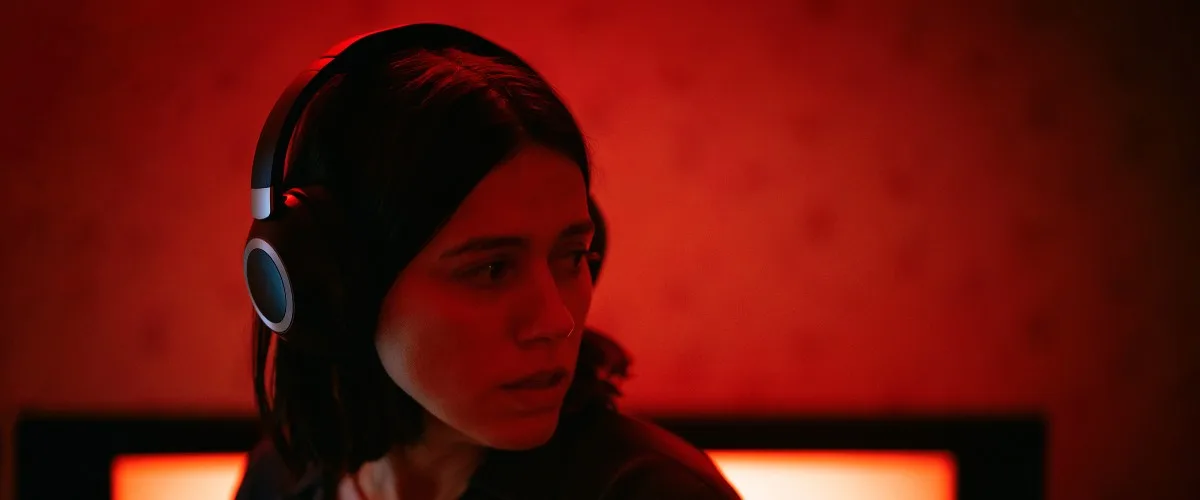
As horror continues its impressive run through the 2020s, A24 is readying the release of a genuinely unnerving standout in Ian Tuason’s superb undertone. The film circles familiar modern-horror territory, grief, and spiritual doubt, but folds those ideas into a deeply immersive audiovisual assault that immediately marks Tuason as a filmmaker to watch.
Too many horror directors take shortcuts, leaning on jump scares, blaring music stings, or the assumption that a creepy premise alone will carry the experience. Tuason does the opposite. He builds dread through negative space, restricted perspective, skewed compositions, and some of the most striking sound design in recent memory.
The goal isn’t to observe events from a safe distance; it’s to inhabit the fear, to let image and sound tap into something raw and instinctive. Some viewers may feel the film’s ideas don’t neatly interlock, but that ambiguity feels intentional. Undertone has no interest in tidy explanations; nightmares rarely offer them.
The camera never leaves Evy (Nina Kiri), a podcaster who returns home to care for her dying mother (Michele Duquet), who spends most of the film unresponsive in bed. Evy’s life revolves around caregiving, with her only real reprieve coming during recordings of her show with co-host Justin (Adam DiMarco). The Undertone Podcast focuses on paranormal phenomena, with Justin cast as the true believer and Evy playing skeptic.
Highly Recommended: Send Help (2026) Parents Guide
Their past topics include cursed videos and unsettling Ouija board stories, but this final episode proves far more disturbing: they receive ten audio recordings tied to a married couple who begin hearing inexplicable sounds in their house. As Evy and Justin attempt to decode the noises, the stability of Evy’s own reality begins to erode.
Tuason confines the film entirely to Evy and the house she inhabits, a space thick with the looming presence of death. (The fact that Tuason shot the film in his own parents’ home is both impressive and, frankly, something best unpacked with a therapist.) Whenever Evy slips on her podcast headphones, the audience is plunged into the same sonic cocoon, cut off from the outside world and forced to listen only to the recordings and the show itself. As the pair analyzes the sounds, we become complicit in the investigation.
Anyone who’s ever stared too long at a grainy video, convinced a shadow might be a ghost, will recognize the compulsion at work here. Of course, horror logic dictates that they should absolutely not listen to all ten recordings, especially once the boundary between the audio files and their own lives starts to blur, but curiosity, as always, wins.
Rather than hammering its themes into place, the undertone lets them drift in and out organically. Evy is pregnant; the recordings feature eerie infant sounds and suggestions of violence against children. A brief conversation with a doctor hints that Evy may be considering ending the pregnancy, while upstairs, her mother lies dying in a house saturated with religious iconography, statues, crosses, portraits of Jesus and Mary. Birth and death, belief and doubt, good and evil all echo between Evy’s personal life and the increasingly disturbing audio nightmare she can’t quite accept as real.
The film’s suffocating sense of confinement is heightened by Tuason’s precise use of space. Cinematographer Graham Beasley frequently tilts the camera, sometimes subtly, sometimes aggressively mirroring Evy’s growing disorientation. Most effective is how Evy is often pushed to the edge of the frame, leaving the camera lingering on dark hallways or partially visible staircases. Watching someone’s podcast isn’t inherently cinematic, so Tuason invites the audience’s eyes to roam. Was there a movement in that doorway? Something at the top of the stairs? Usually, there’s nothing, but soon we start imagining things anyway, much like viewers who swear they’ve spotted proof of the supernatural in so-called “real” haunting footage online.
Highly Recommended: In Cold Light (2026) Parents Guide
The film’s deliberate pacing pays off with a final act that ranks among the most unsettling in recent horror. As Evy’s world collapses and undertone descends into sensory chaos, the audience feels just as trapped as she is. What do the recordings truly represent? What actually happened to the couple in the tapes, or to Evy herself? At a time when horror films often over-explain themselves, catering to distracted viewers, it’s bracing if that’s even the right word to encounter a movie that trusts sound and image over exposition. The fear lingers precisely because it’s never fully spelled out.
It’s no surprise that after A24 acquired Undertone in a seven-figure deal, Blumhouse tapped Tuason to direct the reboot of Paranormal Activity, an obvious touchstone for this film. Given how far that franchise has drifted into incoherence, Tuason has a challenge ahead of him.
Undertone (2026) Parents Guide
Undertone is rated R by the Motion Picture Association (MPA) for language throughout and some drug material. While not a splatter-heavy horror film, it is intensely unsettling, relying on sound design, psychological dread, and thematic darkness rather than explicit shocks.
Violence & Intensity: There is very little on-screen violence, but the film is steeped in sustained psychological terror. Much of the fear comes from disturbing audio recordings that imply harm, including threats involving children, illness, and death. Themes of dying, pregnancy complications, and existential dread loom over nearly every scene. The atmosphere is claustrophobic and relentless, making the intensity far more draining than the body count might suggest.
Language: Strong language appears consistently throughout the film, mostly in conversational dialogue. Characters use profanity casually rather than aggressively, but it is frequent enough to justify the R rating. There are no notable slurs, but the tone is often grim, stressed, and emotionally raw.
Sexual Content / Nudity: There is no nudity and no explicit sexual activity. Sexual content is limited to mature thematic material, including pregnancy and a brief implication that a character may be considering an abortion. These moments are handled seriously and without sensationalism, but they may prompt difficult conversations.
Drugs, Alcohol & Smoking: Drug material is present but minimal. References to substance use occur in dialogue, and there are brief moments involving alcohol, though it is not glamorized or central to the story. Substance use functions more as background realism than a focal point.
Age Recommendations: Undertone is best suited for adults and older teens (17+) who are comfortable with slow-burn horror, heavy themes, and deeply unsettling sound-based scares. Younger viewers, or those sensitive to anxiety-inducing material, illness, or child-related horror implications, are likely to find it overwhelming rather than entertaining.
This review was filed from the Sundance Film Festival. The film opens on March 13.
