In the Blink of an Eye is rated PG-13 for sexual content, thematic material, and some bloody images.
In the Blink of an Eye, humanity caught mid-stride, stretched across millennia, trying to survive, connect, and move forward. That sense of cosmic continuity is exactly the sort of thing Andrew Stanton has always been drawn to, which makes it all the more bittersweet that his long-delayed return to live-action feels so visibly strained. After the infamous ordeal of John Carter, this film arrives without quite the same behind-the-scenes chaos, but you can still feel the friction in every frame.
Stanton himself has acknowledged that the project was meant to roll years earlier before the pandemic stalled it. Shot back in 2023 and finally emerging at Sundance before quietly heading to Hulu in early 2026, the movie carries the unmistakable weight of something that had to fight simply to exist.
That struggle shows up on screen. Whatever promise Colby Day’s once-lauded Black List script may have held, the finished film feels like a patchwork of ideas that were either overworked or never fully realized. Threads are introduced, gestured toward, then abruptly abandoned. Nowhere is this more apparent than in the rushed final stretch, where montage stands in for narrative momentum, and the story’s grand aspirations collapse into emotional shorthand. It wants to reach the cosmos but keeps slipping back into abstraction.
Stanton structures the film around three timelines: deep past, near present, and distant future. The opening chapter takes us to 45,000 BC, at the supposed twilight of the Neanderthals. A small family, father Thorn, mother Hera, daughter Lark, newborn Ebb, moves silently through vast, pristine landscapes. With no spoken language, the film leans on onscreen text and Thomas Newman’s sweeping score to communicate meaning. Visually, it’s striking, occasionally echoing the primordial awe of The Tree of Life. Narratively, though, it’s thin. Beyond a few broad strokes, birth, survival, loss,s this segment never quite becomes a story, more a mood board of human origins than a fully realized chapter.
The present-day storyline does most of the heavy lifting. Rashida Jones plays Claire, an anthropologist literally brushing dust from ancient bones that may belong to Thorn’s clan. Stanton and editor Mollie Goldstein cut between Claire’s work and the prehistoric past, reinforcing the idea of an unbroken human chain stretching across tens of thousands of years. Claire’s personal life unfolds more slowly. She begins a relationship with Greg, a statistics student played by Daveed Diggs, who brings a grounded warmth and specificity the film badly needs. Their connection develops under the shadow of Claire’s mother dying back in Vancouver, giving this portion of the film its most recognizable emotional texture: grief, distance, tentative intimacy.
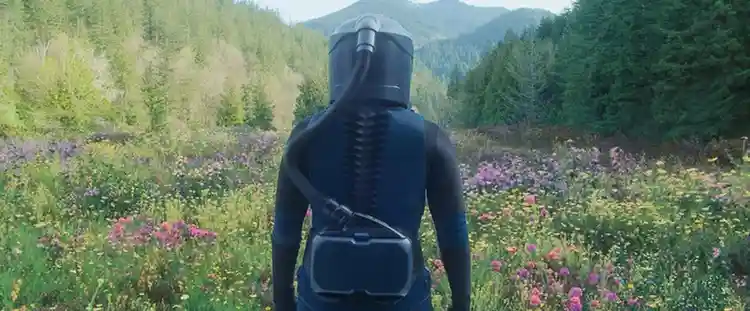
The future, set in the 2400s, introduces Coakley, a lone space traveler tasked with transporting stem cells destined to become children on a far-off colony. Kate McKinnon approaches the role with seriousness, but the character is thinly sketched, defined more by function than inner life. Her only companion is ROSCO, an A.I. voice that informs her of a potentially catastrophic infection threatening the ship’s oxygen supply. The stakes are enormous, the choices grim, yet the film rarely lingers long enough to let those dilemmas breathe.
Stanton’s intention is clear: these aren’t just parallel stories, but variations on a single human theme, evolution shaped not only by biology, but by emotion, devotion, and curiosity. The film hints at connections between eras that go beyond symbolism, weaving in plot elements that link past, present, and future under a shared existential banner. It’s an ambitious framework, and a noble one.
But ambition can be a double-edged sword. At a brisk 90 minutes, “In the Blink of an Eye” often feels like the abridged version of something far larger, as if you’re skimming the highlights of a massive novel rather than living inside its world. Ironically, in an era bloated with limited series that should have been lean features, this is a film that might have benefited from more room in episodic space to deepen characters, explore ideas, and let its themes unfold organically. Instead, it feels oddly disposable for a movie that’s quietly trying to grapple with all of human history and the species’ possible future.
Newman’s score is, as ever, elegant and emotionally precise, but it’s repeatedly asked to compensate for absent development, smoothing over gaps that feel less like intentional ellipses and more like missing pieces. You sense scenes that were never shot or perhaps never fully imagined.
There’s enough humanist sincerity here to make you want to forgive the missteps. The notion of humanity in conversation with its ancestors and descendants is rich soil for science fiction, and Stanton clearly believes in it. But belief alone isn’t enough. Whether the blame lies with pandemic delays, production compromises, studio upheaval, or a script that never quite survived the transition from page to screen, “In the Blink of an Eye” never gets the nourishment it needs to grow into something lasting.
In the Blink of an Eye (2026) Parents Guide
Violence & Intensity: The prehistoric storyline includes moments of survival-based peril and death, including brief bloody imagery tied to injury and loss. In the future-set segment, tension comes from life-or-death decisions rather than action, with existential stakes that may feel heavy for younger viewers. Nothing is prolonged or graphic, but the emotional weight of mortality and extinction is a constant undercurrent.
Language: Language is mild and infrequent. There is occasional use of adult language in contemporary scenes, but no slurs and nothing aggressive or mean-spirited. The overall tone is serious and introspective rather than abrasive or crude.
Sexual Content / Nudity: There is brief sexual content involving consenting adults in the present-day storyline. Scenes are non-graphic and handled matter-of-factly, with no nudity beyond what’s typical for a PG-13 drama.
Drugs, Alcohol & Smoking: Minimal. Some casual alcohol use appears in modern settings, without emphasis or excess. No drug use is depicted, and substance use is not a thematic concern of the film.
Age Recommendations: Best suited for teens 13 and up, particularly older teens who are comfortable with slower pacing and abstract ideas. While the content itself is relatively mild, the film’s themes human extinction, legacy, sacrifice, and the future of the species may be emotionally dense or dull for younger viewers expecting traditional sci-fi thrills.
This review was filed from the film’s world premiere at the Sundance Film Festival. “In the Blink of an Eye” begins streaming on Hulu on February 27.