You don’t have to wait long for “Hokum” to make its intentions clear. It opens like a ghost story, yes, but it quickly reveals itself as something heavier, more personal, almost accusatory in the way it circles grief and guilt. This is what Damian McCarthy does so well. Ever since Oddity quietly unsettled audiences, he’s shown a knack for horror that doesn’t just frighten, it lingers, like something unresolved in your own past. With “Hokum,” he returns to familiar terrain, folk horror, inherited trauma, the idea that violence doesn’t simply vanish, but nothing here feels recycled. If anything, it feels distilled.
McCarthy’s earlier Caveat hinted at a filmmaker working toward something more complete. “Hokum” feels like that arrival.
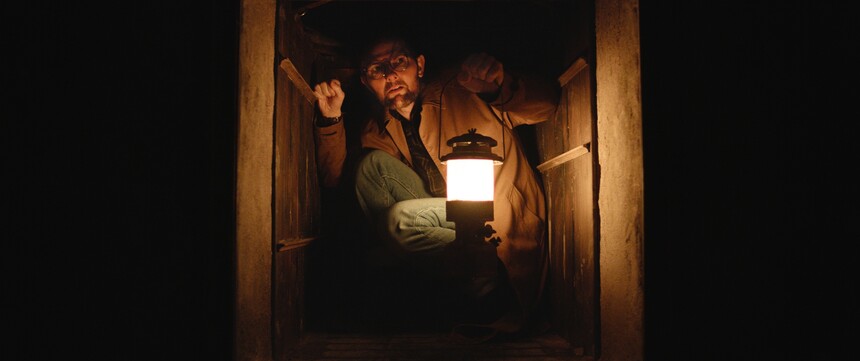
At the center is Adam Scott, doing work that quietly recalibrates how we see him. He plays Ohm Bauman, a successful horror novelist who carries himself like a man who’s spent too long mining his own darkness for material. You can sense shades of Stephen King in the conception of another writer haunted as much by his inner life as anything supernatural, but Scott doesn’t lean into imitation. He makes Ohm prickly, withholding, and often unpleasant in ways that feel disarmingly honest.
Ohm travels to an isolated hotel in Ireland, chasing something that sounds simple on paper: closure. His parents honeymooned there years ago, and he’s come to scatter their ashes beneath a redwood tree preserved in a photograph of his mother, a relic from a happier time. But even this act reveals the imbalance in his grief. When he lays his mother’s ashes down, there’s a kind of reverence to it you can feel the care in the gesture. With his father’s remains, it’s different. There’s impatience, maybe even resentment, as if this final duty is one he’d rather not perform at all. It’s a small moment, easy to miss, but it tells you almost everything about him.
The hotel itself feels like it’s waiting for something to go wrong. McCarthy populates it with offbeat figures who hover somewhere between welcoming and unknowable. Among them is Fiona, played by Florence Ordesh, who shares a brief, quietly charged interaction with Ohm before disappearing after a Halloween party. It’s the kind of vanishing that horror films often treat as a narrative device, but here, it lands with a strange emotional weight. Maybe it’s because Ohm, for all his abrasiveness, seems to latch onto her absence as a chance at redemption. Or maybe it’s because you sense he’s trying to fix something much older than this one missing woman.
When he insists on searching the sealed-off Honeymoon Suite, the resistance from the hotel staff feels less like concern and more like fear hardened into ritual. No one goes in there, they say. That’s where the witch lives. And the film doesn’t rush to clarify whether that’s superstition or something far worse—it lets the idea sit, uneasily, in your mind.
Strip “Hokum” down to its bones, and it’s almost deceptively straightforward: a volatile man descends—emotionally, spiritually, maybe even literally into a kind of hell to uncover the truth. But what makes it work is how meticulously it’s built. The craftsmanship here is impossible to ignore.
Cinematographer Colm Hogan, reuniting with McCarthy after “Oddity,” composes each frame with a patience that feels deliberate rather than indulgent. Shadows aren’t just aesthetic—they’re active, pressing in on the edges of the image. The camera often stays tethered to Ohm’s perspective, forcing you to confront the same uncertainties he does. You find yourself scanning the darkness, questioning shapes, anticipating movement that may or may not come. It’s not about what you see, it’s about what you think you see.
And when the film does scare you, it rarely relies on brute force. Yes, some moments jolt, but the deeper unease comes from something quieter, something that settles under your skin. McCarthy understands that dread doesn’t need to announce itself. It can drift in, linger, then vanish before you’ve fully processed it.
That fluidity owes a great deal to editor Brian Philip Davis. There’s a rhythm here that feels almost musical tension, tightening, loosening, then tightening again in ways that never feel mechanical. Horror editing is often overlooked unless it’s flashy, but this is the kind of work that shapes your entire experience without calling attention to itself. The film moves through its confined spaces a handful of rooms, corridors, and thresholds with a precision that turns limitation into strength. It really does feel like a haunted dollhouse, each compartment carefully arranged, each transition deliberate.
At the center of it all, Scott holds everything together. What’s striking is how little he asks you to like Ohm. This is a man who can be petty, cruel, even absurdly dismissive. There’s a moment where he lashes out at someone seeking advice that borders on darkly comic in its nastiness. And yet, Scott never pushes him into caricature. He lets the contradictions sit. The fear, when it comes, feels earned because it breaks through that hardened exterior. The regret, too, arrives in fragments, never fully articulated but always present.
You start to wonder, not unfairly, whether Ohm deserves what’s happening to him. And the film seems aware of that question. It hangs there, unresolved, as if even Ohm is asking it of himself.
It’s tempting to group McCarthy in with filmmakers like Oz Perkins or Zach Cregger—directors who’ve found their footing by bending horror into something more personal, more idiosyncratic. But McCarthy doesn’t quite move the same way. His films feel less like reinventions and more like rediscoveries. There’s a respect for the bones of the genre, the old rhythms, the patience, the belief that atmosphere can carry as much weight as plot. And yet, nothing about “Hokum” feels dusty or overly reverent. It’s as if he’s reaching back into something ancient and pulling it forward, reshaping it without sanding off its rough edges. You can feel the history in it, but it never feels trapped there.
“Hokum,” as a title, almost dares you to dismiss it to write it off as folklore, as exaggeration, as something not meant to be taken seriously. But the film refuses that distance. It treats its world and its characters’ suffering with a kind of gravity that never winks at the audience. Even at its most fantastical, it insists on emotional truth.
And that’s what lingers. These stories of witches, of hauntings, of things that refuse to stay buried aren’t told to frighten. They endure because they resonate. Because somewhere in them, you recognize something real.
“Hokum” understands that. It doesn’t ask for belief. It demands attention. And if you dismiss it too easily, you might miss the point entirely.
Hokum Parent Guide
“Hokum” carries an Motion Picture Association R rating, and it earns it in ways that feel less about excess and more about accumulation. This is a film that unsettles gradually, then lingers.
Violence & Intensity: The violence here isn’t constant, but when it surfaces, it’s sharp and unnerving. McCarthy doesn’t lean on gore so much as imply the sense that something terrible has happened, or is about to. Some images and sequences feel genuinely disturbing, not because they’re explicit, but because they tap into dread and helplessness. You can feel the psychological weight pressing in on the main character, and the film occasionally crosses into imagery that younger viewers may find overwhelming. This is less about jump scares and more about sustained unease, with a few moments that hit hard and stay with you.
Language (profanity, slurs, tone)
The language reflects the personality of Ohm Bauman: abrasive, impatient, and often cutting. There’s frequent strong profanity, used casually and sometimes aggressively, especially in moments where his frustration spills over. It’s not stylized or playful; it feels lived-in, which makes it land a bit harder. There are no notable slurs, but the tone can be harsh and dismissive, particularly in how Ohm interacts with others.
Sexual Content / Nudity: This isn’t a film interested in sexuality, at least not in any direct or visual way. You won’t find lingering scenes or explicit material here. If anything, the absence stands out the story is so consumed by grief and unease that there’s little room for anything else. Any references are fleeting, almost incidental, and easy to miss. The film’s focus never drifts from its emotional and psychological core.
Drugs, Alcohol & Smoking: Alcohol plays a thematic role, tied closely to family trauma and personal decline. Ohm’s father is defined in part by alcoholism, and that history hangs over the film. There are scenes of drinking, and the emotional consequences of it are made clear. Substance use isn’t glamorized, it’s presented as part of a cycle of damage that the film quietly interrogates.
Age Recommendations: This is firmly a film for mature audiences. While there’s nothing excessively graphic on the surface, the psychological intensity, disturbing imagery, and heavy emotional themes make it better suited for older teens (16–17+) and adults.
The film premiered at the SXSW Film Festival and is set for release on May 1, 2026.
