There’s a certain audience that will meet The Faithful: Women of the Bible exactly where it stands, viewers who come not for reinvention but for recognition, who simply want to see scripture made visible. For them, this trio of made-for-television films, each reframing an Old Testament story through a woman’s eyes, may feel sufficient, even comforting. But if you’re hoping for something that wrestles with these stories that really live inside, then the experience becomes more complicated.
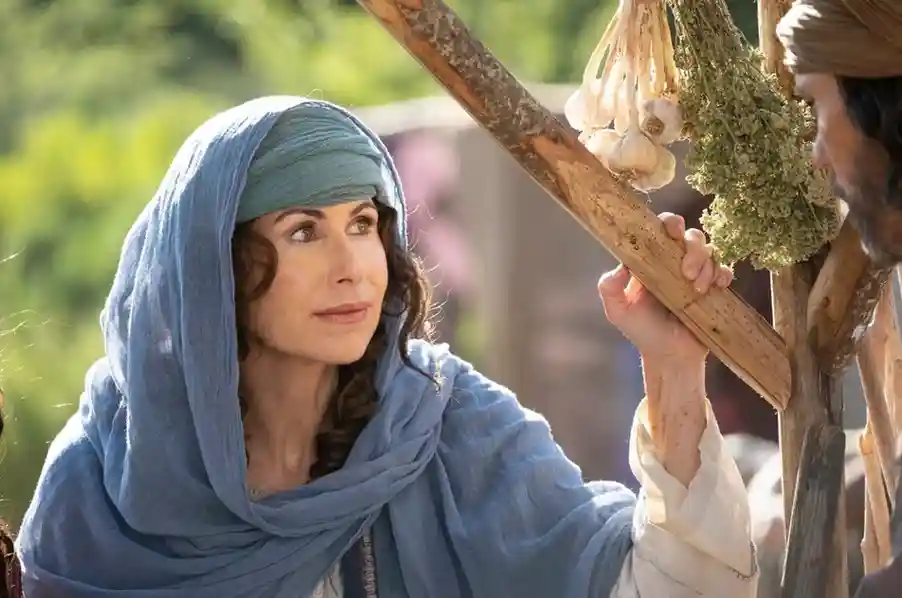
The first installment, The Woman Who Bowed to No One, centers on Sarah, played with a firm, almost modern steeliness by Minnie Driver, and Hagar, embodied by Natacha Karam with a quiet, watchful sensitivity. Jeffrey Donovan’s Abraham drifts at the edges, less patriarch than supporting figure, as if the story itself is gently but deliberately shifting its gaze. Sarah, in this telling, is meant to dominate the frame not just as a matriarch, but as a kind of proto-heroine.
And yet, you can feel the tension between intention and execution almost immediately.
These biblical narratives have endured not simply because they are sacred, but because they are emotionally thorny. Sit with them for even a moment, and they begin to unsettle you. What does it do to a woman, Sarah, to long so desperately for a child that she offers her husband to another? Not out of indifference, but out of hope. And then, having crossed that line, to claim the child as her own? There’s something almost unbearably human in that contradiction.
And Hagar, there’s an entire interior life implied there that the film only brushes against. She escapes one form of bondage, finds a kind of fragile safety with Sarah and Abraham, and then is asked to surrender the very child she carried. What does gratitude look like under those conditions? What does resentment feel like when it has nowhere to go? You can sense the story reaching for these questions, circling them, but rarely settling in long enough to let them breathe.
It’s hard not to notice how closely these dynamics echo modern conversations about surrogacy, ownership, autonomy, and the emotional cost of creating life for someone else. But here, those parallels are redirected toward something more overtly spiritual, more doctrinal. That in itself isn’t a flaw. Faith-based storytelling can be powerful when it embraces its own contradictions. The issue is that The Faithful: Women of the Bible never quite finds the language, visual or emotional, to carry that weight.
Part of the difficulty lies in how little the series invites us into its world. It assumes familiarity, perhaps too generously. Yes, many viewers will recognize these stories. But recognition isn’t immersion. Modern audiences, even reverent ones, expect to be grounded to feel the texture of a place, the logic of a society, the rhythm of a lived-in world.
Here, that groundwork is largely absent. The result is a kind of narrative limbo. Are we meant to experience this as history? As a myth? As something hovering in between? The show gestures toward the miraculous, but never quite establishes the rules of its reality. And that matters, especially with material like this, where the sacred and the supernatural are inseparable.
You might think of recent adaptations that have navigated that balance more successfully—Cien Años de Soledad or Like Water for Chocolate, for instance. What they understand is that magic only resonates when the world around it feels tangible. In those stories, you can almost taste the air, feel the soil underfoot. So when something extraordinary happens, a curse that lingers, an emotion that travels through food, it doesn’t feel imposed. It feels inevitable.
By contrast, the visual language of The Faithful: Women of the Bible often recalls something far more modest. There’s a simplicity to it that might be endearing if it were intentional, but instead it feels underdeveloped. At times, it resembles a well-meaning nativity play costumes that strain for authenticity but land closer to approximation, production choices that never quite escape their own limitations. You might even find yourself distracted by details that should disappear into the fabric of the story: wigs that don’t convince, garments that feel assembled rather than lived in, a divine voice rendered as a straightforward voiceover when something more evocative is needed.
For a text as culturally and spiritually monumental as the Bible, that lack of scale becomes difficult to ignore.
Then there’s the question of characterization, particularly with Sarah. The episode frames her as defiant from the outset a young woman who refuses an arranged marriage, who chooses her own path. It’s a familiar beat, almost too familiar. We’ve seen this kind of spirited independence in countless heroines over the past few decades. There’s nothing inherently wrong with that, but it flattens what could have been a more specific, more historically rooted portrait.
Later, when divine intervention shields her from men who would dominate her, the stakes feel oddly abstract. The show doesn’t give us enough context about the society, about other women, about what makes Sarah singular. So when characters respond to her as if she possesses an almost mythic allure, it doesn’t quite land. You’re left wondering: what exactly sets her apart? The script insists on her uniqueness, but the world around her never confirms it.
That disconnect creates a subtle but persistent distance. Instead of drawing us closer to Sarah’s inner life, it keeps us observing from afar.
There are also moments where the storytelling sidesteps its own most compelling possibilities. One of the most striking involves childbirth. We witness Hagar’s labor in detail, the pain, the physical toll, but Sarah’s experience is notably absent. And that omission lingers. Because narratively, emotionally, Sarah’s pregnancy is the more extraordinary one. She conceives at an age that defies not just ancient expectations, but modern ones as well. What would that feel like, physically? Spiritually? Terrifyingly miraculous?
The film doesn’t say. It moves past the question, leaving behind a sense of something missed, an opportunity to explore the very thing that makes Sarah’s story so singular.
And that, ultimately, is where The Faithful: Women of the Bible struggles most. It gestures toward a richer, more intimate retelling of these women’s lives but rarely commits to the complexity such a perspective demands. It feels content to assume its audience is already invested, already moved, rather than earning that investment through detail and depth.
Which is a shame. Because the foundation is there, a genuinely compelling idea to revisit these ancient stories through a more explicitly female lens, to interrogate them, to sit with their discomforts. Instead, what we get often feels like something designed to accompany the season rather than challenge it, to exist in the background rather than claim the foreground.
And you can’t help but think: these women, Sarah and Hagar, have waited thousands of years for their stories to be told this way. They deserve more than reverence. They deserve curiosity, contradiction, and the full weight of their humanity.
The Faithful: Women of the Bible Parents Guide
Violence & Intensity: There are moments where women, especially Sarah, are placed in situations that feel threatening, with power, expectations of submission, and the quiet danger of being desired in the wrong way.
Language: There’s no profanity here, nothing that would raise a red flag on a surface level. The dialogue leans into a kind of solemn, almost ceremonial tone people speak with intention, with weight. But that seriousness can feel heavy in its own way. Conversations about obedience, faith, and destiny aren’t casual, and even without harsh words, the emotional tone can feel intense, especially for kids used to lighter storytelling.
Sexual Content / Nudity: The entire emotional engine of the story hinges on Sarah asking Abraham to be with Hagar so a child can be born, an arrangement that carries obvious sexual implications, even if the series never visualizes them. There’s no nudity, no explicit intimacy.
Drugs, Alcohol & Smoking:. There’s no emphasis on substance use, no lingering attention given to it.
Highly Recommended:
