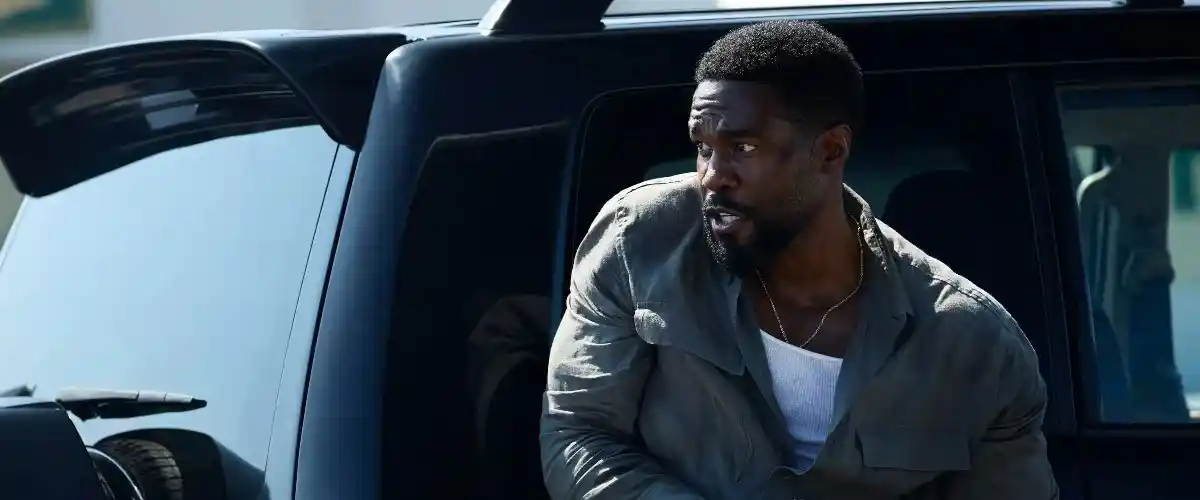
Somewhere around episode four, I caught myself doing something I rarely do during a screener. I opened my phone. Not to check anything important. Just because the shootout on screen had stopped asking anything of me, and my brain quietly opted out. That’s not a death sentence for a show, but it tells you something. And the thing it told me about “Man on Fire” is this: there’s a genuinely affecting story buried in here, and the show spends most of its runtime burying it deeper.
Yahya Abdul-Mateen II plays John Creasy, ex-mercenary, functional alcoholic, man who tried to die in the first episode and didn’t quite manage it. He’s taken in by his estranged best friend Paul Rayburn, Bobby Cannavale, doing that thing he does where he seems to be the only naturally warm person in any room, and brought to Rio, ostensibly to help dismantle a terrorist cell. Then Rayburn dies in an explosion, leaving behind a daughter, Poe, and leaving Creasy with the particular burden of having to protect someone when you’ve already decided you’re not worth protecting yourself.
Abdul-Mateen II is not the problem. He never is. There’s real physical intelligence in how he holds his body through this, the stiffness, the flinching that he tries to disguise as stillness. But the script keeps him locked inside Creasy’s damage in a way that starts to feel less like dramatic restraint and more like the writers weren’t sure what to do with him once they’d established that he’s broken. Broken in what direction? Toward what? The show isn’t always sure, and that uncertainty costs it.
The person who gives the series what life it has is Alice Braga, playing Valeria, a driver who gets pulled into their world and can’t get out. Her trauma runs quieter than Creasy’s, less scarred skin, more careful silences, and Braga finds things in those silences that the script didn’t necessarily put there. When the three of them are together, Creasy and Poe and Valeria, the show almost becomes what it advertised itself as being. There’s a scene, just the three of them eating, nobody shooting, nobody running, where you can see who these characters might be to each other if the plot would leave them alone for five minutes. It doesn’t.
That’s the core frustration, and I want to be precise about it: the action sequences in “Man on Fire” aren’t just forgettable, they actively drain the show. They’re shot under this aggressive, flattening light that turns Rio, one of the most visually extraordinary cities on earth — into something that looks like a cable drama from fifteen years ago. The government conspiracy threading through all seven episodes gets more elaborate with each installment, pulling focus from the only thing that actually works, which is the question of whether a man who has given up on himself can learn to be responsible for someone else.
The 2004 film with Denzel Washington knew to keep that question central. Everything else, the kidnapping networks, the corrupt officials, existed to pressure that relationship, not compete with it. This version loses that hierarchy somewhere in episode two and never quite finds it again.
What’s left is a show that’s neither the character study it wants to be nor the action series it keeps defaulting to. Billie Boullet, playing Poe, works harder than she should have to for scenes that deserve more room to breathe. Cannavale is gone too soon. And Abdul-Mateen II keeps doing subtle, precise things with his performance that the camera occasionally catches and the editing occasionally honors, but not often enough.
There’s a line Valeria delivers around the midpoint something about recognizing a piece of yourself in a stranger that the show clearly intends as its thesis statement. And sitting there watching it, I thought: yes, exactly, that’s the film you should have made. Three people who are each other’s mirrors. Grief as a language they share without meaning to. Instead, someone keeps calling cut and sending in the tactical team.
Seven episodes. By the end, I wasn’t angry. Just tired in that specific way you get tired when something almost works for a very long time. Abdul-Mateen II will be fine, he always lands somewhere better. But I keep thinking about that three-minute scene where they just sat and talked, and how easily, how completely, it eclipsed everything around it. Someone on this production knew what the real story was. They just didn’t trust it enough to actually tell it.
Man on Fire (2026) Parents Guide Not Rated (Netflix Original Series)
The violence here is persistent and mostly bloodless in the Hollywood sense, lots of gunfire, tactical gear, explosions, but it doesn’t carry much weight, which is almost its own problem. The action sequences are frequent enough that younger viewers would clock this as a shoot-em-up, but there’s nothing grotesque or lingering about the carnage. The opening episode, however, opens on a suicide attempt, and that’s handled with enough directness that it warrants a conversation. It’s not exploitative, but it’s not shy about it either.
Language runs about where you’d expect for this kind of show, strong profanity scattered throughout, nothing that would surprise anyone who’s watched an hour of prestige cable. No slurs that registered in the episodes screened.
Sexual content is minimal to nonexistent. There’s a romantic undercurrent between two of the adult characters that the show is fairly restrained about pursuing. Nothing explicit, nothing that would raise an eyebrow.
Alcohol is a different matter. Creasy’s drinking is central to who he is in these early episodes, it’s framed as self-destruction rather than recreation, but it’s on screen constantly and treated as a coping mechanism for trauma. Younger viewers who pick up on context will notice it. There’s also some smoking throughout.
As for age, Fifteen and up feels right, with the caveat that the more interesting parts of the show are the quieter, adult ones anyway. Anyone under that age will likely be bored long before they’re disturbed.
