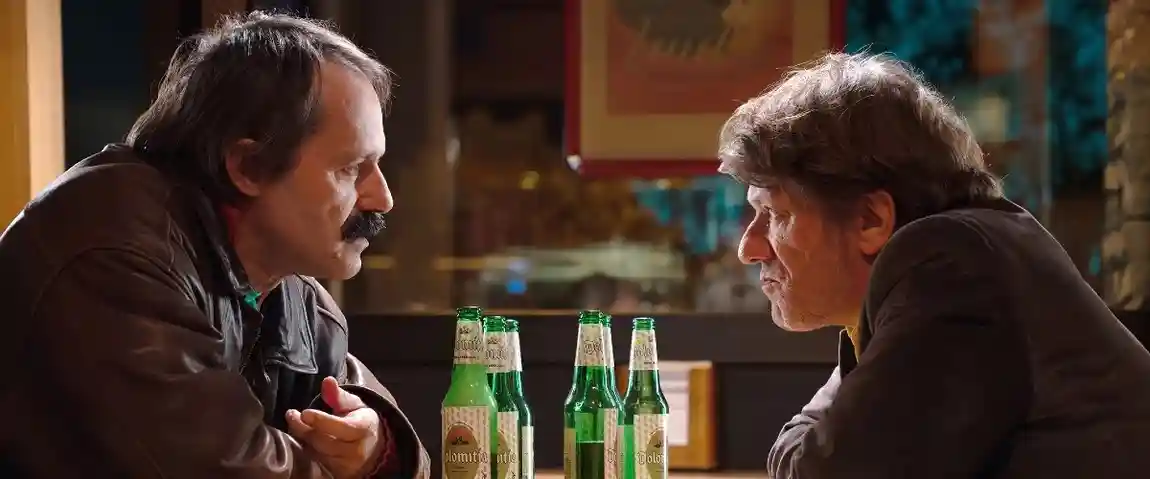
Have you ever had a friend who keeps saying “one last one” but means absolutely none of it? That friend who somehow convinces you to stay out two hours longer than you planned, bouncing from place to place with no real destination, just vibes and momentum and the vague sense that something interesting might happen if you stick around? That’s this movie. Except the friends are aging Italian small-time criminals, and the something interesting is more like a slow, quiet reckoning with everything they never became.
Last One for the Road, directed by Francesco Sossai, follows Carlo and Dori, two guys well past their prime and perfectly comfortable with that fact, mostly. They used to run a decent little operation lifting sunglasses with a sharper crook named Genio, who eventually skipped the country to dodge prison and left his own mother to take the heat. Classic. Now Carlo and Dori drift. They drink. They talk about nothing with the practiced ease of men who’ve had this conversation a hundred times before. They hear Genio’s back in Italy for the first time in twenty years, and apparently stashed some cash before he left, so there’s a loose plan forming — though calling it a plan is generous. It’s more like a direction. Roughly northwest, toward another bar.
The vibe here is somewhere between a road movie and a poem. Not a loud poem. Not the kind that gets performed at a slam and ends with applause. The quiet kind you find folded in the back of a used book that someone left there on purpose. It’s funny in the way that only genuinely melancholy things can be funny, you laugh, and then you sit with it for a second. If you grew up watching anything in the vein of Waiting for Godot or even the slower, stranger corners of Italian cinema, you’ll feel at home here. If those names mean nothing to you, think of it this way: imagine if two guys from a heist movie stuck around for the part that usually gets cut, the long drive, the bad ideas, the conversations that go nowhere and somehow go everywhere.
What keeps you in the car with them, almost literally, is the moment a young architecture student named Giulio climbs in. Filippo Scotti plays him with this careful, watchful quality, he’s got the exam tomorrow, he keeps saying he should go, and yet he doesn’t. Something about Carlo and Dori pulls him in. Maybe it’s curiosity. Maybe it’s the kind of pull that only makes sense when you’re young and the world still feels like it’s full of people who might know something you don’t. Scotti’s performance is the film’s quiet anchor, precise where the older men are loose, still accumulating a life they can’t yet see the shape of.
The film looks genuinely beautiful, which matters more than you’d think. Cinematographer Massimiliano Kuveiller shoots the southern Italian landscapes, factory lots next to highways, centuries-old estate walls, roadside bars with murals, with the kind of attention that makes you feel like you’re seeing them through Giulio’s architecture-trained eyes. Colors are rich where they need to be, spare where they don’t. There’s a tomb sequence, the famous Brion Tomb, that plays like a waking dream, Carlo and Dori standing in a place built for contemplating mortality while probably thinking about where to get a drink next.
If anything slows the film down, it’s its own looseness. That’s partly the point, these are men with nowhere to be, and the film mirrors that, but younger viewers used to tighter narrative momentum might find stretches where they’re waiting for something to click into gear. It never really does, and that’s an intentional choice, not a failure. But it’s worth knowing going in. This isn’t a film that builds to a confrontation or a twist or a big moment. It builds to a feeling.
There’s a line in the middle of it all that stuck with me: one character says he used to look at houses and imagine someday he’d see the inside. Now he looks at them and knows he won’t. He says it without self-pity, almost offhandedly, like he’s reporting the weather. And somehow that lands harder than a full speech would.
If you’re the kind of person who liked Superbad for the friendship underneath the chaos, or found yourself weirdly moved by the quieter moments in Stand by Me, this film is operating in that same emotional territory, just slower, older, Italian, and considerably more interested in the philosophy of diminishing returns on pleasure. There’s even a genuine discussion of that exact economic concept in the film, and it fits perfectly, because the whole movie is asking whether the last drink ever tastes as good as the first.
For younger viewers, this one works best for the fifteen-and-up crowd with a taste for something a little more patient and offbeat. It rewards attention. Not every movie needs to. But the ones that do usually leave something behind.
Last One for the Road will leave you thinking about the last time you stayed somewhere longer than you meant to, and whether that was a mistake or the whole point.
