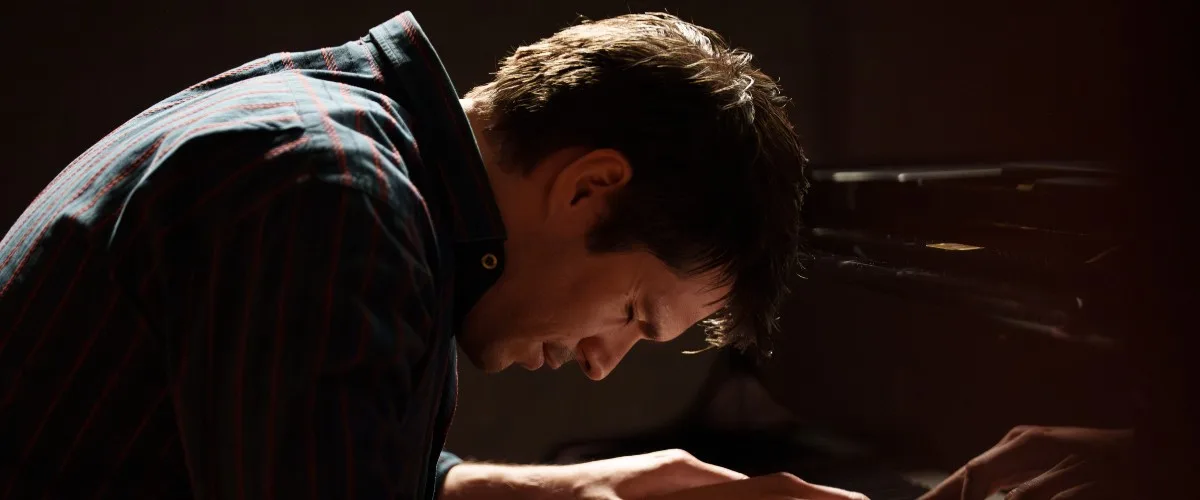
There’s a moment about fifteen minutes into Two Pianos when the pianist Mathias steps into an elevator, rides it down from his mentor’s party, and walks into the lobby and the woman he has spent eight years running from is standing right there. Neither of them speaks. She turns and vanishes. He collapses. Not metaphorically. The man drops to the floor in a dead faint.
I laughed. Then I leaned forward in my seat. That’s the thing about Arnaud Desplechin’s movies: they catch you doing both at the same time, and somehow that doesn’t feel like a contradiction.
Desplechin, working here with co-writer Kamen Velkovsky, has made a film that knows exactly what it is and refuses to apologize for it. Two Pianos is melodrama, the operatic, maximalist, everyone’s-a-wreck kind, dressed up in the clothes of a contemporary French art film. Paul Guilhaume shoots it with handheld restlessness. Laurence Briaud cuts it with occasional jump-cuts that belong to the tradition of Cassavetes or a prestige cable drama from 2008. But the bones of the story are much older than any of that. You can smell the old movies all over it, and that’s not a criticism.
Mathias, played by François Civil with the specific, practiced charm of a man who has made his own recklessness into a kind of lifestyle, is a former child prodigy returning to Lyon after eight years of teaching piano in Japan. He didn’t so much leave as escape. We understand this without being told. Civil has the face of someone who’s rehearsed his own mythology so many times he almost believes it. He was summoned back by his mentor Elena, played by Charlotte Rampling in the way only Rampling can: every line delivery a closed door with something moving behind it.
The woman in the lobby is Claude, his former lover, now married to their mutual friend Pierre and raising a son. Nadia Tereszkiewicz plays her like a window someone’s left slightly open in a windstorm, you can feel the pressure from both sides. Claude chose the sane life. Pierre’s love, she tells Mathias, was stable, not crazy like his. And she’s right. Pierre, played with quietly decent conviction by Jérémy Lewin, is the Ralph Bellamy of this particular triangle: the good man who wasn’t the exciting one. The film treats him better than the genre usually does. He isn’t a fool. He knew what he was choosing when he married her. He chose it anyway.
What Desplechin does that most melodramas don’t is refuse to let his disasters off the hook. The film’s gallery of types, the devoted teacher, the profane and devoted manager Max (Hippolyte Girardot, giving the movie its most reliable bursts of oxygen), the best friend who isn’t quite what she presents, all get the same treatment. We watch them long enough to see through their self-presentations. There’s a scene between Judith, Claude’s best friend, and Mathias in conversation, and for the first half of it you think you understand her. Then her eyes give her away, and you realize you understood nothing. That’s the film doing something that’s actually hard to do: changing what you thought a scene was about while it’s still happening.
I kept thinking about the way the screenplay handles time, not manipulatively, but like water finding its way through rock. Just when you’ve absorbed the weight of what you’ve seen, another scene arrives with more. It never lets you sit in one feeling long enough to settle.
Is Mathias sympathetic? Civil is handsome enough to get away with more than he should, which is probably the point. These are the roles Warren Beatty used to play beautiful men whose awfulness is legible but somehow forgivable, at least in the moment, at least in the dark. I didn’t forgive Mathias exactly. But I couldn’t look away from him, either. He and Claude aren’t star-crossed lovers in any romantic sense. They’re adrenaline addicts who’ve found their most reliable hit in each other. Their smiles in the wrong moments confirm they’ve run these scenes before and enjoyed them both times.
The film’s moral universe, if you can call it that, is built from two contradictory impulses. The first is Wilde’s: I love humanity, it’s people I can’t stand. The second is Lincoln’s: I don’t like that man I need to understand him better. Desplechin holds both at once without forcing a resolution. His characters are mostly disasters, and the brokenness is the point. The manager who’s let his most exhausting client become his entire purpose. The husband who knew he was second choice and made peace with it because he loves her genuinely. Even the worst of them have something in there, some real thing that keeps you from writing them off entirely.
That’s a harder trick than it looks. Most films about people behaving badly want you to enjoy their bad behavior from a comfortable distance. Desplechin wants you inside the mess. By the end, I wanted all of them to be happy. But only after I’d had the chance to be properly furious at each of them first. That’s the bargain the movie offers.
Two Pianos Parents Guide
Not officially MPA ratedFrench release — equivalent guidance: R (mature themes, language, alcohol use)
Violence & intensity: Mild: No physical violence. Intense emotional confrontations throughout. A character faints from psychological shock. Scenes of acute emotional distress and personal crisis. The film’s violence is entirely emotional and relational in nature.
Language: Moderate–Strong: Strong profanity throughout, including in the French original (and subtitled or dubbed translations). The manager character is described explicitly as “hilariously profane.” Adult conversational language covers themes of infidelity, desire, and regret. No slurs noted.
Sexual content / nudity: Moderate: Strong adult romantic and sexual themes, including an extramarital affair and erotic tension between characters. Scenes of intimacy are implied and emotionally charged rather than graphically depicted. Themes of desire, infidelity, and marital betrayal are central to the story. No explicit nudity reported.
Drugs, alcohol & smoking: Notable: Alcohol use is significant and plot-relevant. The main character goes on an extended drinking spree that results in arrest. He arrives to a professional rehearsal visibly hungover and impaired. Social drinking throughout. No depiction of illegal drug use noted. Smoking may appear in keeping with French cultural context.
Age recommendation: 17 and older Mature themes, strong language, and alcohol-as-plot make this unsuitable for younger viewers.
