My wife walked through the room during the third episode and asked what I was watching. I told her. She sat down. She didn’t leave for two hours. That’s not a review, but it’s something.
What Starz has done with Amadeus or more accurately, what writer Joe Barton has done, is take a story everybody thinks they already know and quietly hollow it out from the inside. Not the Forman film. Not the Shaffer play. Something rougher than both, and in some ways more honest than either. The wigs are still there. The candlelight. The period trappings that tell you where and when you are. But underneath all of that, this is a show about two men eating themselves alive, and the candles are just there to watch it happen.
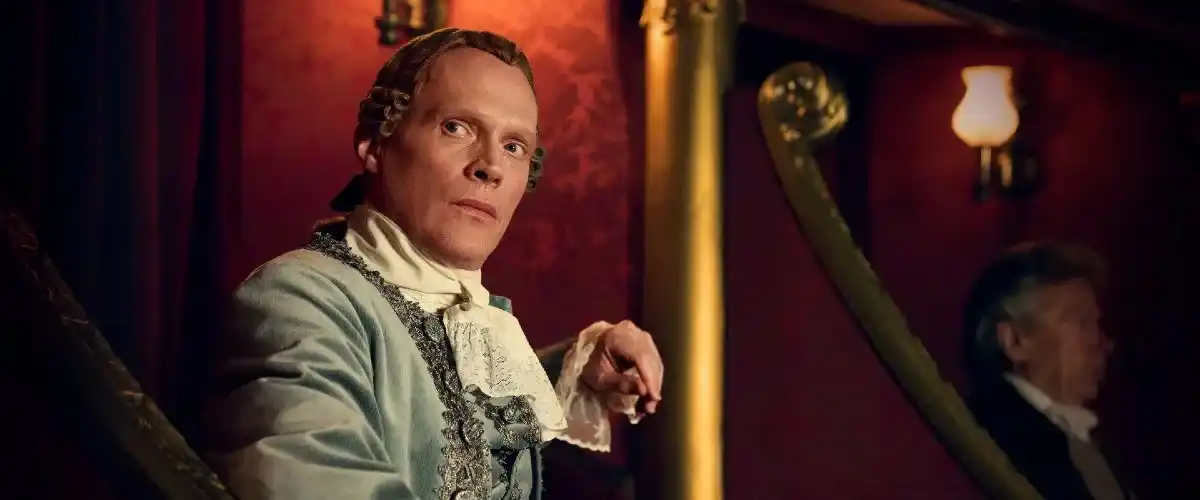
Paul Bettany plays Salieri, and I want to be careful about how I say this: there’s a scene midway through the second episode where he’s alone, praying, and the room doesn’t respond. The candles don’t flicker. No music. Nothing shifts. He sits in the silence after and his face does this thing not grief, not anger something past both of those. It’s the expression of a man who has just received a confirmation he’s been dreading his whole life. Bettany holds it for maybe four seconds and then the scene moves on, and I rewound it twice. I rewound it because I’ve seen a lot of television and I don’t rewind things.
That’s the whole show in four seconds, if you know how to read it.
Will Sharpe’s Mozart falls out of a carriage in his first scene and throws up in the street. That’s your introduction. Sharp-tongued, allergic to tact, constitutionally incapable of playing the room, and yet the room keeps going his way regardless. He writes an opera about a harem when every sensible instinct says don’t, and somehow the Emperor likes it. Things land for him. Not because he’s charming. Because he’s operating on a frequency Salieri can’t tune into, no matter how hard he listens. And Salieri listens very, very hard.
Recommending: Man on Fire (2026) Parents Guide
Sharpe does something in this performance that I don’t think gets done often enough with genius characters he makes the gift look like a burden that Mozart doesn’t fully understand he’s carrying. There’s a brightness in the eyes that doesn’t connect to anything warm. He’s present in every room and somehow absent from all of them. By the time the show starts letting his edges fray, you’ve already clocked that the fraying was always coming. You just didn’t know when.
Rory Kinnear is Emperor Joseph, and his greatest trick is being almost entirely harmless — a man of genuine but shallow taste who keeps requesting Salieri’s older work, who doesn’t notice this is killing Salieri slowly, who doesn’t notice because why would he. Kinnear plays him with a warmth that makes the damage almost accidental. That’s more frightening than a villain would be.
The show structures itself as a cat-and-mouse game on the surface. One man trying to destroy the other. That’s the advertising pitch. The actual show is something stranger, it’s about what happens when you let your relationship with one person become the load-bearing wall of your entire internal life. Salieri doesn’t just want Mozart to fail. He needs him to. Without that need, there’s nothing left. The show understands this with a clarity that’s almost uncomfortable to sit with.
Not everything lands clean. There are moments in the middle run of episodes where the tension thins out and you feel the runtime. But the formal architecture holds, the series opens with a confession whispered in darkness and closes on the same image, and that decision, that simple circular shape, gives the whole thing a weight that looser dramas can’t manufacture. You feel, by the end, that this was always going to end here. That was always going to be the room. That was always going to be what got said in it.
Recommending: Hijack Season 2 Parents Guide
I don’t think this show will get the attention it deserves, which is a sentence I hate writing because it sounds like a consolation prize. It’s not. It’s just that quiet, dark, slow-burning television about psychological ruin doesn’t travel as fast as it should. The people who find it will feel like they found something.
Those candles at the end. They stayed with me for a day and a half. Still not entirely sure they’ve left.
Amadeus Parents Guide
Violence: No physical violence. The damage here is entirely psychological obsession, humiliation, slow emotional destruction. That said, the final two episodes carry a suffocating weight that may be harder to sit with than a fight scene.
Language: Moderate. Some profanity and coarse language, mostly through Mozart’s deliberately graceless dialogue. Sexual wordplay used for character effect. Not relentless but present.
Sex & nudity: Mild. Brief intimacy, handled without explicitness. Suggestive themes around an opera subplot. Partial nudity in line with the period genre.
Substances: Alcohol runs through both characters’ arcs as a feature of their deterioration, not a backdrop. Not glamorized. Smoking consistent with period. No modern drug use.
Themes: Spiritual despair, obsessive jealousy, self-destruction, the corrosion of identity. These aren’t subplots they’re the point. Heavy material, handled with intelligence rather than sensationalism.
Recommended: 16 and up. Nothing gratuitously adult but the emotional register is dense and unrelenting in ways that require a certain life experience to fully absorb. Younger viewers won’t be scarred. They’ll just be bored, which is almost worse.
Recommending: Stranger Things Season 5 Parents Guide
