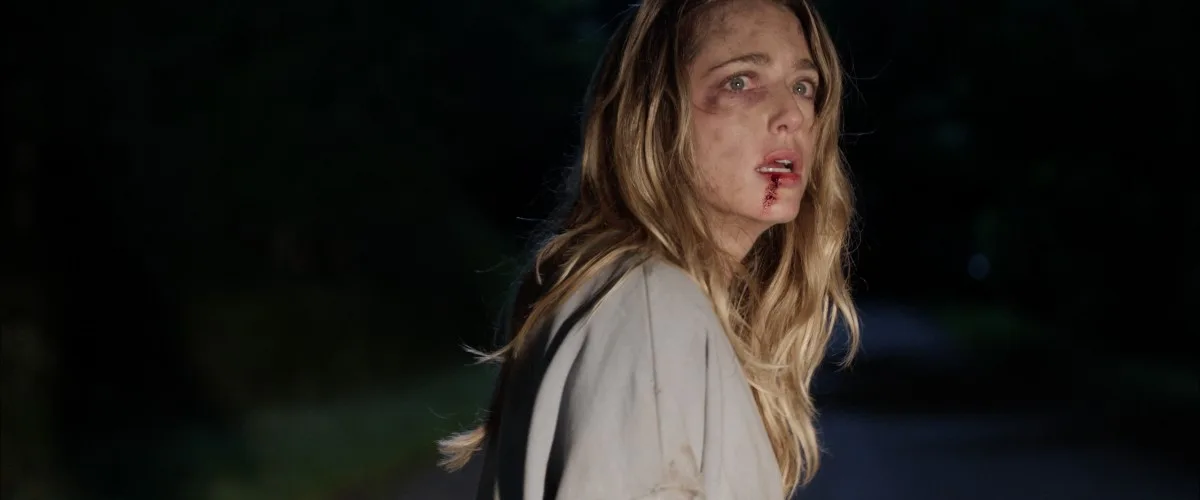
For about thirty minutes, I had no idea what was happening in Affection. A woman wakes up in a house she doesn’t recognize, in a bed she’s never slept in, next to a man who looks at her like she belongs to him. She tries to run. He stops her, not violently, not at first, with a kind of practiced patience that’s somehow worse than violence. And the film just drops you there, in that confusion, with no handrail. Those thirty minutes are the best thing writer-director BT Meza has made. I’m still not sure the rest of the film deserves them.
Jessica Rothe plays Ellie, and what she does in those early scenes is genuinely impressive. She’s not playing fear in the broad strokes, she’s playing the specific, nauseating disorientation of someone whose own mind has become unreliable. She fights, physically and hard, in ways that cost her something on screen. There’s a seizure sequence in the opening minutes that sets the body-horror register for everything that follows, and Rothe doesn’t hold anything back. You feel it. Problem is, Meza puts her through version after version of that same physical and psychological gauntlet across the full runtime, until what started as harrowing starts to feel closer to punishment. For her. For us.
Recommending: My Demon Parents Guide
The film belongs to a genre I’d call domestic-abuse horror, movies that take the mechanics of control and coercion and externalize them into something literal and monstrous. It’s a rich vein. Affection has the right instincts about what it wants to say. Bruce, played by Joseph Cross, is a specific and recognizable type: the nice guy who is terrifying precisely because of how nice he is, right up until he isn’t. Cross gets this. There’s a scene early on where he’s explaining, very calmly, very reasonably, why Ellie’s memories of her own life aren’t real, and the patience in his voice is more frightening than anything the film’s practical effects budget can produce. He believes he’s the hero of this story. That’s the whole horror.
And then the film decides to agree with him. A little. Which is where it loses me.
Midway through, Meza starts giving Bruce scenes that soften him, a widower who loved deeply, a man undone by grief, romantic in a way the first half of the film had no interest in entertaining. I understand the instinct. Complicated villains are more interesting than flat ones. But this particular complication arrives without earning it, and it muddles something the film was handling well. Is Bruce a monster or a tragic romantic? The film wants both, and in trying to hold both at once, it accidentally starts letting him off a hook it had very deliberately put him on.
There’s a sequence late in the film, I won’t say more than this, where Ellie stops being the person the film has asked you to follow and becomes something else entirely, almost without warning or preparation. It’s a tonal lurch that might have worked in a different film, one that had been building toward that inversion. Here it just lands with a thud, and you spend the remainder of the runtime trying to recalibrate a moral compass the film has stopped helping you hold.
The production looks like it was made on a budget that required some creative problem-solving, and mostly that’s fine, the practical body-horror effects in the second act are inventive and genuinely weird in the right way, the kind of thing that suggests a filmmaker with a real visual imagination when the money runs out. But the cinematography is generic in a way that dulls the film’s edges when they should be sharp, and the dialogue, especially in scenes meant to carry emotional weight, has a clunkiness that Rothe and Cross paper over as best they can.
What I keep coming back to is that first half hour. No context. No explanation. Just a woman in a wrong house and a man with a patient smile and the camera holding on both of them long enough to make you deeply uneasy. Meza knew something there. He knew that the horror lives in what you don’t understand yet, in the gap between what you’re seeing and what it means. The film’s first thirty minutes trust the audience completely.
The more Affection tells you, the less it frightens you. That’s not a coincidence. That’s a lesson about what horror actually is, and this film accidentally teaches it by forgetting it halfway through.
Affection Parental Guidance
Violence: Strong. Physical confrontations are frequent and visceral, this isn’t stylized action-movie violence, and it’s the kind that feels effortful and ugly. Seizure sequences with body-horror imagery. A late-film sequence involving pursuit and lethal threat. Domestic violence depicted as a core story element, not background detail.
Language: Moderate. Profanity present throughout, including in scenes of high emotional intensity. Nothing excessive by genre standards.
Sex & nudity: Mild. The film deals with themes of bodily autonomy and coerced intimacy in its premise, but handles this thematically rather than explicitly. No graphic sexual content.
Substances: Minimal. Not a significant element of the film.
Themes: Psychological manipulation, coercive control, identity erasure, and domestic abuse are the film’s central subjects. The body-horror elements visualize these themes literally. Viewers with personal experience of abusive relationships may find specific scenes more than unsettling, genuinely distressing. The film’s moral ambiguity in its second half, where the abuser receives a partial sympathetic framing, is worth flagging for younger or more impressionable viewers.
Recommended: 17 and up. The violence and body horror put it firmly in adult territory, but the more serious concern is the thematic content, coercive control depicted with real specificity, and the film’s unresolved moral ambiguity around its villain. Old enough to watch it is not necessarily old enough to unpack it.
Recommending: Shōgun Parents Guide
