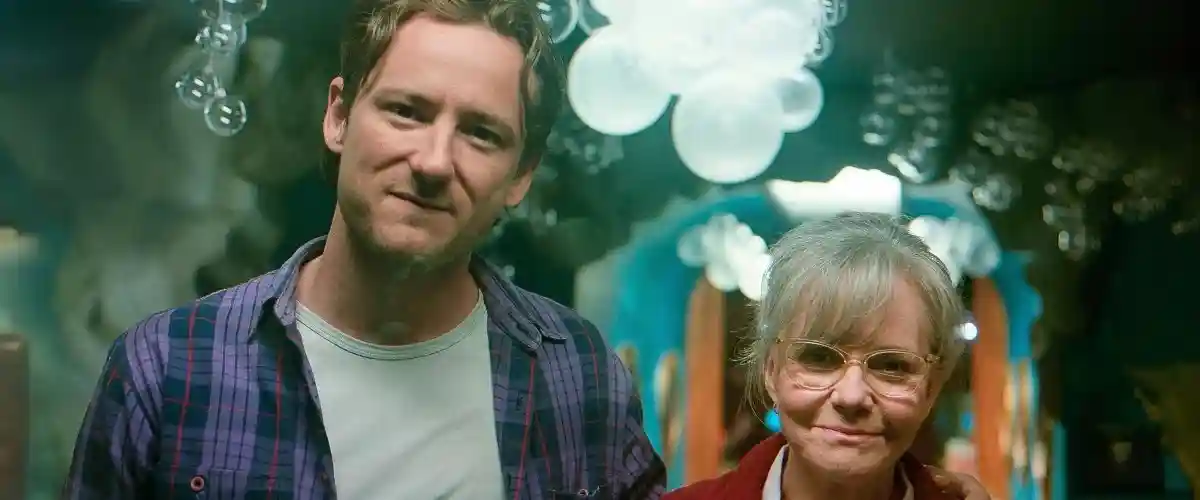
I don’t trust a film that tells me when to be sad.
“Remarkably Bright Creatures” does this constantly. A character sits alone. The camera holds. The music rises, not too much, just enough to let you know this is a moment. And I found myself leaning away from the screen, the way you lean away from someone who keeps touching your arm while they’re talking. Back off. I’ll tell you when I’m moved.
What works in this movie works despite the movie. Sally Field, for instance. She plays Tovah, a widow who lost her husband and teenage son on a lake thirty years ago. She cleans an aquarium at night. She talks to the octopus. And here’s the thing about Field: she has never been afraid of silence. There’s a shot about an hour in where she’s sitting at her kitchen table, just sitting, and you can see the math happening behind her eyes, the way grief recalculates itself every few years, finding new ways to hurt. She doesn’t cry. She doesn’t even look sad, exactly. She looks like someone doing her taxes on a Tuesday. That’s the truth of long grief. The movie wants to underline it. She refuses to let it.
The octopus is named Marcellus. Alfred Molina does the voice, dry, tired, a little amused, like a retired professor who’s seen too many grad students ask the same dumb questions. The CGI is remarkable. I mean that. You watch him move across a concrete floor and you forget you’re watching pixels. He has weight. He has curiosity. He has a plan to escape his tank, which is more than I can say for most of the human characters.
Highly Recommending: Beef Season 2 Parents Guide
And then there’s Lewis Pullman, who looks so much like his father Bill that I literally said “holy shit” out loud in the theater. He plays Cameron, a broke musician whose mother died of an overdose, who’s come to this small town to find the father he never met. He’s good. Really good. There’s a scene where he plays guitar in his dead mother’s camper van, not performing, just playing, and the way his shoulders drop — like the music is the only place he can put the weight down, that’s acting. That’s watching someone who understands what it means to be lost.
But here’s my problem.
The movie doesn’t trust me to connect any of this myself. It keeps explaining. Marcellus actually says, out loud, via Molina’s voice: “I suspect that what Tova needs to escape lies somewhere deeper.” No shit, octopus. I gathered that from the thirty years of her sitting alone in a house full of ghosts. You don’t need to narrate the theme. You just need to show her living inside it.
And the plot, oh, the plot. You will guess every beat forty minutes early. Cameron’s father is exactly who you think it is. The shopkeeper (Colm Meaney, warm and lovely) will eventually admit he loves Tovah. The young lovers will separate for exactly as long as it takes to learn a lesson and then reunite. It’s not a spoiler to say any of this. The movie spoils itself just by existing.
I kept thinking about why this story needed an octopus. Not as a gimmick, the octopus is wonderful — but as a narrator. What does Marcellus give us that we couldn’t get from just watching Tovah? He gives us wit, I guess. He gives us a creature who sees human sadness from the outside, through glass, and finds it both baffling and tender. That’s not nothing. That’s actually something. But the movie doesn’t lean into that distance. It keeps pulling Marcellus back into the emotional machinery, making him part of the solution, part of the healing. And I think I would have preferred an octopus who just watches. Who stays in his tank, escapes anyway, and swims away without explaining himself.
Sofia Black-D’Elia plays Avery, the surf-shop owner with the tragic secret, and she has one good line: she tells Cameron he makes her “want to be on time.” That’s the best writing in the whole thing. It’s small. It’s specific. It doesn’t try to be profound. It just is.
The rest of it tries too hard to be profound. The score nudges you. The dialogue explains the subtext. The actors Field, Pullman, Meaney, Kathy Baker, Joan Chen, all of them — keep trying to shove the movie back toward something messier and realer, and every time they almost get there, the screenplay pulls them back into the Hallmark machinery.
Highly Recommending: The Devil Wears Prada 2 Parents Guide
I don’t hate “Remarkably Bright Creatures.” I almost love it, in stretches. Field has a moment near the end where she finally says the thing she hasn’t said in thirty years, and the other actors on screen aren’t acting anymore, they’re just watching her, because she’s so present that watching her is the only honest response. That’s the movie I wanted. That’s the movie that exists for about ninety seconds.
The rest is a beautiful, frustrating half-step between sincerity and sentimentality. It wants to earn your tears. But it’s too afraid you won’t cry unless it tells you where to put them.
Parental Guidance
Violence & Intensity: Minimal. A drowning is discussed. A character dies off-screen. No graphic violence. Emotional intensity around suicide ideation (discussed, not shown) and parental loss. The octopus escapes but is never hurt. One brief scene of panic in a confined space. Safe for sensitive kids 8+.
Language: None. Not a single swear I can remember. The tone stays gentle.
Sexual Content / Nudity: Zero. A few kisses. That’s it.
Drugs, Alcohol & Smoking: A character’s mother died of a drug overdose — mentioned, not shown. Social drinking in a bar. No on-screen drug use or smoking.
Age Recommendation: 7 and up, though younger kids might get bored between octopus scenes. Nothing scary or inappropriate. Fine for family viewing. Just be prepared to explain why the old lady is sad for so long.
Highly Recommending: Michael 2026 Parents Guide
