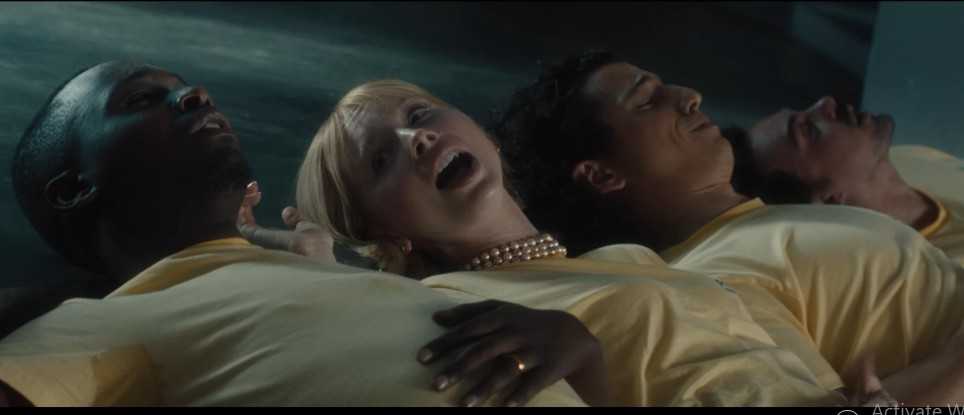
I walked into Corporate Retreat expecting a gimmick. The premise is too easy to summarize: tech executives get trapped at a remote team-building weekend, and someone starts killing them off one by one while forcing them to confront the harm they’ve caused. The Menu meets Saw, like everyone has been saying. And for the first twenty minutes, I was ready to write it off. The opening is too pleased with itself. The corporate jargon lands with the subtlety of a slogan on a startup’s “About Us” page. I caught myself checking my watch, which I almost never do unless a movie has lost me.
Then something shifted. I can’t point to exactly when. Maybe it was the PowerPoint scene, which I’ll get to. Maybe it was the moment Odeya Rush’s character bright, hungry, and terrifyingly good at pretending she has no edges finally cracks, and you realize she’s been cracked the whole time, just holding the pieces together with sheer will. That’s when I leaned forward. That’s when I stopped being a critic and started being a person in the dark, worried about people who don’t exist.
Let me say this plainly: Odeya Rush is too good for this movie. Not because the movie is badit’s not but because she’s found a level of truth that the script doesn’t always earn. Her character, whose name I won’t bother mentioning because you’ll forget it five minutes after the credits roll, is written as a collection of ambition tropes. The young gun. The striver. The one who sent that email at 2 AM because she wanted to be seen working late. But Rush plays her like a wound.
There’s a scene where she’s asked to apologize for a choice she made that destroyed a colleague’s career, and instead of delivering the speech the movie clearly wants the tearful confession, the redemption arc teasednshe just stares at the person asking. Her mouth opens. Closes. Opens again. Nothing comes out. Because what do you say when an apology is legally mandated? When forgiveness is part of the agenda, scheduled between “lunch” and “trust fall”?
That’s the film’s real subject, I think. Not violence. Not revenge. The performance of remorse. How corporations have learned to weaponize vulnerability, to turn “I’m sorry” into a line item on a quarterly report. Corporate Retreat understands this deeply, even when it doesn’t know how to dramatize it cleanly.
The violence, when it comes, is not fun. Fisher doesn’t shoot these deaths like a horror director showing off his effects budget. He shoots them like security footage. Matter-of-fact. Almost boring in their execution. A throat cut is just a throat cut when you’ve seen it a hundred times in movies, but here it lands differently because Fisher holds on the aftermath the gurgle, the confusion, the way a body doesn’t know it’s dead for a few horrible seconds. I heard someone behind me whisper “oh god” during one of them. Not a scream. Just a small, private prayer. That felt earned.
The PowerPoint scene. I have to tell you about the PowerPoint scene.
The characters are forced to present their own “performance reviews” to the group. Except the reviews have been written by their captor, and they don’t pull punches. One executive, a mid-level climber played by someone you’ve seen in four other things but can never name, has to watch as his entire career is reduced to a single bullet point: “Let Jasmine take the blame. She had a family. He knew that.” The room goes silent. The actor doesn’t get a speech. He just sits there, frozen, while the slide clicks to the next bullet point. And the next. And the next. Eight slides. Fourteen accusations. No music. No reaction shots. Just a man, a screen, and the slow realization that someone out there remembers everything.
I laughed. I’m not proud of it. It was a nervous laugh, the kind that escapes when something is too true to process any other way. Half the theater laughed with me. The other half stayed completely still. That’s the response Fisher is after discomfort wearing the mask of humor, until you can’t tell the difference anymore.
The third act nearly loses me. Fisher introduces a twist that makes sense structurally but feels like a betrayal emotionally. Without spoiling: the architect of the retreat is given a speech explaining their motives, and it’s the wrong choice. The mystery should have stayed mysterious. The silence should have been louder than any explanation. When a character finally says, out loud, “I did this because you ruined my life,” the movie deflates. We knew that. We felt that. We didn’t need it spoken. There’s a version of this film where the villain never explains themselves at all just watches, smiles, and walks away and that version haunts me more than the one I actually saw.
Highly Recommended: Slanted Parents Guide
Rosanna Arquette shows up for maybe twelve minutes total, and she’s the best thing in every scene she occupies. She plays a former CEO, retired now, who seems to have wandered into the retreat by accident. Or maybe not by accident. Arquette has this way of holding her body that suggests she’s forgotten more about power than anyone in the room will ever learn. When she finally takes action I won’t say how it’s so quiet, so casual, that I almost missed it. That’s craft. That’s someone who has been doing this long enough to know that the loudest performance is rarely the deepest.
So what is Corporate Retreat? It’s a horror movie that doesn’t trust its own horror. A satire that occasionally explains its jokes. A character study that shortchanges its best characters. It’s a mess. A real mess. But it’s a mess made by someone who has felt the thing they’re trying to say, even if they couldn’t quite say it.
I left the theater thinking about that knife again. The one Ruck was handed. He never uses it, by the way. Not once. He just carries it, from room to room, holding it like a question he doesn’t want to answer. That’s the whole movie in one image. A man, a blade, and the long silence before he decides what kind of person he’s going to be.
Corporate Retreat Parents Guide
R — Restricted
Violence & Intensity: High / Graphic
The film features sustained, graphic violence including stabbings, blunt-force trauma, and elaborate practical gore effects. Several sequences are explicitly designed to shock one involving a kitchen utensil has been singled out as particularly disturbing by festival audiences. Deaths are not quick or clean. The violence escalates progressively and is central to the film’s horror mechanics, not incidental to them.
Language: Moderate / Strong
Frequent strong profanity throughout, consistent with the film’s hard-R register. Includes repeated use of the f-word and other strong language, largely in the context of extreme stress and confrontation. No racial or ethnic slurs have been reported. Tone throughout is often hostile and aggressive.
Sexual Content / Nudity: Mild
No significant sexual content or nudity. Some suggestion of romantic relationships between characters, handled without explicit depiction. The film is almost entirely focused on survival horror rather than sexual content.
Drugs, Alcohol & Smoking: Mild / Social
Alcohol consumption appears in the context of the corporate retreat setting cocktails, dinner wine consistent with the social scenario being depicted. No drug use has been flagged in available materials. Drinking is not presented as glamorous but functions as part of the film’s satirical portrait of corporate culture.
Age Recommendation: Strictly for viewers 17 and older. The film’s graphic practical effects, sustained intensity, and escalating violence make it wholly inappropriate for younger audiences, including older teenagers without a strong prior tolerance for graphic horror. This is not a gateway horror film it earns its R rating repeatedly and without apology. Adults who are sensitive to realistic-looking gore or sustained sequences of physical suffering should also approach with caution. Ideal for adult horror genre enthusiasts who enter knowingly.
Highly Recommended: Hokum Parent Guide