I almost walked out forty minutes in.
That’s not a flex. I don’t walk out of movies. I sat through “The Brown Bunny” twice. I made it through “Freddy Got Fingered” in a theater with three other people and we all just kept looking at each other like is this really happening. So when I say I almost walked out of “Her Private Hell,” I mean it crossed my mind as a real option.
Not because the film is offensively bad. Because I got bored. That specific, sinking boredom where you realize you’re watching someone imitate themselves and the imitation is technically correct but spiritually dead.
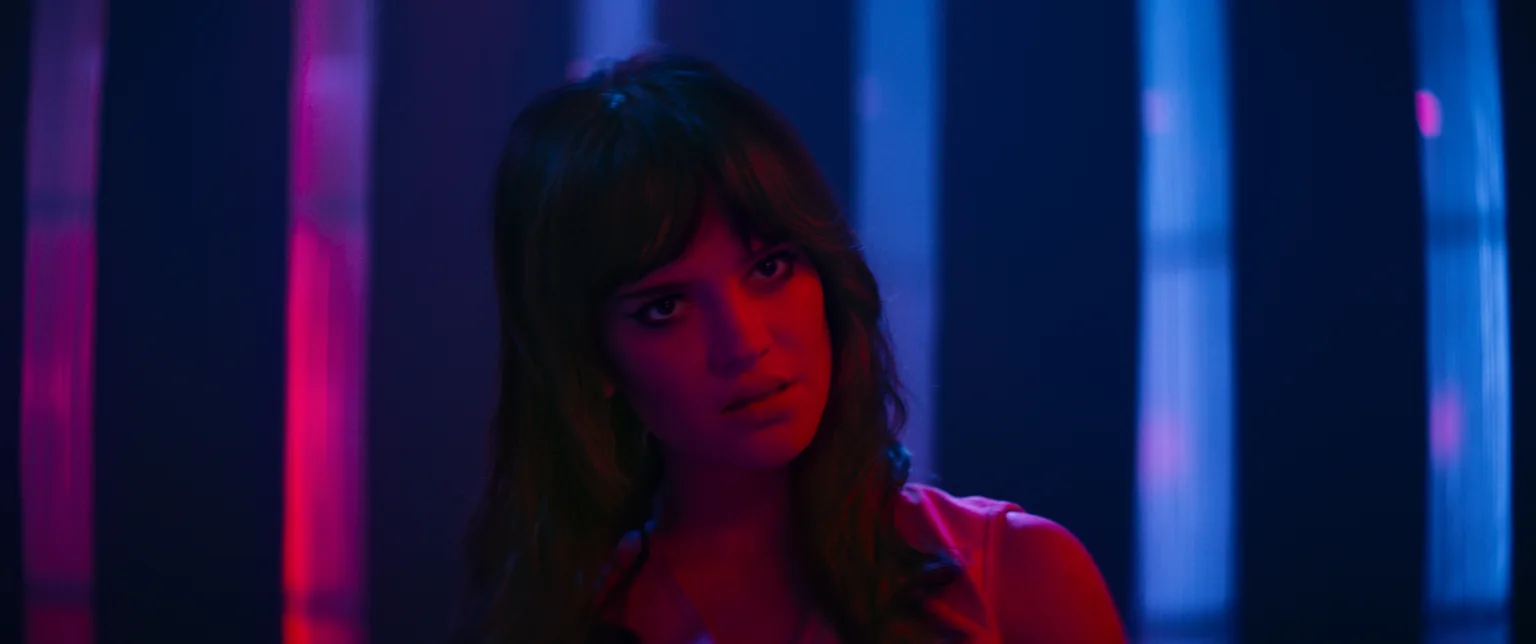
The story Sophie Thatcher plays Elle, a rich young woman living in a fog-choked futuristic city where the air itself might kill you. She finds a stray named Hunter (Kristine Froseth), brings her home, introduces her to stepmother Dominique (Havana Rose Liu). Meanwhile, a villain called Leather Man is ripping people apart. Meanwhile, a soldier named Private K (Charles Melton) is searching for his daughter. Meanwhile, everyone wears leather and speaks in riddles that sound like they were translated from Japanese to Italian to English by someone who didn’t speak any of those languages.
Highly Recommended: Deep Water (2026) Parents Guide
None of this matters. Not really. Refn has never cared about plot and I’ve never cared that he doesn’t care. But he used to replace plot with something a mood, a dread, a pulse. “Drive” worked because you felt the loneliness underneath the cool. “Only God Forgives” worked for me because the cool was so absolute, so committed, that it became its own kind of truth. This movie has the surface of a Refn film without the nerve. It’s all posture, no spine.
There’s a scene about an hour in where two characters speak “wolf” to each other. I am not making this up. They sit across from one another and howl and growl and it’s meant to be primal, transcendent, some kind of communication beyond language. What it is, in practice, is two attractive people making animal noises while Pino Donaggio’s score tries to convince you this is profound. The audience at my Cannes screening and Cannes audiences will applaud anything sat in stunned silence. Not the good stunned. The what are we doing here stunned.
Let me talk about Donaggio for a second because he’s the best thing here and also the problem. The man scored “Carrie.” “Blow Out.” “Tenebrae.” He’s a legend and he showed up to work. His music swells and sighs and aches in ways the images can’t match. There’s a moment where Thatcher walks down a hallway and Donaggio’s violins do this thing this heartbreaking, romantic, completely undeserved thing and for ten seconds I believed in the movie.
Then the shot held too long, and Thatcher said something about hunger, and the violins kept going but I was already out again. A great score on a mediocre film doesn’t save it. It just makes you resent the film for wasting the score.
Highly Recommended: The Devil Wears Prada 2 Parents Guide
Charles Melton tries so hard. You can see him trying. He was remarkable in “May December” because he understood stillness as a form of suffering. Here, Refn wants stillness as a form of cool, and those are different muscles. Melton punches people. He stares. He delivers lines like “The fog takes everything” with the kind of earnestness that might work in a different movie but here just feels like an actor lost without a director who knows what he wants. Dougray Scott chews leather and scenery in equal measure. Havana Rose Liu glides around looking expensive and miserable. Everyone is beautiful. Everyone is bored. I started to wonder if the boredom was intentional if Refn was making a movie about the emptiness of beauty, the way luxury isolates, the pointlessness of it all. But then another scene would drag on and I’d realize: no, he just doesn’t have it anymore.
The cinematography is the real tell. Magnus Nordenhorf Jønck shot Refn’s “Copenhagen Cowboy” and that looked fine on a laptop. On a giant screen in Cannes, it looks muddy. Underlit. Compositions that feel like placeholders for compositions that never arrived. Refn used to shoot cities like they were characters Los Angeles in “Drive,” Bangkok in “Only God Forgives,” the whole sick fairy tale of “The Neon Demon.” This city is just fog and neon and skyscrapers. I’ve seen it before. I’ve seen it done better. I’ve seen Refn do it better.
I kept thinking about the title. “Her Private Hell.” Whose? Elle’s? She seems fine, honestly. Rich, beautiful, waited on, occasionally threatened by a leather demon. That’s not hell. That’s Tuesday for half the people in this business. Hunter’s? Maybe. Private K’s? The title implies a feminine specificity her private hell but the movie gives most of the emotional weight to the male soldier searching for his daughter. That feels like a mistake. Or maybe it’s honest: Refn doesn’t know how to write women, only how to dress them. “The Neon Demon” worked because it was about that, about the horror of being seen as a surface. This movie just surfaces.
There’s a sequence about two-thirds through where Leather Man attacks someone in a parking garage and it’s shot like a music video from 2004. Slow motion. Neon reflecting off wet concrete. Blood that looks more like paint than blood. I leaned forward. For maybe ninety seconds, I leaned forward. The rhythm clicked. Donaggio’s score went dark and percussive. Thatcher watched from a balcony and you could see something behind her eyes not fear exactly, but recognition. Like she’d been waiting for this. Like she wanted it.
And then the sequence ended and we were back to people speaking in non-sequiturs and I sank into my seat again.
Highly Recommended: Michael 2026 Parents Guide
That’s “Her Private Hell” in a nutshell. Flashes of the old fire, surrounded by hours of smoke. You keep waiting for the ignition. You keep believing it’s coming. And then the credits roll and you realize you’ve been waiting for a movie that doesn’t exist anymore, made by a filmmaker who maybe doesn’t either.
I don’t know if Refn has lost it. That feels too easy, too final. Maybe he just needs someone to say no to him. A producer who says “that wolf scene isn’t working.” A cinematographer who says “let’s relight this.” An editor who says “cut forty minutes.” But he’s Nicolas Winding Refn. Nobody says no to him. And “Her Private Hell” is what happens when a visionary runs out of people who tell him the truth.
I walked out into the Cannes sun and blinked. The Mediterranean was right there, blue and stupid and perfectly happy to exist without meaning anything. I stood there for a minute. Then I walked to a bar and ordered something cold and thought about the parking garage sequence and wondered if that was enough.
Her Private Hell Parents Guide
Rating: Not rated
Violence & Intensity: This is a Refn film. You know what that means, but I’ll spell it out: a villain named Leather Man rips people apart on screen. We see viscera. We see eyes gouged with swords. Brass knuckle beatings shown in unflinching close-up. The camera doesn’t look away. Unlike mainstream action violence that cuts every half-second, Refn holds. You will sit with the damage. Intensity is high throughout not jump-scare high, but dread high. The kind that sits in your chest. For viewers with any sensitivity to body horror or prolonged graphic violence: skip it.
Language (profanity, slurs, tone): Frequent strong profanity. “Fuck” appears constantly. “Shit,” “cunt” (yes, Refn uses it), and other expletives. No racial slurs in the Cannes cut. The bigger issue for parents might be the tone cold, affectless, sexually charged. Characters speak in flat monotones even when saying aggressive or threatening things. This emotional deadness can be more unsettling than shouting.
Sexual Content / Nudity: Significant and deliberately objectifying. Nudity includes breasts and buttocks, female. Simulated sexual situations. A scene of implied sexual threat from Leather Man that will disturb more than any actual sex scene would. The film’s treatment of women is complicated is it critiquing objectification or performing it? Either way, your teenager will see beautiful women treated as visual commodities. No explicit penetration.
Drugs, Alcohol & Smoking: Constant. Characters smoke in nearly every scene. Alcohol flows constantly, often in stylized, ritualized ways. Cocaine use shown in one scene. The film’s aesthetic makes all of this look cool because everything looks cool, even the emptiness. If you’re concerned about glamorization of substance use, this movie is a problem.
Age Recommendation: 18 and up. Not negotiable. Not for 16-year-olds who liked Drive save that conversation for when they’re older. This is not Drive. This is Refn without the restraint, which means more violence, more sexual content, more emptiness. For adults who already know Refn’s work, this will be familiar but not necessarily comfortable. For anyone else: start elsewhere. “Drive” first. “The Neon Demon” if they want to push further. “Her Private Hell” is for completists only.