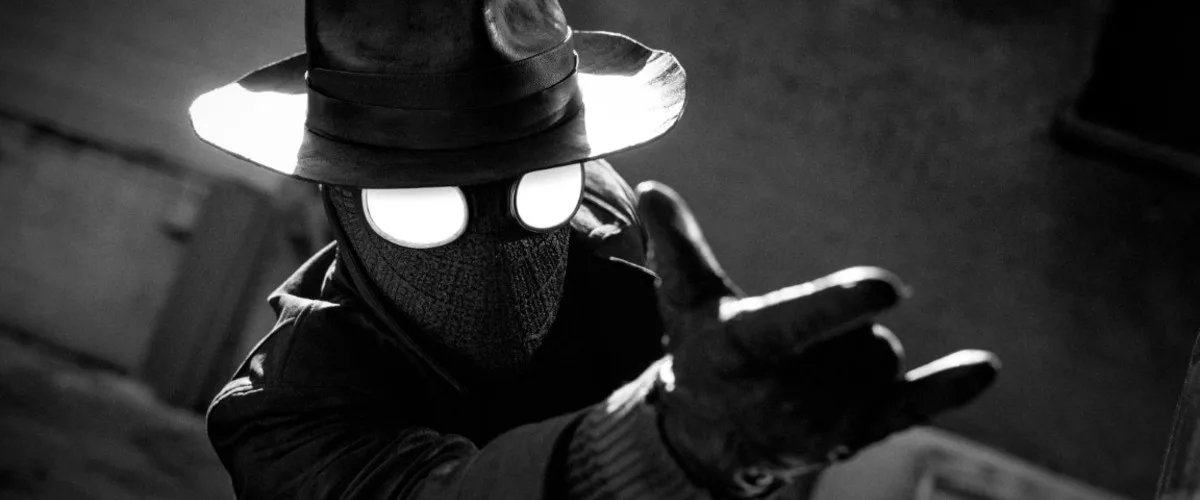
SPIDER-NOIR (2026) Prime Video | Directed by Harry Bradbeer, Nzingha Stewart, Alethea Jones & Greg Yaitanes
Nicolas Cage once described his acting method as “nouveau shamanic.” I didn’t know what that meant when I first read it. I think I do now.
There’s a moment maybe fifteen minutes into the first episode of Spider-Noir where Ben Reilly, sitting across a desk from a man whose wife may or may not be cheating on him, receives a photograph of said wife. Cage looks at it. Then looks up at the husband, this stout, unremarkable, clearly un-magnetic man. And asks, with the gentle curiosity of a doctor delivering a diagnosis: “You a rich man?” Nothing else. No smirk. He’s just… doing the math out loud.
I laughed. Then I sat up straighter. Because that’s not a superhero. That’s a person.
That, in a single beat, is why this show works when it has no earthly business working.
Spider-Noir is set in 1930s New York, deep in the Depression’s belly, where the rain is always about to fall and everyone is owed something by someone who can’t pay. Ben Reilly not Peter Parker, and the distinction matters is a retired costumed hero turned fledgling private investigator, which is another way of saying a man who once tried to save the world and settled for finding your missing watch. He wears the past like a bad knee. It doesn’t stop him. It just makes everything slightly harder.
This is Nicolas Cage’s first lead role in a television series. Which is strange to type in 2026. Stranger still to watch, because he moves through this thing like he’s been waiting for it. Not coasting, waiting. The performance is seventy percent Bogart, thirty percent something you’d struggle to name. He can be genuinely funny and then, in the same sentence, genuinely sad. He breaks into song at one point. Completely deadpan. The show doesn’t comment on it. Neither should you.
The directors, Bradbeer, Stewart, Jones, Yaitanes, give him a world worth inhabiting. The show can be watched in black and white or color, and I’d fight someone over which is correct. Black and white is where the atmosphere lives, the way light carves through a window, the texture of a wet street, shadow that feels like a character. The color version earns its place during the action sequences, where the strange dark tinge of The Spider’s webbing reads differently against a blood-warm palette. My suggestion is to watch it once in black and white and go back for episodes three and six in color. You’ll see what I mean.
But the show’s real pleasure isn’t the cinematography, gorgeous as it is. It’s the people.
Brendan Gleeson plays crime boss Silvermane like a man who stopped pretending to be polite about thirty years ago and found the freedom in that. Every scene he’s in has a particular gravity, not menace exactly, more like a weather system. You adjust your behavior around him the way characters adjust their behavior around him. Li Jun Li, as Cat Hardy, is doing something more difficult: she’s playing a woman who is always three steps ahead of the scene she’s in, and making it look like stillness rather than calculation. Her chemistry with Cage has this low, unhurried heat that the show is smart enough not to explain. Lamorne Morris brings an easiness to Robbie Robertson that you’d miss if you took it for granted. Don’t take it for granted.
Where the show stumbles, and it does, occasionally, is in its plot architecture. The noir conventions are so lovingly reconstructed that some beats arrive wearing a sign that announces themselves in advance. The femme fatale operates on schedule. A revelation in the fifth episode lands with all the shock of expected rain. You can see certain turns coming from far enough away that you have time to find a seat and wait for them. For a show this confident in its textures, that predictability is a little frustrating. Not fatal, but present.
What saves it, every time, is Cage. When the plot threatens to become formulaic, he does something small and irreversible, a look, a pause, a choice that contradicts what the scene seems to be asking for, and suddenly you’re watching again. Really watching, not just following. That’s rarer than it sounds.
There’s something genuinely moving, actually, about a show this committed to its own oddness. Superhero storytelling has spent the last decade either collapsing inward under franchise weight or sprinting toward ironic self-awareness as a defense against criticism. Spider-Noir is neither. It takes the premise completely seriously while also understanding that a sixty-two-year-old man crawling on ceilings in a fedora is inherently, irreducibly absurd. It holds both truths at once without flinching from either.
The Great Depression setting isn’t just production design. It earns its place thematically. Everyone in this show is broke, or grieving, or running from something, or all three. The crimes Ben Reilly investigates aren’t evil for evil’s sake, they’re desperate, which is something sadder and more interesting. Noir at its best has always understood that. This show does too.
I’ve thought a lot about why certain characters lodge in the memory and others don’t. I think it comes down to whether the actor seems to have a life that exists before and after the scene you’re watching. Cage’s Ben Reilly has that. You believe in his bad mornings. You believe in what he looks like eating breakfast alone. That’s a gift you can’t manufacture with good writing or careful direction. It just either exists or it doesn’t. Here, it does.
Parental Guidance
Rating: TV-14 — the most mature rating ever given to a Spider-Man production, for strong violence, mature themes, language, and substance use.
Violence & Intensity: Fistfights, gun violence, mob confrontations, and crime scenes throughout. The violence is grounded and consequential rather than cartoonish, closer to a 1930s crime drama than any previous Spider-Man adaptation. Occasional scenes carry real emotional weight around loss and trauma.
Language: Coarse period language, crude humor, and dark wit. No extreme profanity, but consistently harder-edged dialogue than the PG-13 Spider-Man films.
Sexual Content / Nudity: Suggestive tension and noir-style romantic dynamics. No nudity, no explicit scenes. The innuendo is period-appropriate and handled with restraint.
Drugs, Alcohol & Smoking: Drinking, smoking, and alcohol as a coping mechanism appear throughout, consistent with the 1930s setting and hard-boiled tone. Flagged explicitly in the TV-14 classification.
Age Recommendations:
- Under 13: Not suitable. The tone and content are genuinely darker than any prior Spider-Man.
- 14–16: Fine with parental context. A conversation about noir storytelling and Depression-era history beforehand helps.
- 17+: Comfortably appropriate. This is the target audience, and it rewards them.