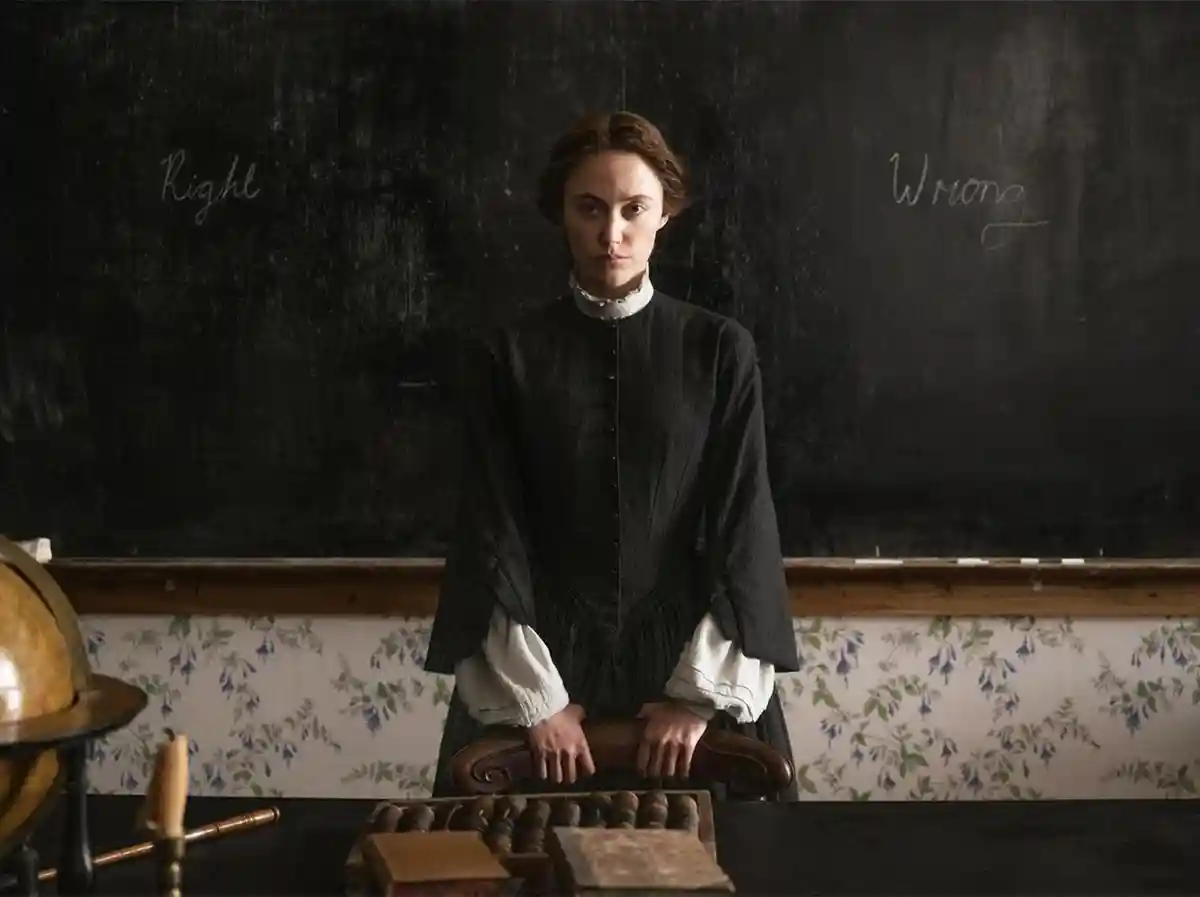
I keep coming back to the smile. Not the violence, not even Jason Isaacs doing what Jason Isaacs does with a room but that smile Maika Monroe wears through almost every frame of Victorian Psycho, the one that doesn’t quite reach anything.
She plays Winifred Notty the name is not subtle, and the film knows it isn’t subtle, and this is the first of many jokes it makes directly to your face while maintaining complete composure. It’s 1858, Yorkshire moors, a manor house full of the sort of people who’ve confused wealth with personhood.
Winifred arrives as governess. Her job is to educate the children, model virtue, reinforce hierarchy. She does none of these things. What she does instead is narrate her own moral catastrophe in voiceover, with the dry precision of someone itemizing groceries.
“My name is Winifred Notty and I’m the sanest person I’ve ever met.”
You laugh of course and then something quieter happens, you start to wonder if she’s right.
This is the gamble Wigon makes and largely wins. He’s working from Virginia Feito’s novel, and both the book and this adaptation understand that a female psychopath in 1858 isn’t a monster so much as a woman who has absorbed the full logic of her world and pushed it one stop further than polite society allows.
The Pounds family, Mrs. Pounds (Ruth Wilson, glacial and perfect), Mr. Pounds (Isaacs, sneering with effortless menace), their pineapple-obsessed heir Andrew, their daughter Drusilla are all terrible in ways the era considered acceptable. Winifred is terrible in ways it didn’t. That gap is where the comedy lives.
“Wigon’s camera doesn’t just observe Winifred — it thinks like her, Canted, tilted, occasionally upside-down.”
Cinematographer Nico Aguilar deserves more credit than he’ll get. His camera doesn’t just observe Winifred it thinks like her. Canted angles, frames tilted just enough to make you distrust your own equilibrium, a handheld restlessness that breathes too fast.
It’s the kind of visual language that could tip into affectation in less confident hands, but here it works because it’s never decorative. Every skewed frame is a joke about perception. About who gets to define sanity? About what you see when you let a woman tell her own story from inside her own head.
Monroe is extraordinary, not in a loud way but in the way of an actor who has found something specific and is simply living in it. Her line readings are flat and precise, the timing surgical. When she tells the children about evil, she sounds like she’s discussing the weather forecast.
Highly Recommended; Good Omens Season 3 Parents Guide |Age Rating & Content Review
When she commits an act of violence on an animal, to make a pedagogical point, naturally her expression does not change. The audience’s does. I heard people next to me gasp and then immediately laugh at themselves for gasping. That’s the trick the film is running, and it runs it well.
Where it runs it less well is in explaining itself. There are moments, particularly late, where Victorian Psycho seems to worry you haven’t caught the subtext, and nudges you toward it with a firmness that isn’t quite in keeping with the rest of the film’s elegance. Winifred’s voiceover is sharpest when it’s oblique when it lets you do the work. Occasionally it gets tidy in ways that feel like the novel asserting itself over the film, or the film asserting itself over the audience’s intelligence. Neither is necessary. The smile already told us everything.
Ariel Marx’s score is doing something genuinely strange strings arranged into something that sounds almost decorous until you notice the whispers woven underneath, the tiny screams buried in the orchestration. It’s the sound of correct behavior with something wrong inside it. Which is also, come to think of it, a decent description of the entire film.
I’ve seen Victorian Psycho compared to Poor Things, and I understand why, but I think it’s a different animal. Lanthimos wanted to remake a woman’s consciousness from scratch. Wigon isn’t rebuilding Winifred, he’s revealing her. She arrived fully formed.
That’s precisely what makes her frightening, and what makes her so hard to look away from. She was always going to be this way. The moors didn’t do it. The Pounds didn’t do it. She did it herself, out of what the film suggests is a very reasonable response to an unreasonable world.
The pineapple, by the way, is the funniest running gag I’ve encountered in a film this year. I won’t explain it. Explanations are for people who haven’t seen the film yet, and by September 25, you won’t be one of them.
Victorian Psycho Parents Guide: Age Rating & Content Review
Violence & intensity: An animal is killed on screen, abruptly, used as a darkly comic beat. Human violence is present and sometimes sudden. The psychological menace is sustained and deliberate throughout. The horror is real, even when it’s funny, perhaps especially then.
Language: Period-restrained but sharp. The voiceover is frank about violence, cruelty, and moral vacancy no profanity, but the content is blunt. Language is a weapon here, not decoration.
Sexual content & nudity: Minimal. Wigon directed the erotic thriller Sanctuary prior to this, some of that charged tension carries over in Winifred’s power dynamics, but nothing explicit. No nudity.
Drugs, alcohol & smoking: Alcohol is present in period-appropriate social settings. Laudanum or tincture use is likely referenced given the 1858 setting. No recreational drug content.
Age recommendation: 17 and up, firmly. The film’s violence is casual in a way that’s more unsettling than gore younger teens won’t have the frame of reference to read the dark comedy correctly and may just absorb the darkness. For older teens with an appetite for gothic fiction and black humor, it’s one worth discussing afterward. The themes around class, gender, and sanity reward conversation.
Highly Recommended; The Punisher One Last Kill Parents Guide