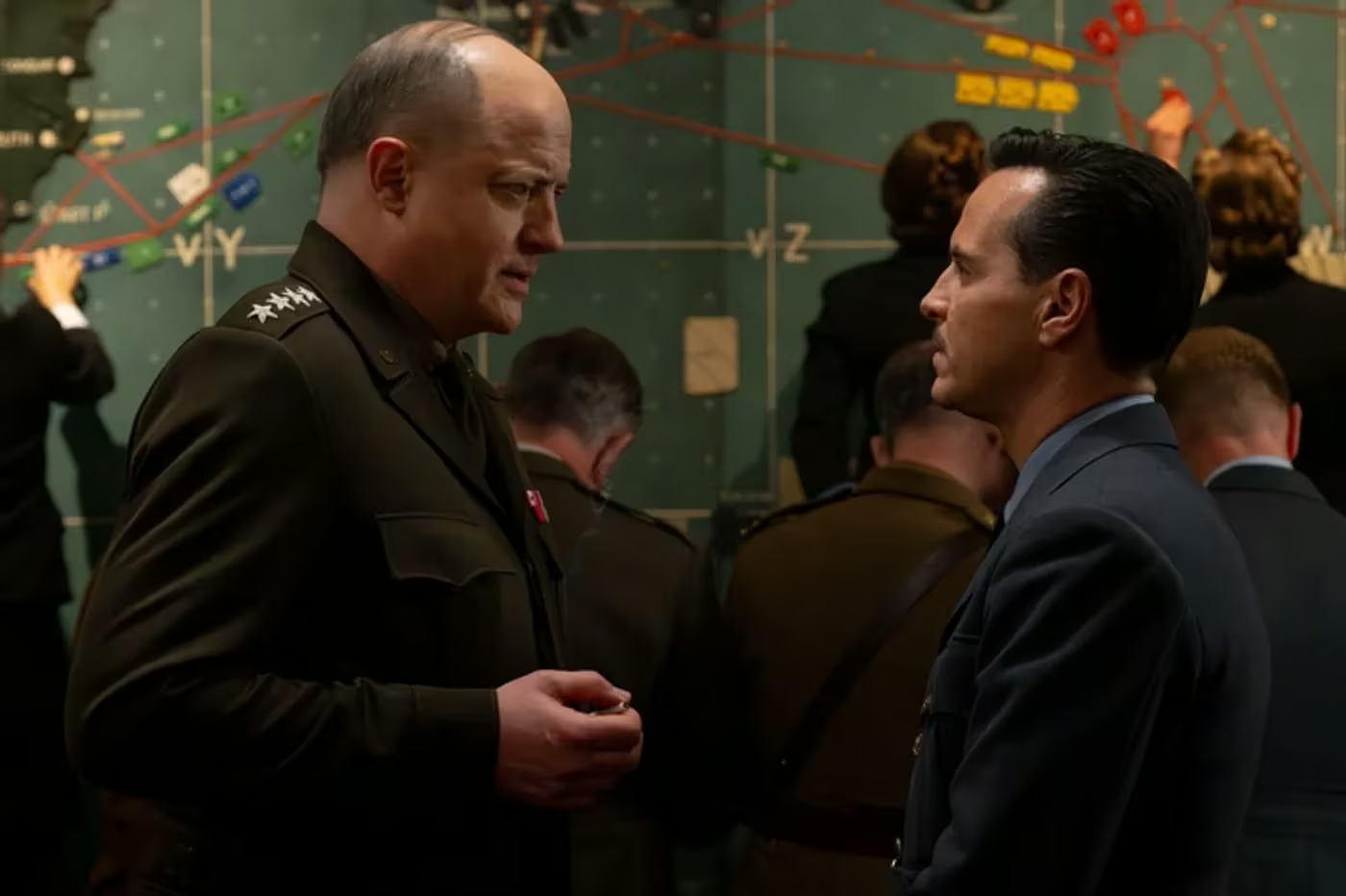
My grandfather used to say that, the most dangerous man in any room isn’t the loudest one, it’s the quiet one in the corner who already knows how everything’s going to end. I thought about him a lot while watching Pressure. Not because the film reminded me of him, exactly. But because Andrew Scott’s James Stagg this mild.
That’s the film’s beating heart, and honestly, when Pressure stays close to it, something real and tense starts to happen on screen. The year is 1944, the Allies are days away from D-Day, the invasion of Normandy, 150,000 troops, the whole weight of the war balanced on a single decision and the weather is not cooperating.
Stagg keeps telling everyone that, the problem is that there’s another meteorologist in the room, an American named Irving Krick, played by Chris Messina with this wonderful breezy certainty, and Krick is predicting sunshine. He’s got historical patterns on his side.
He once predicted weather for Hollywood films, for special events, for important occasions where he was right more often than not. And the generals, God love them, would much rather believe the man who’s promising clear skies.
Highly Recommended: Corporate Retreat Parents Guide
I sat watching those early scenes with something close to pleasure. Two scientists talking past each other, neither of them wrong about everything, but only one of them right about this particular thing, right now, with the clock running. There’s something almost unbearable about it watching expertise collide with wishful thinking, watching data lose to optimism in real time.
Messina plays Krick without making him a villain, which was the smart choice. He’s not lying. He’s just a man who has trusted his method his whole career and can’t quite bring himself to believe it’s failing him now. You understand him even as you’re willing Stagg to break through.
Scott barely raises his voice through any of it. He states things the way a doctor delivers a diagnosis carefully, directly, and with the full knowledge that the person across from him doesn’t want it to be true.
It works. It really works. And then slowly, gradually, in ways you almost don’t notice until it’s too late the film starts hedging its bets.
Somewhere along the way, someone decided that a drama about two meteorologists arguing over a weather window wasn’t quite enough for a feature film. So Stagg’s wife, Liz, is pregnant back home. Communications are restricted. And then there’s an attack near where she is, and suddenly Stagg has to carry that fear on top of everything else.
I understand the instinct you want the audience to feel the personal stakes, not just the historical ones. But here’s the thing: Stagg’s stakes are already personal. He’s trying to stop the most powerful military commander in the world from making a catastrophic mistake based on a forecast he believes is wrong. That’s personal. That’s intimate and terrifying in its own right. The pregnant wife subplot doesn’t add pressure to the drama. It dilutes it.
Highly Recommended: I Love Boosters (2026) Parents Guide
Brendan Fraser is Eisenhower, and I want to be gentle here because there are moments where he’s genuinely good, quieter scenes, walking the corridors alone at night, carrying the particular grief of the rehearsal operation that went wrong before D-Day even began.
In those moments you feel the weight of command the way you’re supposed to. But the film also keeps asking him to explode, to boil over, to shout, and Fraser’s version of that has a quality I can only describe as effortful. You can see him working.
The seams show, and when you can see the seams on Eisenhower, you’re no longer watching history unfold, you’re watching an actor in a period drama, which is a much less interesting thing to watch.
Kerry Condon turns up as Kay Summersby, Eisenhower’s aide and confidante, and does everything the script asks of her, which is mostly to stand near Ike and be sensible. She’s too good for what she’s been given. The film treats her like a piece of furniture that occasionally speaks, which is a waste of a genuinely magnetic screen presence.
Here’s what I keep coming back to, though. At one point, Stagg says almost defensively, almost to himself, that meteorology is an inherently interesting occupation. And he’s right. The science of reading a sky that doesn’t care about your plans, of finding patterns in chaos, of standing in a room where the whole history of a war could turn on whether you’re correct, that is interesting. Deeply interesting. The film knows this in its bones during its best scenes. It just doesn’t trust it enough to let those scenes carry the whole weight.
Highly Recommended: Affection Parental Guidance
By the time the script maneuvers Stagg and Krick into a tidy, unearned reconciliation near the end, you feel the machinery of it. The narrative convenience. That’s the moment a drama stops feeling lived-in and starts feeling assembled.
There’s a shot I keep returning to, Stagg at a window, early on, light coming off the Channel, the whole world outside indifferent and enormous and about to become history. For a second the film is exactly what it should be: small, exact, a man alone with what he knows.
Then someone calls him back into the room and the machinery starts up again, and the moment’s gone. Pressure is full of moments like that. Flashes of the film it could have been, living right alongside the film it settled for being. It’s not a bad film. Parts of it are genuinely good.
But it’s a film that didn’t quite believe in its own best idea, and that hesitation costs it something you can feel all the way through the particular sadness of watching something almost get there, and then not.
Content breakdown for parents
Rating: PG-13: War drama. Emotional intensity throughout, but no graphic content. Not suited for young children.
Violence & Intensity: Mild – Moderate: A brief, deliberately restrained depiction of the D-Day landings. References to wartime casualties, including a disastrous rehearsal operation. Tension-driven rather than graphic. No gore or prolonged combat.
Language: Mild: Occasional mild profanity in a military wartime setting. Mostly formal, period-appropriate dialogue. Some heated exchanges but nothing severe or sustained.
Sexual content / Nudity: None, No sexual content or nudity of any kind. A pregnancy is referenced as a subplot but handled entirely off-screen.
Drugs, Alcohol & Smoking: Minimal, Possible period-appropriate social drinking and tobacco use consistent with 1940s military settings. Neither is dwelt on or given significance in the story.
Themes: War, Grief, Duty, Explores the psychological weight of command, wartime trauma, and the fear of catastrophic failure. References to real historical loss of life. Adult in emotional weight, not in explicit content.
Recommended for ages 13 and above: Best suited for older teens with an interest in history, and adults. The drama is cerebral and slow-burning younger children are unlikely to engage with it, and wartime themes may unsettle sensitive viewers under 12.