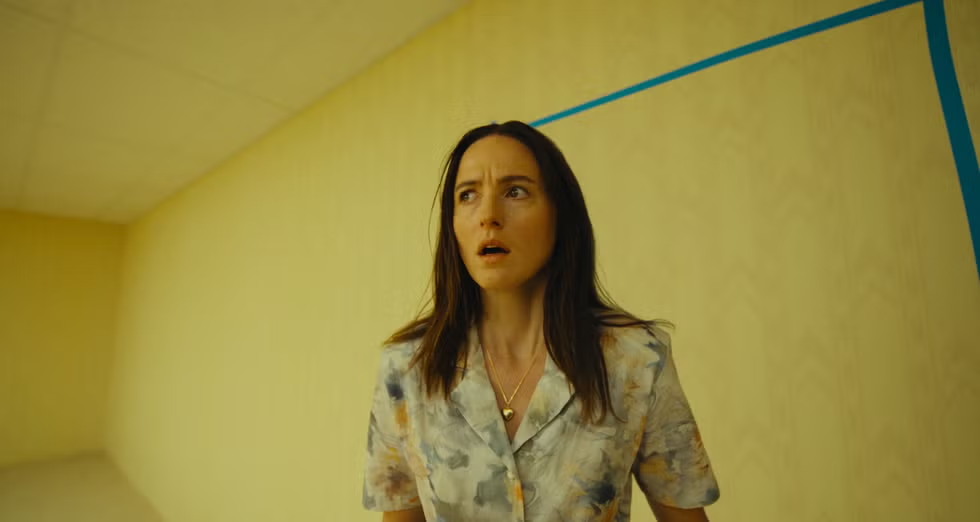
I’ve been in enough bad horror movies to know what the genre looks like when it’s coasting. You feel it in the first ten minutes a laziness dressed up as atmosphere, the camera lingering on shadows because no one decided what the shadows mean. Backrooms doesn’t do that. Within the first few scenes, you understand you’re watching someone who built this world from the ground up and is now walking you through it with the confidence of a man who has memorized every corridor.
That man is Kane Parsons. He’s twenty years old. He became A24’s youngest director ever by pitching a feature based on a nine-minute found-footage short he uploaded to YouTube at sixteen, in his bedroom, using free VFX software. That short has been watched 78 million times.
Highly Recommended: Her Private Hell Parents Guide
The feature it spawned may well open to $50 million tracking figures that would smash A24’s opening weekend record. At some point the story of how this film got made starts to overshadow the film itself, so let me be clear: Backrooms earns the attention independent of any origin myth.
Clark owns a pirate-themed furniture store in 1990 Silicon Valley. That sentence alone tells you something about Parsons’ sensibility the slight absurdity, the specific period-setting, the blue-collar ordinariness of the premise. Clark is played by Chiwetel Ejiofor, and Ejiofor brings to the role something I haven’t seen from him in a while: genuine bewilderment.
Not the performed confusion of an actor hitting a plot beat, but the real, searching quality of a man encountering something that rearranges his relationship to the world he thought he understood. When a doorway opens in the basement of his showroom and he steps through it into corridors of acid-yellow wallpaper, drop ceilings, and fluorescent lights humming at exactly the frequency of low-grade dread he doesn’t scream.
That instinct to map, to understand, to document the unknowable rather than flee from it, drives the film’s first half. It’s also what pulls his therapist, Dr. Mary Kline, in after him when Clark goes missing. Renate Reinsve plays Kline, and this is her first horror film, which is remarkable only because you’d never guess it.
She’s done this kind of emotional surgery before the quiet devastation of The Worst Person in the World, the raw grief of Sentimental Value and she brings the same quality here: she does large things without visible effort. There’s a scene where she watches recorded footage of Clark inside the Backrooms, trying to make clinical sense of something that defeats clinical thinking entirely, and the camera holds on her face for what feels like a long time. Parsons doesn’t cut away. He trusts her, and she earns it completely.
The Backrooms themselves are the film’s most significant achievement, and they were, remarkably, built. Thirty thousand square feet across four soundstages. The production team spent a month on the wallpaper alone fifty different prints, fifty camera tests hunting for the exact shade of yellow that triggers the specific unease Parsons had mapped out in his original shorts. The cast reportedly got lost on set. Crew were given printed maps each morning. There’s a room where staircases spiral upward in configurations that shouldn’t work, and you feel the vertigo without any obvious camera trick. The architecture is wrong in a way that the body registers before the brain does.
Parsons has talked in interviews about what makes the Backrooms frightening at a fundamental level, and his answer is precise: it’s not that the rooms keep changing. They don’t. If you go back the way you came, you will go back the way you came.
But it just keeps going. It preys on the human brain’s ability to map space, and then defeats that ability by extension rather than distortion. The horror isn’t chaos. It’s infinite recognizable order. A place that looks exactly like a place you know an office, a storage room, a corridor you’ve walked through a hundred times but never ends, never empties into the world you recognize, never resolves.
The creature design, which the marketing wisely concealed until the last possible moment, fits this logic. The Lifeform as fans of the web series know it belongs to this space the way the yellow wallpaper does. It’s not a monster dropped in from outside. It grew there.
I kept thinking, watching the film, about Heretic another recent horror film that trusts its premise enough to let it unfold slowly, without the conventional infrastructure of cheap scares and rising string sections. The critics who screened Backrooms in early May called it claustrophobic and “a waking nightmare,” which are accurate descriptions but don’t quite get at the specific quality of dread Parsons achieves. The LA Times’ Joshua Rothkopf put it better, describing it as “horror stripped to its essentials: a hallway, a door, knowing that you will go through it.” That’s exactly right. Conceptually, it’s a nightmare with its own weather.
Highly Recommended: I Am Ryan (2026) Parents Guide
The film’s weakest passage is its midsection, where the screenplay written by Will Soodik, the Westworld and Ash vs Evil Dead veteran occasionally mistakes deliberate pacing for depth. There’s a stretch in which the philosophical undertow Parsons is reaching for doesn’t quite break the surface. The central idea that the Backrooms represent something interior, the spaces we construct in our own minds, the rooms we’ve lived in so long we’ve stopped questioning them is genuinely resonant, but it lands unevenly. You feel the film strain toward a unified meaning it almost grasps and then releases. Only almost, though.
The score is extraordinary. Parsons co-composed it with Canadian musician Edo Van Breemen, sampling vintage synthesizers through software the film’s characters might have seen advertised in a catalog. It sounds like memory processed through anxiety. There’s a track in the second half that doesn’t let go. I don’t know if it’s been officially released yet, but it’s been stuck somewhere at the back of my skull since the lights came up.
Mark Duplass plays a character that fans of the web series will recognize immediately. He plays it with the concentrated stillness of someone who has decided to know everything and share almost nothing, and it’s exactly right for what the film needs.
James Wan, who produced this alongside Shawn Levy, and who guided David F. Sandberg from Lights Out to genuine horror significance has said he’s trying to pass a torch. That Parsons is his next bet. Based on the evidence: the bet is sound. This is a first feature that already knows its own grammar. It doesn’t borrow the logic of other horror films and apply it to a new setting. It invents a new logic and follows it with discipline, which is much harder to do.
What stays with you, once you’ve left the theater and walked back out into the ordinary world, isn’t any specific scare. It’s the quality of the light inside those corridors. That yellow. The way the fluorescents hum. The fact that every room looks like a room you’ve been in before, at some job or school or hospital, some institutional space you passed through once and forgot and the slow, cold realization that you might not have been as far outside the Backrooms as you thought.
Backrooms 2026 Parents Guide
Rating: R — for bloody images, some violent content, and language
Violence & Intensity: The film is primarily psychological in its horror, sustained and atmospheric across its full runtime rather than delivered in spikes. Creature-based threat and pursuit sequences are present. Some bloody imagery appears, though the film is not gratuitously gory the violence registers as visceral and earned rather than explicit. The intensity is high and essentially continuous. Jump scares exist but are not the primary tool; the dominant mode is existential dread that accumulates.
Language: Moderate. Occasional strong language consistent with an R rating. No slurs.
Sexual Content / Nudity: None.
Drugs, Alcohol & Smoking: Minimal and incidental. The 1990 period setting includes background period-appropriate behavior, nothing depicted prominently or approvingly.
Age Recommendation: 15 and above, firmly. The horror here is psychological and spatial rather than explicit, which means it tends to linger rather than resolve harder to shake than a standard jump-scare film. Mature teenagers with a genuine appetite for atmospheric, idea-driven horror will find it rewarding. Parents should know this is closer in tone to Hereditary or Midsommar than to a conventional creature feature. The film doesn’t rely on gore to disturb you; it relies on architecture.