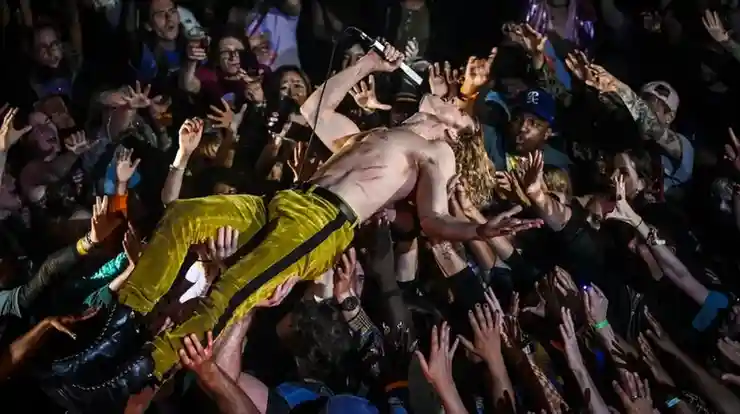
Nobody told me a vampire rock tour would be the thing that finally made me understand Lestat de Lioncourt. Not two seasons of watching him through Louis’s grief-warped memory, not Anne Rice spelling it out across four hundred pages. It took watching Sam Reid bomb a guitar solo in front of a half-empty venue playing it completely straight, no wink, no irony for something to click. This man is not performing desperation. He is desperate. And the show has finally built a season worthy of that distinction.
The setup, if you can call it that: Lestat, furious that Louis’s published memoir painted him as a tantrum-throwing narcissist, responds the only way he knows how by becoming a rock star and recording an album of rebuttals. It sounds like a bit. It isn’t. Rolin Jones plays the absurdity completely straight, and the straightness is the point.
Lestat hires the now-undead Daniel Molloy (Eric Bogosian, who has made a career out of making you want to leave the room and stay in it simultaneously) to film a documentary. And then, running underneath all of it, there’s a second layer: recordings Lestat made alone, after something went badly wrong that he calls, with the self-awareness of a man who knows exactly what he’s doing, “Failures.”
Those recordings are where the season lives. He narrates from the rubble of something we don’t fully understand yet, circling backwards through his own story the way you circle a bad memory arriving at different angles each time, not always telling the truth, sometimes too high to tell much of anything. He’ll admit he’s padding. He’ll include a scene he wasn’t present for because he needs it somewhere. It has the shapeless, digressive quality of someone actually trying to explain themselves, which is rare enough in fiction that it feels startling when it lands.
“Reid plays the humiliation with the precision of someone who has been rehearsing it for two seasons not as a joke, but as a wound.”
And Reid. God, Reid. The first two seasons blurred Lestat through Louis’s perception, which meant we got the monster version, the romanticized version, the convenient villain. Here he’s in his own narration, which turns out to be no more reliable but significantly more inhabited. He’s a strutting rock star mangling Gen Z slang. He’s a jealous ex who still can’t say Louis’s name without something shifting in his face. He’s a little boy who misses his mother in a way that is psychologically complicated, to put it gently. That last part brings us to Gabriella.
Jennifer Ehle plays her Lestat’s vampire mother, his fledgling, and yes, his lover and the show doesn’t dress it up. There’s no tasteful cut away, no euphemistic suggestion. The relationship is what Rice wrote it as: a woman who escaped the suffocating smallness of her era by becoming a creature with no obligation to human morality, and then used that freedom in every direction available to her.
The show misses something by not following through on Gabriella’s full rejection of gender as Rice wrote it, which would have made her even stranger and more thrilling. That’s a genuine missed step. But what’s here is still more than most adaptations would attempt.
This has always been the thing that separates the show from AMC’s other Rice projects. “The Mayfair Witches” keeps apologizing for how weird the books are. “The Vampire Lestat” doesn’t apologize for anything. Rice’s vampires were never meant to care about human morality, and the show has finally stopped trying to make them likeable in a comfortable way. What’s a little moral depravity when you’ve been alive for three centuries? What’s a little incest when you don’t have a pulse?
Jacob Anderson’s Louis is quieter this season a man who has decided to move on and then fails at the first obstacle, which is more honest than a clean break would have been. Bogosian’s Daniel, newly undead and apparently no happier about existence for it, brings a bitter documentary-maker energy that makes every scene slightly combustible.
Assad Zaman’s Armand has apologies to make that he may or may not be capable of making sincerely. And Lestat’s human band just trying to survive a North American tour with their blood still inside them grounds everything with a dark comedy the show earns rather than reaches for.
The season isn’t flawless. Short episode runs have been a structural problem since season one, and it hasn’t resolved itself certain moments need more room to breathe, more time before the next revelation arrives, and instead they get pushed through because the plot won’t wait. There’s a version of this season that’s forty minutes longer and considerably more devastating. What we have is still striking. Just occasionally bruised by its own momentum.
I’ve been a Rice reader long enough to know that her best work has always scared adapters off. The incest. The amorality. The self-regard so massive it bends the narrative around it. Jones has spent three seasons proving he’s not scared. That counts for a lot, this show could have been “True Blood” with better lighting. Instead it’s genuinely, stubbornly itself weird where it needs to be weird, tender in places you don’t expect, and built around a performance that I suspect I’ll still be thinking about years from now when someone asks me what prestige television in the 2020s actually looked like when it tried.
The Vampire Lestat — AMC Season 3 (2025)
The Vampire Lestat is rated TV-MA, Strictly for mature audiences. Contains content unsuitable for viewers under 17.
Violence & Intensity: Graphic vampire violence throughout feeding, killing, and blood are depicted directly, not suggested. Scenes carry genuine horror weight. Psychological cruelty and manipulation are also recurring and treated seriously, not as background texture.
Language: Strong and frequent profanity including the f-word. Crude language is part of the natural dialogue register, not isolated outbursts. No slurs identified.
Sexual Content & Nudity: An incestuous sexual relationship between a vampire and his maker/mother is depicted without euphemism and is central to the narrative. Nudity present. Same-sex relationships portrayed as a matter of course.
This is not peripheral content it is the story. Viewers sensitive to any of the above should know before they start.
Drugs, Alcohol & Smoking: Drug use depicted and referenced, a key character narrates while visibly under the influence across multiple sequences. Alcohol present throughout in social and performance settings. Smoking likely in historical flashback sequences.
Age Recommendation: 18+ recommended
The combination of explicit sexual content including incest depicted without softening, graphic violence, and adult psychological themes makes this a genuine adults-only viewing experience. Not appropriate for under-17s. Even mature adult viewers should know what they’re walking into.