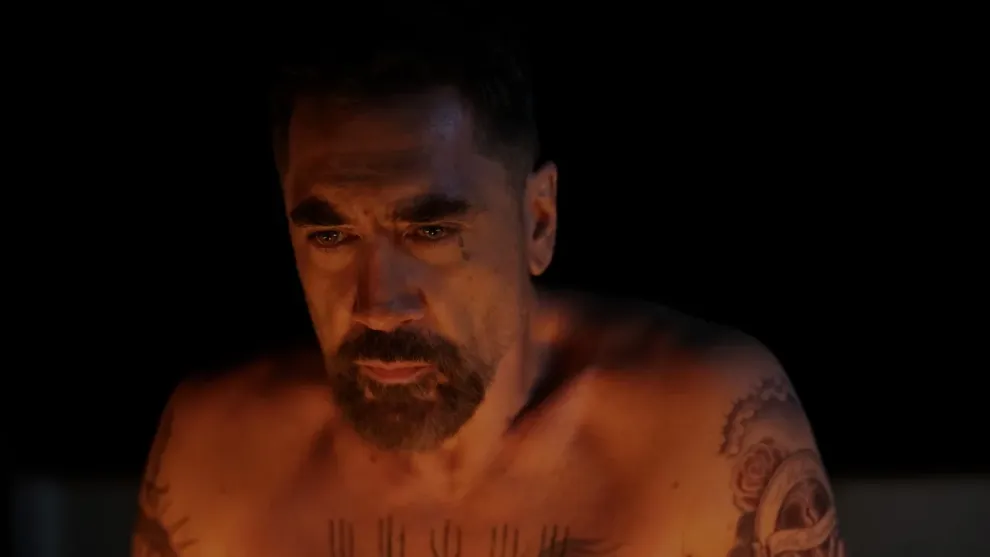
There comes a point in Apple TV+’s Cape Fear when Javier Bardem’s Max Cady has inserted himself into the Bowdens’ lives so completely that he starts feeling less like a stalker and more like a permanent houseguest. He appears at their workplace. He appears at their social events. He appears at moments that should be private. By the middle of the series, he’s hanging around so often that the situation borders on absurdity.
That’s the strange achievement of this new adaptation of John D. MacDonald’s The Executioners. Instead of trying to recreate the straightforward dread of the 1962 film or the operatic nightmare of Martin Scorsese’s 1991 remake, creator Nick Antosca builds something more psychological, more contemporary, and often more uncomfortable. This isn’t a story about a monster invading a healthy family. It’s about a damaged family encountering someone who knows exactly where all the cracks already exist.
The Bowdens are introduced as the kind of affluent Southern family that appears successful from a distance. They live in Savannah, Georgia, surrounded by old-money beauty, Spanish moss, and carefully maintained appearances. But the series wastes little time revealing how much dysfunction is hiding beneath the surface.
Highly Recommended: Not Suitable for Work Tv Parents Guide
Anna Bowden, played by Amy Adams, is an attorney whose career has been built on freeing people she believes were wrongfully convicted. Adams gives one of the strongest performances of the series, playing Anna with a constant sense of internal calculation. Even when she’s calm, you get the feeling she’s carrying the weight of decisions she’d rather not revisit.
Her husband Tom, played by Patrick Wilson, is almost her professional mirror image. Once a prosecutor, he now defends wealthy clients. The contradiction isn’t lost on his teenage son Zack, who delivers one of the show’s sharpest lines when he points out that his father used to send poor people to prison and now helps rich people avoid it. Wilson understands exactly who this man is: someone desperately trying to convince himself that every compromise he’s made was reasonable.
Their marriage is fraying. Tom is quietly experimenting with microdosing and entertaining thoughts he probably shouldn’t be entertaining. Anna’s fifteen years of sobriety feel less like a triumph than a daily negotiation. Their daughter Natalie has learned to survive by saying less than she thinks. Every member of the family seems to be keeping score against the others.
Which is why Max Cady’s arrival feels less like the beginning of the story than the acceleration of something that was already happening.
The series reimagines Cady’s connection to the family in ways that immediately complicate the traditional setup. Years earlier, Anna represented him. Tom prosecuted him. After the trial ended, Anna and Tom became a couple, creating a knot of personal and professional history that the show returns to repeatedly. Cady was convicted of murdering his wife and unborn child, spent years in prison, and then finds himself unexpectedly exonerated when new evidence emerges.
The details matter because this version of Cady isn’t simply seeking revenge, he’s pursuing recognition, validation, and ccountability. He wants the people he blames for his suffering to acknowledge what was taken from him.
Highly Recommended: Backrooms (2026) Parents Guide
Every actor who takes on Max Cady faces the shadow of the performances that came before. Robert Mitchum’s version was frightening because of how little he seemed to be doing. Robert De Niro’s was frightening because he appeared capable of doing anything. Bardem lands somewhere between those extremes. He’s charismatic enough to make people lower their guard and volatile enough to make them regret it.
More importantly, he understands that modern intimidation doesn’t always require physical violence.
One of the smartest decisions the series makes is updating Cady’s methods for the digital age. Previous versions of Cape Fear were built around physical proximity. Here, the threat is often technological. Social media, manipulated narratives, online outrage, digital surveillance, and AI-assisted deception become weapons every bit as effective as brute force. The result is a version of Cape Fear that feels more relevant than either film because its fears are rooted in vulnerabilities most viewers already recognize.
The show’s best episodes understand that anxiety isn’t generated by what Cady might do. It’s generated by the uncertainty of whether anyone can stop him once he decides to act.
That said, the series occasionally stretches credibility. There are moments when Cady’s ability to appear wherever he wants and influence whoever he needs begins to feel less like strategy and more like narrative convenience. A few late-season developments require viewers to accept coincidences that the earlier episodes work hard to avoid.
Amy Adams is exceptional throughout, giving Anna a level of emotional complexity that elevates nearly every scene she’s in. Patrick Wilson brings a weary self-awareness to Tom that prevents him from becoming merely unlikeable. CCH Pounder, as Anna’s law partner Noa, steals scenes with remarkable efficiency, often delivering the kind of blunt observations everyone else is too afraid to voice.
What’s most impressive about his performance isn’t the menace. We already know he can play intimidating. It’s the humor. Bardem finds moments of charm, awkwardness, and even vulnerability that make Cady feel human without ever making him trustworthy. You understand why people are drawn to him at the same time you understand why they should run in the opposite direction. That’s a difficult balance to achieve, and Bardem rarely loses it.
By the time Cape Fear reaches its final episodes, it becomes clear that the series isn’t really interested in asking whether Max Cady will destroy the Bowdens. The more interesting question is whether the Bowdens were ever capable of saving themselves in the first place.
And it’s the reason this adaptation succeeds where many modern reboots fail. Rather than simply updating a familiar story, it finds a new way into it. The result is a thriller that’s less interested in jump scares than emotional corrosion a slow, unsettling examination of guilt, resentment, and the damage people inflict on themselves long before an outsider arrives to finish the job.
Cape Fear Tv Parents Guide
Cape Fear is Rated TV-MA for graphic violence, sexual content, strong language, and mature psychological themes throughout. Not appropriate for viewers under 17 without parental discretion.
Violence & Intensity: Frequent and often graphic. Brutal physical confrontations, violent outbursts, and scenes of psychological torture are spread across the series. A character dies by suicide depicted with enough weight to disturb. The violence is purposeful rather than gratuitous, but it is consistent and at times genuinely upsetting. Not for the squeamish or younger teens.
Language: Strong profanity used regularly throughout. Includes the full range of adult language. Tone varies from aggressive and threatening to casual, which in some ways makes it land harder. No racial slurs noted, but the dialogue is unambiguously adult in register.
Sexual Content / Nudity: Explicit sexual content present. Cady’s character is written with a strong undercurrent of sexual menace. There are scenes involving adult relationships and implied or depicted infidelity. Nudity appears in select scenes. The sexual charge of the threat is central to the story, this is not incidental content.
Drugs, Alcohol & Smoking: A central character is established as a recovering alcoholic with fifteen years of sobriety handled seriously, not as a joke. Another character micro-doses LSD regularly, depicted as normalized behavior. Alcohol is present throughout social scenes. No glamorization, but substance use is woven into character identity.