Lucky — The Case of the Show That Didn’t Trust Its Own Instincts
Every summer produces at least one show engineered from spare parts of things that already worked, a cast this good, a premise this glossy, a soundtrack cue this perfect, and you spend the whole runtime waiting for it to add up to something more than the sum of those parts. Lucky, premiering today on Apple TV, is that show for July 2026, and the critical reaction rolling in is split almost exactly down that line: is this a crowd-pleasing thriller carried by a genuinely good cast, or a case study in how badly a taut little novel curdles once a studio insists on stretching it across seven hours?
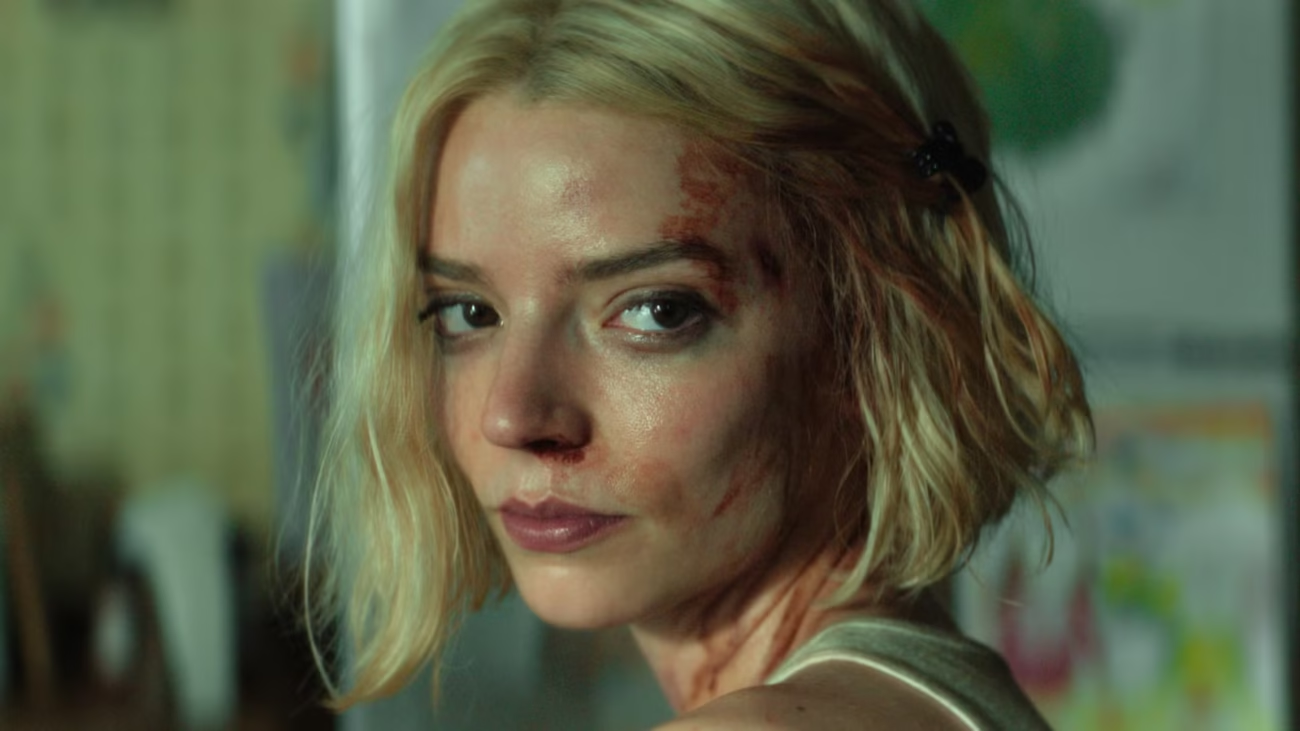
I haven’t sat down with all seven episodes myself yet, the reviews landed today, alongside the premiere, which puts me in the position of triangulating from a dozen critics who have, but the shape of the disagreement is instructive on its own. The premise: Luciana “Lucky” Armstrong, played by Anya Taylor-Joy, is the daughter of an incarcerated con man who raised her inside the family business from childhood.
She and her husband Cary pull off a ten-million-dollar heist against a mob boss on her father’s orders, and within a day the money’s gone, her husband’s vanished, and she’s being chased simultaneously by the FBI and her own mother-in-law’s crime family.
It’s pulp with good bones, Marissa Stapley’s source novel is apparently a fast, disposable beach read, the kind of book you finish on a flight and don’t think about again, and the question every critic seems to be asking is whether Jonathan Tropper’s adaptation found something worth the expansion, or just found seven hours to fill.
The camp that likes it likes it for reasons I find completely credible. One reviewer described the show’s best material as the scenes between Timothy Olyphant’s con-man father and Taylor-Joy’s Lucky, calling their dynamic genuinely fascinating, a father whose charm is inseparable from his dishonesty, and a daughter who loves him while never quite trusting a word he says.
That’s a real dramatic engine, the kind of push-pull that doesn’t need gunfights to justify itself, and it apparently produces the show’s most alive stretches. There’s also real affection out there for the show’s confidence as pure genre object, one writeup called it a propulsive, stylish thriller, the kind of thing that could plausibly become appointment television for a certain kind of viewer, helped along by a Fiona Apple-produced theme song that multiple critics singled out as an honest-to-god highlight.
The other camp is less forgiving, and its complaints are worth taking seriously precisely because they’re specific rather than reflexive. The most persistent criticism is structural: this is a show that has maybe two episodes’ worth of plot and character work stretched to fill seven, with critics describing entire episodes delivering ten or fifteen minutes of real development inside a forty-five-minute runtime.
That’s the “why isn’t this a movie” problem streaming has been quietly normalizing for years, a story engineered to hold your attention rather than earn it, paced for someone half-watching on their phone rather than someone actually leaning in. One particularly unimpressed review went further, arguing the show discarded much of what made Stapley’s novel work in the first place, filling the gaps with new subplots and conveniences that don’t track logically, the kind of adaptation choice that leaves you asking, scene after scene, how anyone in this story knew what they apparently knew.
What’s strange, reading across both camps, is that nobody seems to think the cast is the problem. Even the harshest notices carve out real respect for Taylor-Joy, Bening, Fichtner, and the rest of an ensemble that’s uniformly described as never bad and frequently doing more with the material than it deserves.
That’s a specific kind of disappointment, not a show sunk by bad performances, but one where good performances are apparently spread so thin across padded episodes that they can’t generate the momentum they should. It’s the difference between a show being actively unwatchable and a show being merely a squandered opportunity, and from where I’m sitting, that’s the more frustrating outcome of the two.
Bad television is easy to write off, television with this much talent visibly straining against thin material is the kind that makes you wish someone in the room had cut it down to a hundred-and-ten-minute film and called it a day.
I’ll have a fuller take once I’ve spent real time with all seven hours myself, rather than reading the temperature of a dozen critics who got there first. But the early consensus, an aggregate score hovering in the low-to-mid range, split fairly evenly between “clever, stylish, engrossing” and “an uneven diversion”, tracks with something I’ve felt about prestige limited series for a while now: the format keeps asking good actors to carry stories that would’ve been tighter, meaner, and more memorable at half the length.
Lucky might turn out to be one more entry in that increasingly crowded file. I’ll know for sure once I’ve watched Anya Taylor-Joy do her best against material that, by most accounts, doesn’t quite deserve her.
Rating: TV-MA
Violence & Intensity: Expect gunfights, car chases, and violent enforcement from mob characters, including a character described as doing bloody, brutal work on behalf of the crime family pursuing Lucky. Tense chase sequences and FBI raids are frequent; violence is depicted with real weight rather than played for camp.
Language: Strong adult language consistent with a crime-thriller TV-MA rating; expect frequent profanity in high-tension scenes.
Sexual Content / Nudity: Limited detail available in current coverage; expect adult relationship content (a marriage under strain, betrayal) handled with some intimacy but nothing indicated as explicit.
Drugs, Alcohol & Smoking: Vegas casino and criminal-underworld settings suggest social drinking is present throughout; no specific drug use flagged in available reviews.
Age Recommendations: Best for adults and older teens 16 and up, given the crime violence, mob intimidation themes, and morally complicated family dynamics at its center. Not recommended for younger viewers given the sustained threat and violence woven through its central chase.
