A woman steals a stranger’s kid because she’s decided the kid is secretly her. Written down like that, The Kidnapping of Arabella sounds unhinged, maybe even a little dangerous. Watching it, though, you mostly just feel for her. That gap between how insane this premise sounds and how tender it plays, is the whole reason the movie works, and it’s also, I think, the reason it doesn’t quite work all the way.
Holly is twenty-eight and drowning in the specific way people drown when nothing dramatic is actually wrong. Dead-end job, a private habit of imagining holes in the space-time continuum, like maybe there’s an exit somewhere she just hasn’t found yet.
Benedetta Porcaroli plays her a half-beat slow, like she’s listening to different music than everyone around her, and it’s a performance so unshowy, it took me a scene or two to notice how good it was, she won Best Actress at Venice for this, now I get it.
Then Arabella happens to her eight years old, ditched outside a Taco King by a driver who was supposed to be watching her, and within about ten minutes she’s clocked that this strange adult can be managed.
Lucrezia Guglielmino, the kid playing her, doesn’t do the thing child actors usually do in movies like this, no cute one-liners, no scene-stealing, she plays Arabella flinty and watchful, a kid who’s learned that manipulating a stranger is easier than getting her own father to look up from his laptop. Holly decides, with total conviction, that this girl is her own younger self sent back to fix something. So she takes her, No van, no struggle, just a woman finally answering a question nobody asked her out loud.
I kept waiting for the movie to punish that, it mostly refuses to, and then, here’s my actual problem with the film, the one I can’t talk myself out of: director Carolina Cavalli treats Holly’s break from reality as fuel, not subject.
It gets the plot rolling and then Cavalli moves on to the next joke, a version of this film exists where we sit inside Holly’s certainty long enough to actually feel it, to understand how an eight-year-old with a good poker face could pass, even briefly, as a message from your own past, this isn’t that version.
Cavalli’s clearly more interested in tone than diagnosis, and once or twice that choice tips into something uncomfortably close to using mental illness as a plot device rather than a person. I don’t think she means harm by it, I think she just likes the joke more than the ache underneath it.
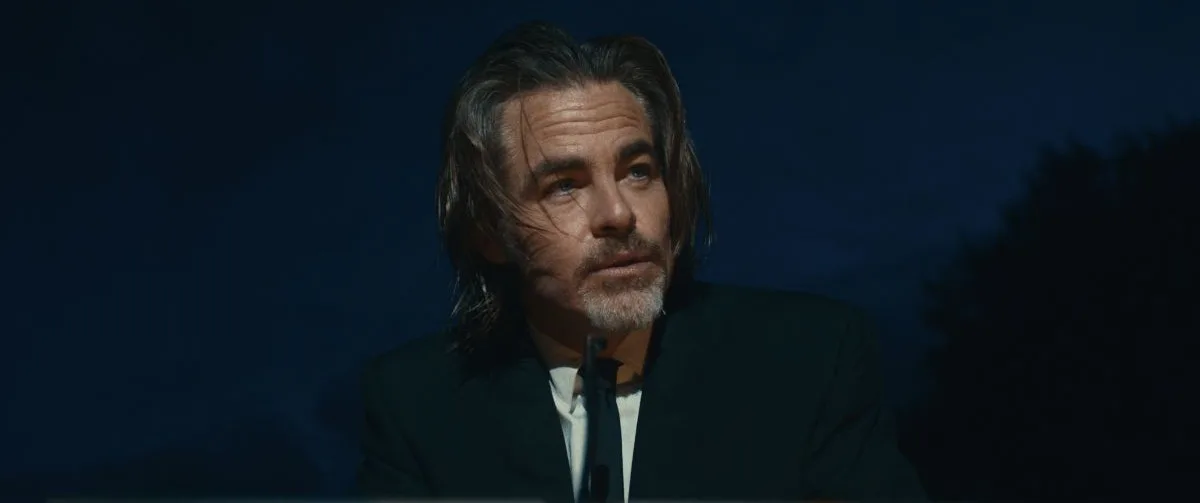
Chris Pine, doing his first Italian-language role, plays Arabella’s father Oreste, a novelist so consumed by his own unraveling that he outsources his daughter’s evening to a hired driver rather than deal with her himself.
You can hear him working in the language, reaching for words, and somehow that effort becomes part of the character instead of a distraction from it, when Oreste finally has to face what his negligence set loose, Pine doesn’t perform contrition, he just looks exhausted. Exhausted is scarier.
The film sags through its middle third, road movies always do, once the destination stops mattering and nothing’s replaced it yet, and there’s a ten-minute stretch where I caught myself checking the runtime, which I don’t say lightly about a movie I mostly liked.
There’s a scene, though, about forty minutes in, that’s stayed with me more than anything else in the film, where Holly and Arabella, parked somewhere, saying nothing, both staring at a strip mall like it might blink first, nothing happens, that’s the point. It’s the one moment Cavalli lets her characters just sit inside their own exhaustion instead of performing it, and it’s better than half the jokes in the film.
Holly doesn’t get fixed by the end, this movie doesn’t believe fixing is on the table, she just gets a little less alone, and on its best days, The Kidnapping of Arabella seems to understand that’s usually the whole trick.
Parental Guidance
Rating: Not yet rated by the MPA at press time. This is a limited-release Italian import from Oscilloscope Laboratories, and specialty films like this one sometimes open in US theaters unrated, worth a quick check with your local theater before booking a sitter.
Violence & Intensity: Minimal physical violence. The “kidnapping” of the title is emotional and situational, not dangerous, no weapons, no chase-thriller peril. The real intensity comes from a young child left unsupervised by an adult, and from the lead character’s unstable mental state, which plays out as quietly unsettling rather than frightening.
Language: Dialogue in Italian with English subtitles. No significant profanity flagged in critical coverage; expect occasional mild language typical of adult drama.
Sexual Content / Nudity: None indicated in available reviews or the official synopsis.
Drugs, Alcohol & Smoking: Nothing significant flagged. Given the adult settings, bars, restaurants, a self-absorbed novelist’s world, incidental social drinking is plausible but not called out by critics as notable.
Age Recommendations: Best suited for teens and adults, roughly 14 and up. Despite the child at its center, this isn’t family fare, the themes of mental illness, parental neglect, and a fairly melancholic tone under the deadpan humor call for some context younger viewers won’t have..