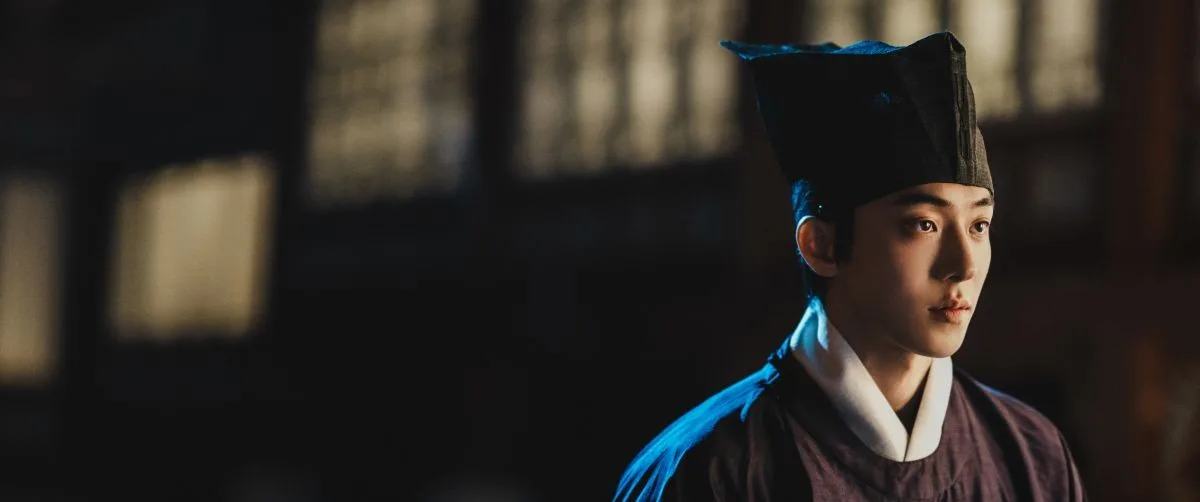
In summary, a court lady who can hear the dead whispering through palace walls, paired against her will with a demon slayer too exhausted by his job to care whether the kingdom lives or dies. Now give them eight episodes, a king watching his sons drop one by one exactly the way his own brothers did thirty years earlier, and a body count that gets genuinely gruesome by episode three. That’s The East Palace, and for about five episodes, it’s the most purely entertaining thing Netflix has put out this year.
The Story follows King Ju-sang is watching history repeat itself, his sons are dying the same way his own brothers did a generation back, and a pond spirit has apparently decided the bloodline owes a debt it hasn’t finished paying. Desperate, he drags in Gu-cheon, a demon slayer with zero interest in saving anyone, royal or otherwise, and forces him into the job at swordpoint.
Gu-cheon gets paired with Saeng-gang, a low-ranking court lady who’s spent her whole life hearing voices nobody else can, plus his own estranged daughter, who talks to spirits the way other kids talk to imaginary friends. Between the three of them, they’re supposed to find out what’s actually killing these princes before the whole royal line runs out.
What struck me first wasn’t the plot, though, it was how the show looks and moves. Director Choi Jung-kyu shoots the fight sequences with an animated, almost hand-drawn energy, like he studied a season of anime and decided to see how much of that language would survive the jump to live action, quite a lot of it does.
The makeup work on the spirits is genuinely unnerving in a way I wasn’t expecting from a streaming period piece, practical effects doing the heavy lifting instead of CG sludge, which is more than I can say for some of Netflix’s bigger-budget swings this year. When a possession takes hold of someone’s body, you feel it in the skin, not just the editing.
But it’s Gu-cheon and Saeng-gang who make the show worth returning to week after week, not the mythology. Nam Joo-hyuk plays the demon slayer with a kind of bone-deep sarcasm that never tips into smugness, this is a man worn completely thin by a job he never wanted, and Nam lets that exhaustion sit in his shoulders rather than his line readings.
Roh Yoon-seo, meanwhile, gives Saeng-gang a guardedness that makes sense the moment you learn what her abilities cost her as a kid, the two of them fall into something closer to a bickering older-brother-younger-sister dynamic than a romance, and it’s a relief, honestly, I was braced for the show to force them together and was glad when it mostly didn’t.
There’s a scene between Roh and Jang Young-nam, playing the grief-locked Queen Dowager, well into the season that hit harder than anything the ghosts managed, two women, one furious and one broken, finally saying the thing neither of them was allowed to say for thirty years. I actually said “fight the power” out loud at my TV, alone, like an idiot.
And then, somewhere around the midpoint, the show starts writing checks its own rules can’t cash, this is the part I keep circling back to, because it’s frustrating precisely because so much of the scene works.
The twists stop feeling earned and start feeling like the writers reaching for a jolt, a confession here, a betrayal there, each one landing with less impact than the last because the show keeps quietly rewriting what its own spirit realm is capable of to make the next reveal possible.
By the finale, I wasn’t confused so much as unconvinced, which is a worse feeling for a mystery show to leave you with, you can forgive a twist you didn’t see coming. It’s harder to forgive one that required the show to bend its own logic to get there.
Is that a fatal flaw? Not really, I’d still call this one of the more purely fun genre swings Netflix has put out this year, wobbly back half and all. If a movie like KPop Demon Hunters got you curious about Korean folklore and you’re ready for something with actual teeth, this earns its violence, and it earns it early, The East Palace is a strong next step. Just don’t expect the back half to hold together as tightly as the front.
Parental Guidance
Rating: TV-MA is the likely Netflix rating given the show’s violence level, though I’d recommend checking the title page on Netflix directly, since streaming ratings can occasionally shift after release. Separately, the Korean content rating board has classified it 15+.
Violence & Intensity: This is the category parents should pay closest attention to. Reviews consistently describe the action as ultraviolent and bloody, with disturbing, intense sequences tied to possession and spirit encounters. The makeup and practical effects work is detailed enough to make injuries and transformations feel visceral rather than cartoonish — this isn’t a show that softens its horror for a younger audience.
Language: Dialogue is in Korean with subtitles. No major profanity concerns flagged in available coverage, though intense dramatic dialogue is common given the palace-intrigue setting.
Sexual Content / Nudity: No sexual content or nudity flagged in reviews or synopses. The core relationship between the two leads is described as platonic, closer to a sibling dynamic than romantic.
Drugs, Alcohol & Smoking: Nothing significant noted in available coverage.
Age Recommendations: This one’s for older teens and adults, 16 and up. Between the graphic violence, disturbing supernatural imagery, and heavier themes of generational trauma, grief, and political betrayal, it sits well outside family viewing territory despite the folklore hook that might attract younger fans of something like KPop Demon Hunters. Parents should know the horror here is played straight, not stylized for a younger audience, and the show doesn’t pull back from showing consequences on-screen.