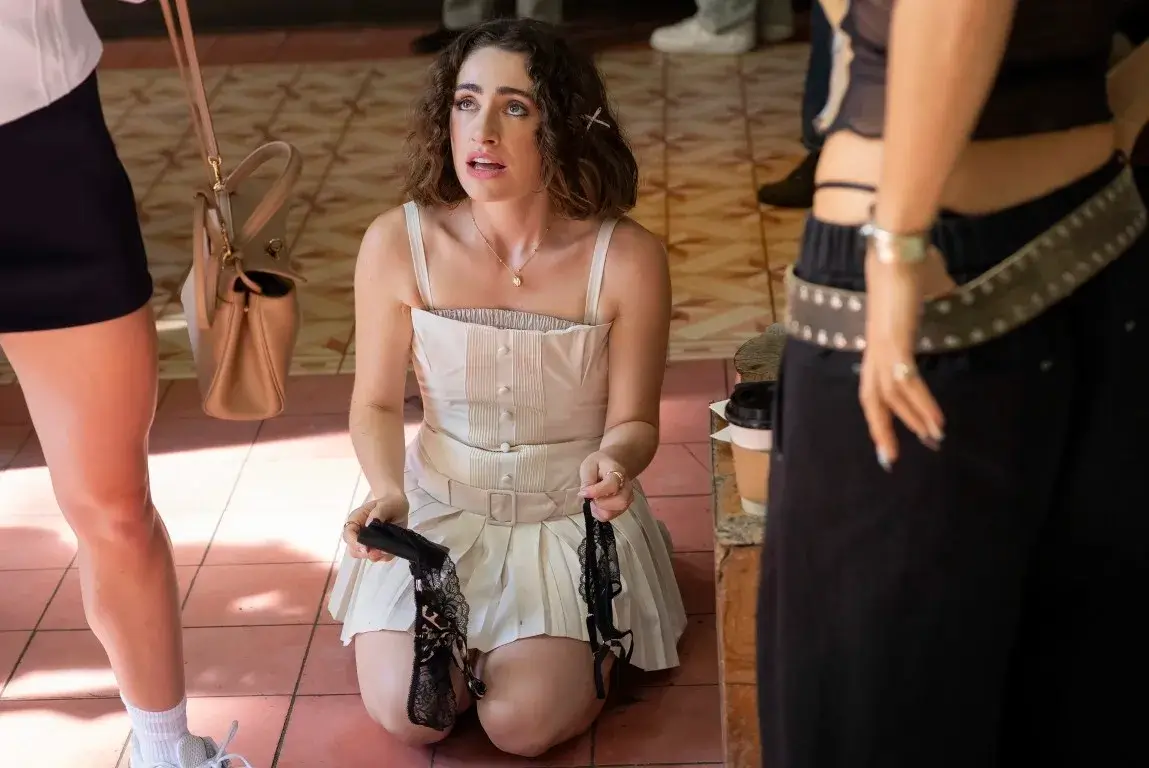
I Love LA is rated TV-MA by Motion Picture Rating (MPA) for mature audiences. This series is best suited for older teens (16+) and adults.
“I Love LA” — Review
Early in Rachel Sennott’s deliriously sharp West Coast comedy I Love LA, someone sighs, “What’s the point of being nice if no one who can help me sees it?” You could call that the show’s mission statement a confession and a provocation wrapped into one. It’s a world where kindness only matters if it trends, and sincerity is a luxury few can afford. In spirit, the series plays like Girls run through the self-promotional circus of Entourage and The Other Two a gleeful ode to the self-absorbed, the chronically online, and the hopelessly unserious. Which is to say, it may capture Los Angeles in the 2020s with alarming precision.
Recommended: Love Is Blind Season 9 Parents Guide
Sennott, who broke out in Emma Seligman’s nerve-rattling Shiva Baby before riding that tension into the anarchic comedies Bodies Bodies Bodies and Bottoms (which she co-wrote with Ayo Edebiri), here takes her sharpest swing yet. She plays Maia, a would-be talent manager stuck fetching lattes for a mid-tier agency. Her boss (a delightfully brittle Leighton Meester) treats her like a confidante one moment and a disposable underling the next depending on who’s in the room and how useful Maia happens to be.
At home, Maia’s living a curated dream: her boyfriend Dylan (Josh Hutcherson) is one of those impossibly kind, quietly competent men who feel too solid for this kind of show. He cooks, he listens, he genuinely loves her. Naturally, Maia takes him entirely for granted. Fortunately or not she’s got her college crew to affirm her delusions: Charlie (Jordan Firstman), a celebrity stylist with a caffeine habit and a persecution complex, and Alani (True Whitaker), a nepo baby actress coasting on charm and good lighting. They’re the kind of friends who’ll look up from their phones long enough to tell you you’re amazing, which in their world counts as intimacy.
Highly Recommended: Your Friends & Neighbors 2025 Parents Guide
Then comes the chaos. Tallulah (Odessa A’zion), Maia’s ex–best friend turned professional frenemy, reappears on her doorstep, radiant and desperate, wanting to “reconnect” and maybe have Maia manage her career. From the first clipped exchange, it’s clear their friendship is a beautiful disaster: toxic, addictive, impossible to quit. They feed on each other’s validation and resentment, circling like ex-lovers who never quite broke the spell. What unfolds is a rekindling filtered through the sunshine and artificial glow of LA New York neurosis repackaged in influencer skin.
From its first episode, I Love LA announces itself as a direct stare into the ring light of Internet culture. It’s about the performance of intimacy, the transactional nature of “relatability,” the way social media both fuels and devours ambition. People here block and unblock each other on Instagram like emotional warfare, weaponize TikTok Lives to settle scores, and treat PR crises like branding opportunities. There’s a wickedly funny bit where a reputation fixer reassures Maia that “white-on-white bullying is much easier to come back from.” You laugh and then you cringe, because you know it’s true.
Sennott and her writers seem to have an almost musical ear for the cadences of contemporary narcissism the half-ironic, full-delusional tone of a generation fluent in self-branding. The dialogue snaps and coils with absurdist venom. “They used to roofie people, but then they fixed it,” Maia deadpans at an LA nightclub. “Bummer,” Tallulah replies without missing a beat. When Charlie’s fired by an ungrateful client, he hurls after them, “You were boho. I made you cunt.” The timing is impeccable, the cruelty intoxicating.
The performances all hum on that same frequency fast, loose, just grounded enough to sting. Whitaker turns Alani’s obliviousness into a kind of tragicomedy; she’s the friend who’s always almost self-aware, and that “almost” is where the heartbreak lives. A’zion, meanwhile, is a live wire messy, magnetic, impossible not to watch. Her fling with a local chef (Moses Ingram, bringing warmth and quiet gravity) gives her character a flicker of humanity that cuts through the chaos.
Hutcherson, bless him, is the show’s moral barometer the one adult in a world of emotional toddlers. He just wants to cook dinner, play board games, maybe talk about feelings. His decency feels alien in this glittering terrarium of performative ambition. But it’s Firstman who steals scene after scene as Charlie, a man weaponizing cattiness in the name of self-worth. The series keeps teasing us with one exquisite question: does he have catastrophically bad gaydar, or has LA queered the entire spectrum of male behavior beyond recognition?
What’s impressive, though, is how Sennott refuses to let the show rest as mere satire. Amid the shrieking egos and social media farce, she finds a vein of tenderness an ache for connection in a culture built on transaction. Maia’s neediness isn’t just comedic fuel; it’s the byproduct of a world where attention is currency and love is something you post about after the fact. You sense the quiet despair beneath the jokes, the yearning for community among people who’ve mistaken proximity for friendship.
That’s where I Love LA sneaks up on you. It isn’t just a comedy of manners for the Instagram age it’s a lament for the kind of authenticity we keep photoshopping out of our lives. These characters are vain, yes, and often monstrous, but they’re also lost. They want to matter, to be seen, to belong even if belonging now means hating the same influencer’s grid together.
In the end, Sennott gives us not a condemnation but a mirror. You laugh, you wince, and maybe if you’ve ever refreshed your own feed a few too many times you recognize a bit of yourself staring back.
Detailed Content Breakdown for Parents
Violence & Intensity: There is limited physical violence or traditional “action”; however there are scenarios showing emotional/psychological turmoil, party-culture excess, online drama, substance misuse (see below). Some sequences may feel intense or uncomfortable (public shame, mobbing, humiliation).
Language: The characters frequently use adult language: swears, insults, sardonic tone. Some insults may be targeted and mean-spirited. The tone is often irreverent, cynical, and emotionally raw.
Sexual Content / Nudity: Sexual talk and situations are present. Early scenes include adult sexual activity (ex: the pilot opens with Maia having sex) and there is frank dialogue about bodies, desire, relationship dynamics. Nudity or graphic sexual content may be minimal on-screen, but the implication is constant.
Drugs, Alcohol & Smoking: Depictions of party culture, influencer excess, and potential substance use (for example one reviewer describes a “cocaine-fueled nightmare” in early episodes). Characters drink and attend nightlife settings.
Parental Concerns
- The characters often behave irresponsibly: using people, chasing clout, lying, self-sabotaging. For younger viewers (teens under ~16) the moral compass is muddy.
- Sexual themes and implied hookups are frequent; though not ultra-graphic, enough to raise eyebrows for younger teens.
- The tone is cynical and the humour often comes from humiliating characters rather than uplifting them some viewers may feel little redemption or “happy moral” payoff.
- The portrayal of influencer culture may glamorize superficial success and social media obsession, which could spark envy or unrealistic expectations in younger viewers.
Premieres Sunday, November 2, 2025; episodes air weekly on HBO and stream on HBO Max
