I’ve read the book twice. Once at fourteen, when my English teacher assigned it and I found it thrilling in the way that fourteen-year-olds find things thrilling all surface, all Lord of the Flies Greatest Hits. Once at thirty, when I understood what Golding was actually doing and found it considerably harder to finish. I mention this only because it matters, going into a new adaptation, whether you’re coming in with the text already living in your head. This one rewards it. It also complicates it. Sometimes both in the same scene.
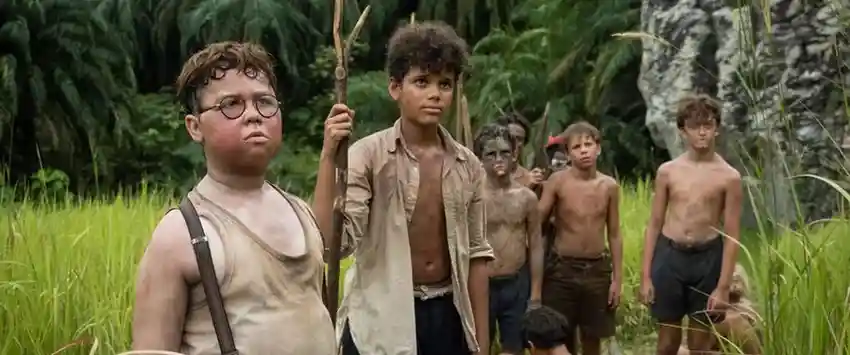
The Netflix version a four-episode BBC limited series, Jack Thorne writing, Marc Munden directing does something quietly smart in its first episode. Munden photographs each boy stranded on the island in close-up. Tight, clinical, held just a beat too long. They play, genuinely, like mug shots. Here are the faces. Here are the crimes they haven’t committed yet. It’s a directorial choice that announces the show’s intentions without a single word of dialogue, and it works.
What also works: the infrared cameras. The island’s foliage glows in neon pinks and oranges, not naturalistic, not quite dreamlike, something stranger than both. The reason for this, it turns out, is practical: so many scenes had to be shot during the day to accommodate child labor laws, and infrared was the workaround for achieving the feel of night. Accidental artistry is still artistry. The island looks genuinely wrong in a way that no amount of production design could have manufactured deliberately.
Thorne structures each episode around one of the four central boys Ralph, the natural leader; Jack, the bully who’s all performance and very little else underneath; Simon, the quiet one; Piggy, who is simultaneously the smartest person on the island and the one most reliably punished for it. The perspective rotation gives Thorne room to build backstory without making it feel like homework, though he’s borrowing a device so thoroughly colonized by Lost and Yellowjackets at this point that it’s hard to encounter it without a faint sense of déjà vu.
Speaking of which you cannot watch this show without seeing those other shows in your peripheral vision, and Thorne seems to know this. Rather than fighting the comparisons, he leans into the expectations that seventy years of Lord of the Flies descendants have built up. The beast in the jungle. The hint of something watching. The boys who gradually lose track of who they were before the crash. There’s a moment where Simon asks Jack in the forest, alone if he ever feels something behind him. It’s a line from the book. It also sounds like Lost fanfiction. The show has made peace with this and so, eventually, did I.
The cast is the thing that earns the most trust. Nina Gold and Martin Ware did the casting, and what they’ve assembled is an ensemble of largely inexperienced young actors who feel, scene by scene, genuinely prepubescent not the slightly-too-polished version of young that television usually settles for. David McKenna as Piggy is the standout: intelligent, gently irritating, more generous than anyone treats him. He makes you like a character the story is designed to make you watch suffer, which is harder than it sounds.
Lox Pratt plays Jack with a particular kind of public school menace coiled, performative, all House of Slytherin energy. He has since been cast as Draco Malfoy in HBO’s Harry Potter series, which, having watched him here, makes complete sense. He finds something small and real around the edges of a character who could easily be just a symbol.
The deviation from Golding’s book that surprised me most: Simon’s diary, in Thorne’s version, quietly suggests he’s queer, and that his feelings for Jack run deeper than friendship. It’s handled with restraint rather than announcement, and it reframes their dynamic in ways the book could only imply. It’s also the kind of change that feels genuinely earned rather than grafted on an addition that reveals something about the source material rather than replacing it.
The violence, when it arrives, is not softened. One death in particular is handled with a restraint that somehow makes it worse the show looks away at exactly the right moment, which is a more disturbing choice than showing it would have been.
But what I keep coming back to isn’t the violence. It’s smaller than that. Mosquito bites rising on the boys’ arms. Lipstick and blush and eyeshadow from unclaimed luggage, smeared across Jack’s followers’ faces in place of war paint. And an image of a praying mantis rising up from the dirt that the show lingers on in a way that initially feels odd until you realize the show is drawing an equivalence between the creatures that lived on this island before the boys arrived and the creatures that arrived with the plane crash. Something about that comparison, held quietly and without underlining, got under my skin more than anything the story’s more operatic moments managed.
Golding’s book asks whether civilization is what we are or just what we do when people are watching. The show asks the same question with four episodes and infrared cameras and a boy who loved another boy in a way neither of them had words for. It doesn’t answer it either. But sitting with the question, for once, feels like enough.
RECOMMENDING:
