The Odyssey — Reading the Tea Leaves Before the Curtain Rises
I haven’t seen Christopher Nolan’s Odyssey yet, nobody outside a handful of press screenings and one London premiere has, as of this writing, since it doesn’t open wide until July 17. But something rare happened after that first screening on July 6: nearly every critic and industry voice who filed into that theater walked out and said, almost in unison, some version of the same sentence. That doesn’t happen often, and when it does, it’s worth paying attention to what they’re actually agreeing on, because the agreement itself tells you something about the film before you’ve bought a ticket.
What they’re agreeing on is scale, Nolan’s take on Homer arrives with some of the most breathtaking set pieces he’s ever attempted, built around an in-camera commitment to new IMAX technology that multiple critics are calling a genuine technical feat.
That’s not surprising, exactly, Nolan has been building toward something like this since Interstellar taught him what a 70mm frame could hold. What is surprising, if the early word is accurate, is where he’s chosen to point that scale. Nolan himself has said the format’s grandeur isn’t the real news here, the real news is a set of scenes played with unusual intimacy, close enough that the audience is meant to feel like they’re sitting in the room with these characters rather than watching them from a mythic distance.
A director famous for turning the biggest possible canvas into a cathedral for large ideas is apparently, this time, also using it to shoot a marriage.
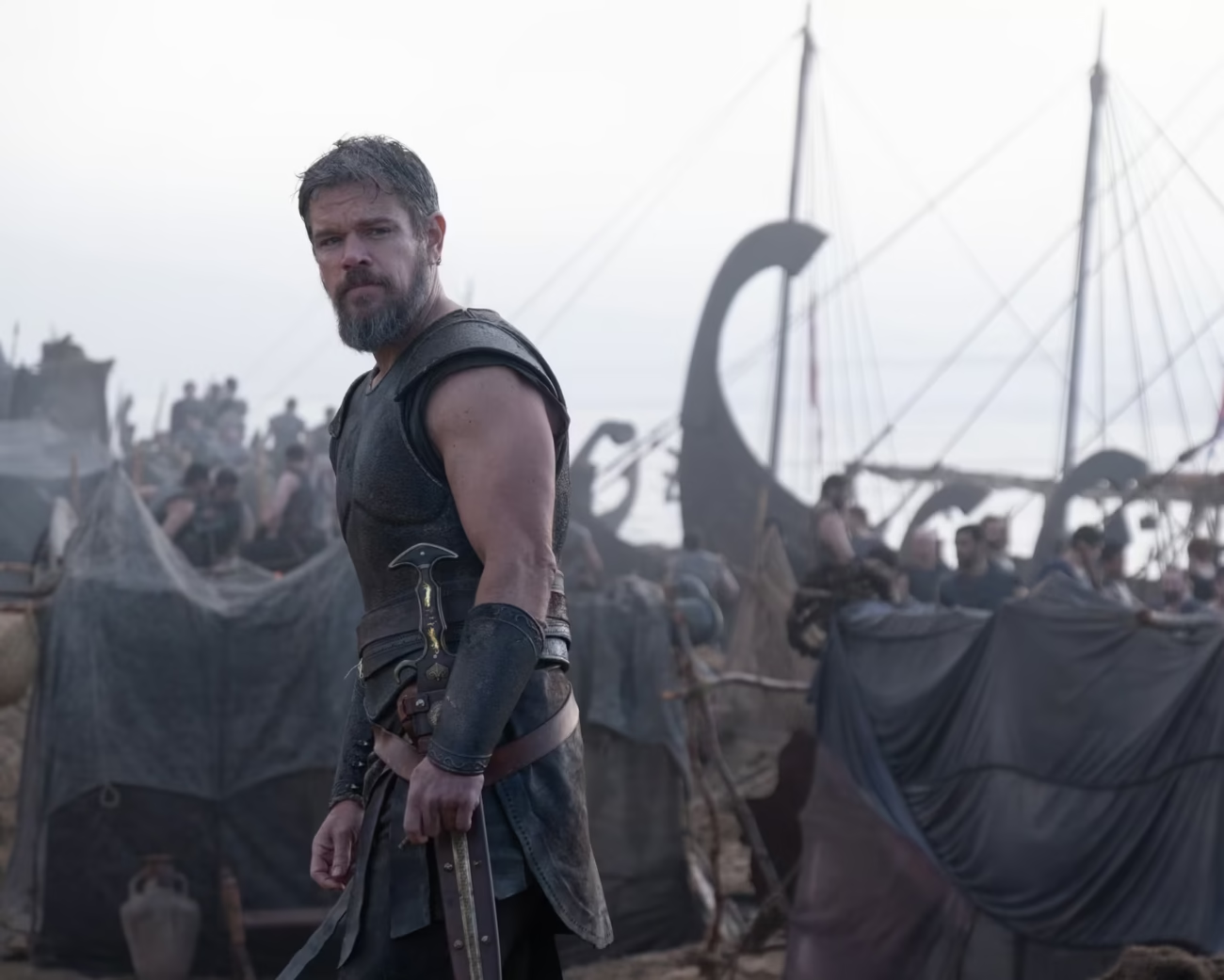
That marriage is the load-bearing wall of the whole enterprise. Matt Damon plays Odysseus, and the reactions circling around his performance keep using a word I don’t see thrown at movie-star performances very often: soul. One review describes Damon’s work as offering a genuine glimpse into Odysseus’s inner life, delivering enormous power inside a role that could easily have collapsed into pure spectacle-carrying.
Anne Hathaway, playing Penelope, is drawing praise in the same register rather than as the dutiful wife waiting at home, her performance is being described as equally powerful, equally emotional, a real counterweight rather than a footnote to Damon’s journey. And Tom Holland, as Telemachus, seems to be getting the coming-of-age arc that this story has always technically contained but that adaptations rarely bother excavating.
I’m struck by how many of these early reactions reach for the same handful of images from the back half of the film, the Cyclops, Circe’s island, as the sequences they can’t stop turning over. One critic singled out the Cyclops and Circe sequences as among the finest work of Nolan’s career, which is a real claim to make about a director whose career includes the Batmobile chase through Gotham and a black hole rendered as an actual tesseract.
If that assessment holds once wider audiences get in the door, it suggests Nolan found something in the poem’s stranger, more folkloric episodes that the historical-epic version of this story usually sands down for prestige.
Not every reaction is pure hallelujah, and the dissent is worth sitting with precisely because it’s coming from serious places. IndieWire’s David Ehrlich, comparing it to Oppenheimer, called the film too clunky to rank among Nolan’s very best work, while still conceding that the final act earns whatever patience the film demands to get there.
That’s a useful corrective to the wall of five-star exclamation points surrounding this release, and it tracks with something true about Nolan generally: his films are often structurally ambitious in ways that produce real friction in the middle stretch, a friction he’s usually betting the ending will retroactively justify. Whether The Odyssey’s three-hour runtime earns that bet is the actual question hanging over this release, and no amount of premiere-night adrenaline answers it definitively.
There’s also a smaller, uglier story running alongside the critical one, which is the online noise around Lupita Nyong’o’s casting as Helen of Troy, the kind of controversy that generates more heat than the film itself will likely sustain once people actually watch what she does with the role.
One commentator dryly noted that outrage over her casting evaporates the instant you actually watch her performance, calling the whole controversy the funniest part of the film’s rollout. I mention it mostly because it’s the kind of pre-release noise that tends to say more about the internet than about the movie, and it’s worth setting aside before the film even opens.
What I keep coming back to, reading these reactions stacked against each other, is that nobody not the raves, not the more measured takes, is describing a safe movie. Nolan has reportedly built the film around the idea that Homer’s poem isn’t just a historical curiosity but a genuinely emotional, visually ambitious undertaking rather than a conventional costume epic.
That’s the bet every adaptation of a two-and-a-half-thousand-year-old poem has to make, that the thing which made it endure isn’t just anthropological interest, but something that still knows how to move a person sitting in the dark.
The early word suggests Nolan found that thing, at least often enough to matter. I’ll know for certain in a few days, when I can sit down with it myself instead of triangulating from a hundred scattered reactions typed out on the walk from the theater to the car.
Parental Guidance: The Odyssey
Rating: Expected PG-13, consistent with Nolan’s prior epics (Dunkirk, Oppenheimer) and the mythological source material’s battle sequences and mature themes.
Violence & Intensity: Early reactions describe large-scale war and monster-combat sequences the Cyclops, sea battles, encounters with the dead pulled up from Hades, as intense and visceral, with one reaction specifically describing the film as full of blood and thunder. Expect combat violence in line with Nolan’s other war-adjacent epics rather than horror-level gore.
Language: No specific profanity concerns flagged in early reactions; expect language consistent with a PG-13 war epic.
Sexual Content / Nudity: The story involves Circe’s seduction and Calypso’s island, both handled with mythological weight in Homer’s text; based on Nolan’s directorial history, expect suggestive or emotionally charged content rather than explicit depiction.
Drugs, Alcohol & Smoking: No indications flagged in early coverage; not expected to be a significant factor.
Age Recommendations: Likely appropriate for 13 and up, with the three-hour runtime and mythological, sometimes ghostly subject matter better suited to older kids and teens who can sit with a long, emotionally dense war story. Younger children may find both the pacing and some of the darker mythological imagery (the dead in Hades, monster combat) too intense.
