100 Nights of Hero is Rated PG-13 for sexual material, some bloody images and language.
Julia Jackman’s 100 Nights of Hero wastes no time establishing its skewed, oppressive universe. In this world, Birdman a godlike figure, clearly modeled on the archetype of the powerful, arbitrary white man has decided that women and queer people are inherently wrong. Why? Because it makes him feel better. Jackman’s film doesn’t dwell on his racist impulses, but the implication is clear: all forms of oppression here are the product of a capricious, self-important deity with too much time on his hands.
At the story’s center is Cherry (Maika Monroe), a young woman trapped in the expectations of her society and, more importantly, under the thumb of Birdman’s deadly rules. She’s married to Jerome (Amir El-Masry), the sort of husband who seems perfectly content to avoid his marital duties quite literally and yet Cherry bears the brunt of the divine threat: if she doesn’t produce a child soon, execution awaits. Jerome, naturally, gets off scot-free.
Enter Manfred (Nicholas Galitzine), a strapping, confident interloper who offers Jerome a dangerous gamble. Jerome will leave for one hundred nights, while Manfred takes up residence in the house with the goal of seducing Cherry. If he fails, Jerome wins and Cherry faces death for failing to conceive; if he succeeds, Manfred claims Jerome’s castle and, of course, Cherry will be executed for infidelity. It’s a diabolical wager, leaving Cherry with virtually no agency in a game entirely dictated by men.
Cherry’s only ally is her devoted servant, Hero (Emma Corrin). Their relationship is emphasized repeatedly almost comically as a deep, lifelong friendship. But beneath the surface, there’s unspoken love: Hero loves Cherry, Cherry loves Hero, and in this world, Birdman’s laws make such feelings forbidden. When Manfred appears, practically dripping with the feral masculinity of a man who has just wrestled an elk to the ground, Cherry’s peril becomes immediate. Hero devises a clever defense: every time Manfred becomes overconfident, Cherry will be reminded of Hero’s cautionary tale.
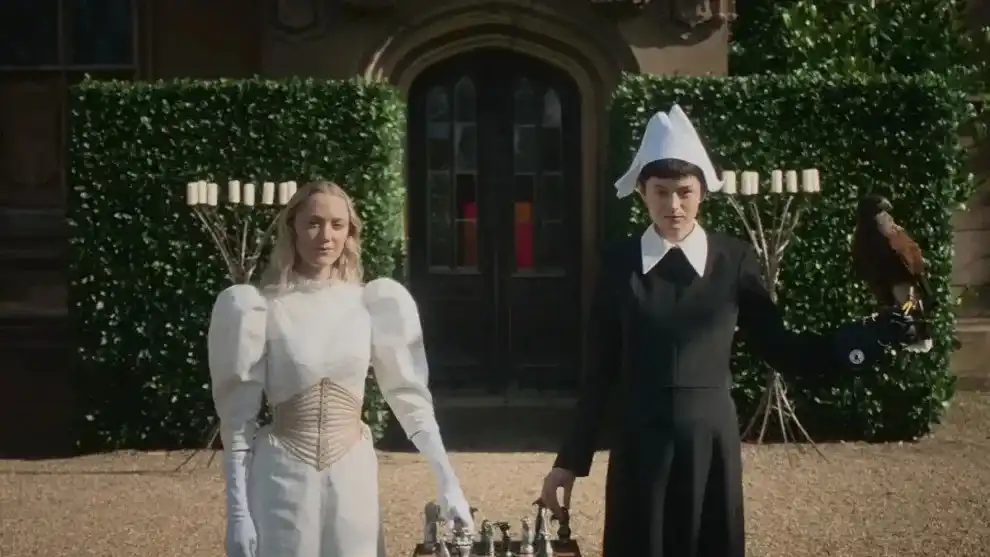
Hero’s story revolves around Rosa (Charlie XCX), a girl who dared to learn to read and write in a society where women are restricted to chess, falconry, and incompetence in general. The tale is metaphorical, and its power lies less in plot than in its moral: knowledge and love are subversive, dangerous, and transformative. It’s a story within a story that, in Jackman’s vision, becomes a shield against the destructive forces of male dominance.
Jackman’s aesthetic choices silly bird masks, grandiose godlike figures, arch performances create a sense of heightened absurdity that underscores the real horror of her world. Oppression is painted in clownish colors, reminding us that the ideologies behind tyranny are often ludicrous, even when deadly serious. Adapted from Isabel Greenberg’s graphic novel, the film’s production values are sometimes modest, the estate settings grand but the overall visual style reminiscent of an intimate art house theater. The performances can feel mannered, but the characters who inhabit the world freely unbound by Birdman’s rules exude a natural ease that emphasizes the contrast with the repressed. Jackman seems to suggest that living under oppression is itself a form of falseness.
Yet this arch quality present in the costumes, the performances, and the storytelling cuts both ways. On one hand, it elevates the film to something resembling a modern Chaucerian fable tackling issues of gender, power, and forbidden love. On the other, it risks alienating viewers who might be put off by the overtly stylized approach. The result can feel like a kitschy, queer-leaning Wes Anderson riff but it’s more than kitsch. Beneath the mannerisms is a genuine meditation on the power of stories to inspire imagined lives, to offer visions of freedom and love that reality may deny.
For all its quirks and occasional narrative thinness, 100 Nights of Hero delivers a potent message: even in worlds governed by arbitrary and cruel rules, storytelling can illuminate alternative possibilities. Even if we cannot live them ourselves, these stories can empower others to imagine a better, freer life. And for that, the film is thoroughly marvelous.
Content Breakdown for Parents
Violence & Intensity:
The film features threatening violence, including the looming threat of execution, coercion, and psychological terror. There are scenes where menacing behavior and danger to characters’ lives is front and center. While it avoids graphic gore, the tension is strong, and younger or sensitive viewers might find the stakes unsettling.
Language:
The movie mostly avoids harsh profanity or explicit slurs the anger tends to be more emotional and oppressive than overtly vulgar. The tone is serious and heavy rather than shockingly crude.
Sexual Content / Nudity:
There is implied sexual tension, seduction, and coercive dynamics. The wager involving seduction carries a strong sexual undercurrent, though the film stops short of explicit sex or nudity. Some scenes may suggest erotic overtones or adult themes.
Drugs, Alcohol & Smoking:
There is no notable use of drugs, alcohol, or smoking in the core narrative. The focus remains on power, control, and the consequences of oppression, not substance use.
Parental Concerns
The film’s dark tone, themes of coercion and threatened violence, and implied sexual tension may be intense for younger viewers.
Some may find the threat of execution and malevolent divine oppression emotionally disturbing.
The moral complexity where good and evil are framed in exaggerated, symbolic ways might be tough for younger kids to fully grasp or process without guidance.
Recommended Age Range Suitable for teens (13+) and older especially those mature enough to handle complex themes, moral ambiguity, and emotional intensity. Parents of sensitive younger teens should consider watching together and discussing the themes afterwards.
