Predator: Badlands is Rated PG-13 by Motion Picture Rating (MPA) for sequences of strong sci-fi violence.
Predator: Badlands (2025) Review
Set on one of the most perilous worlds ever imagined for the big screen, Predator: Badlands arrives as a thrilling, remarkably assured entry in the sci-fi action canon. It’s a film of vivid character work, astonishingly designed fauna and flora both exquisite and terrifying and a script so cleanly engineered it feels practically airtight. At its center are performances that rank among the year’s most commanding, though they’ll likely go uncelebrated because so much of their brilliance exists between words. This is the rare franchise installment that satisfies longtime devotees of the Predator mythology while operating completely on its own wavelength. And, maybe most strikingly, it’s a film about what it means to be human without a single human in sight.
None of this will come as a surprise to anyone keeping tabs on the franchise’s recent resurgence. Like Prey and the animated anthology Predator: Killer of Killers, Badlands is directed by Dan Trachtenberg, who has turned the series into something like a cinematic laboratory. His approach to Predator mythology has an alchemical unpredictability respecting the lore while bending it into shapes no one saw coming. Each film feels wholly distinct in tone, form, and mood, making “best of the trilogy” debates feel irrelevant. They’re more like siblings different, but equals. Trachtenberg’s run carries the same obsessive continuity you see in George Romero’s zombie cycle, John Woo’s Hong Kong operas of violence, or Takeshi Kitano’s existential yakuza tales. Each mined supposedly played-out territory and found infinite ways to make it feel vital again.
Also Read: Little Amélie or the Character of Rain (2025) Parents Guide
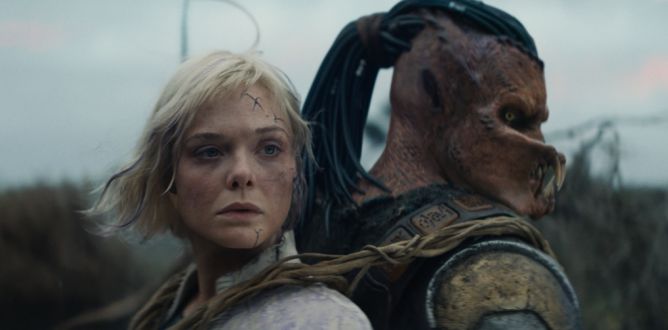
For the first time in the series’ history, a Predator itself takes center stage. The film opens on the Yaujta homeworld, where this warrior species violent, hierarchical, almost Klingon in their devotion to strength lives by ritual and dominance. The protagonist, Dek, is a young predator desperate to earn recognition as a true warrior but dismissed as too small, too unproven a “runt.” When his own father, the tribe’s leader, nearly kills him in a brutal display of contempt, Dek flees to a forbidden planet called Genna, known in legend as the Death Planet. His mission: to slay an invincible Predator known as the Kalisk and return home with its skull and spine as proof of worth. In his mind, that trophy will finally make him whole.
The opening stretch of Predator: Badlands plays like a stripped-down survival saga a creature cast into an alien wilderness, forced to understand its ecosystem before it devours him. It’s Robinson Crusoe by way of The Revenant, Cast Away refracted through cosmic horror. At first, the setup feels almost archetypal an exiled warrior on a journey toward redemption but once Dek sets foot on Genna, the film bursts to life. The planet itself becomes a character, and an antagonist, pulsing with hostility. Everything that breathes or even looks like it might wants him dead.
Then comes Thia (Elle Fanning), an android survivor from a doomed Weyland-Yutani expedition yes, that Weyland-Yutani, the omnipresent corporate hand that links Alien and Predator mythology. The connection between those universes has been teased for decades, but Badlands commits to it with surprising elegance. Like Dek, Thia came hunting the Kalisk, a nightmarish ten-meter titan covered in razors and spines. Her mission was to capture it alive for the company’s bioweapons division. Instead, the Kalisk annihilated her entire crew and tore her body in half. Now she moves on her arms, swinging like a gymnast, part tragic survivor and part eerie marvel. She tells Dek she had a twin android, Tessa same model, same face and she believes Tessa still lives. It’s a leap of faith that hints Thia’s programming has evolved into something startlingly human. Fanning plays both roles, echoing Michael Fassbender’s dual turn in Alien: Covenant, and the effect is hypnotic. Thia convinces Dek to join forces: help her recover her other half and in return, she’ll guide him through the planet that wants to kill them both.
Recommended: I Love LA (2025) Parents Guide
What follows is an oddly tender, darkly comic riff on the buddy-movie formula. Fanning’s Thia is a jittery chatterbox, the kind of relentlessly curious presence that would drive any stoic warrior insane. She’s part Diane Keaton neurotic, part philosophical savant. Dek, taciturn and solitary, can barely stand her company first carrying her strapped to his chest, then flipping her around like a backpack when her questions become unbearable. (“When you chew, which parts move the outside fangs or the inside teeth?” she asks, deadpan.) Yet he can’t let her go. She’s his translator, his compass, his reluctant teacher. “The only way to survive Genna is to learn it,” she tells him and the line becomes the movie’s quiet thesis.
Both Dek and the film take that wisdom to heart. What emerges is a shockingly immersive portrait of an alien world that feels as tactile and ecologically coherent as a nature documentary. Trachtenberg cites Terrence Malick as an influence, alongside Western stylists like Eastwood and Leone, and that mix tracks. There’s grandeur in every frame the sense of a director as attuned to wind, light, and texture as he is to blood and movement. It might sound pretentious to mention Malick in a Predator review, but Trachtenberg earns the comparison. Like Prey, Badlands pulses with awe: a vision of life as interconnected systems of beauty and predation.
Unlike most sci-fi survival films, Badlands doesn’t limit its fascination to the big monsters. It studies the entire web: the herbivores grazing under alien suns, the insects humming in phosphorescent air, even the carnivorous plants waiting to ambush the unwary. Everything on Genna hunts, feeds, adapts. In one brilliant sequence, a winged creature drops stones onto gelatinous flora, igniting the sacs like living napalm a self-sustaining ecosystem of violence and ingenuity. You can almost feel the director grinning behind the camera at the logic of it all.
Also Read: Violent Ends (2025) Parents Guide
Tools, as ever in this series, become extensions of belief systems. Dek carries the weapons of his kind, sleek and lethal, but the film finds drama in the moments he’s forced to improvise stripped of technology, forced to think like prey. Running parallel are ideas of “family,” “heritage,” and “programming”concepts the script toys with but never sentimentalizes. Thia and Dek talk about fathers, brothers, and mothers (a knowing wink to Alien’s MUTHER computer), yet these terms are slippery, maybe even dangerous. The contrast between Thia and Tessa underscores how easily words like “sister” can distort loyalty. When Tessa reappears rebuilt by the company, hollow and obedient Thia can’t see that the soul she’s chasing no longer exists. There’s also Bud, a wide-eyed, monkeylike creature who mimics Dek’s gestures with eerie devotion, like a child modeling its parent. It’s strange, funny, and quietly moving.
To its credit, Predator: Badlands doesn’t treat its philosophical motifs as window dressing. Ideas like “tool,” “family,” and “weakness” are embedded in every exchange, every decision, every battle. Through Thia and Dek’s uneasy partnership, the film shows how communication can be both weapon and salvation how language itself can deceive or heal. Their relationship evolves not through grand speeches but through action, through the slow recognition of mutual dependence. Thia, built to emulate empathy as a survival mechanism, tells Dek that emotion is a tool it opens doors, loosens tongues. Dek, raised to equate feeling with weakness, listens despite himself. “I could survive on my own,” she tells him at one point. “But why would I want to?” It’s the kind of line that sneaks up on you a quiet manifesto buried in pulp spectacle.
On one level, the film plays like a coded Western, even more so than Prey. You might think of The Outlaw Josey Wales, with its hardened loner gathering strays against his better judgment. Thia even lectures Dek on the myth of the alpha wolf how the true alpha isn’t the fiercest, but the one who protects the pack. The callback to Prey is unmistakable: the same earthborn canine that inspired Dek here met its end centuries earlier on the Great Plains. History echoing across planets.
There’s far more to Badlands than can or should be revealed. One of its pleasures lies in surrendering to its unpredictability, trusting the film’s instincts as it twists and transforms. By the time it ends, you realize Trachtenberg has crafted something unexpectedly uplifting: a survival epic about breaking free from the codes cultural, genetic, corporate that dictate who we’re supposed to be. Whether you’re a predator, an android, or something in between, the film’s final insight lands with quiet force: sometimes the thing you think you need most is the very thing holding you back. And when you finally let go, that’s when you start to live.
Content Breakdown for Parents
Violence & Intensity: Unsurprisingly for a Predator film, violence is front and center. There are numerous scenes of combat, dismemberment, and alien predation, though they’re presented with more artistry than shock value. The camera often lingers on the consequences of violence scorched landscapes, the weight of survival — rather than reveling in gore. Still, expect blood (both human-like and vividly alien), impalements, and a few startling moments of body horror, especially involving Thia’s damaged android frame. Younger teens may find some scenes too intense.
Language: Because much of the dialogue is between a Predator and an android, traditional profanity is minimal. However, Thia’s speech occasionally includes sharp, sarcastic remarks or coded references to her human creators’ flaws. The tone is mature, and the emotional vocabulary can be heavy, but there’s no coarse or explicit language in the traditional sense.
Sexual Content / Nudity: None. The film’s tone is deeply emotional but entirely nonsexual. There’s no nudity, and even its physical closeness between characters carries a strange, almost spiritual tenderness rather than romantic tension.
Drugs, Alcohol & Smoking: this is a movie about primal survival on an alien planet. There are no substances, vices, or intoxication of any kind. The characters’ struggles are existential, not chemical.
Scary or Disturbing Scenes: The creature designs are elaborate and sometimes nightmarish, blending beauty and horror in a way that recalls Alien and Annihilation. There are jump scares, grisly moments of creatures being devoured, and an underlying dread that never fully lifts. The sound design screeches, clicks, and inhuman breathing adds to the tension. Sensitive viewers may find the constant threat of death and isolation distressing.
Parental Concerns
Parents should know that this is not a family-friendly entry despite its beauty and thematic richness. The violence, though stylized, is still graphic. The emotional tone is weighty and melancholic, occasionally despairing. There’s also some existential content that might unsettle younger viewers reflections on death, purpose, and the ethics of creation. The film’s pace is deliberate, more contemplative than explosive, which may bore action-hungry kids expecting nonstop fights.