Little Amélie or the Character of Rain is Rated PG by Motion Picture Rating (MPA) for thematic content, peril and brief scary images.
Adapted from the autobiographical novel by Belgian author and artist Amélie Nothomb, Little Amélie or the Character of Rain unfolds as a delicate miniature of a coming-of-age tale one so early in life it feels almost mythical. Directors Maïlys Vallade and Liane-Cho Han follow the story of a child born in Japan to Belgian parents, a girl whose short journey from birth to age three becomes a meditation on divinity, language, and awakening. The film, structured in symbolic threes Amélie is the third child, the story spans three years, and three is itself a sacred number treats early childhood not merely as an age but as a realm. In Japanese culture, a child is said to descend from the world of the gods into that of humans at the age of three. The word okosama, or “lord child,” captures this fleeting holiness, and the film, with its blend of wonder and cross-cultural reflection, lingers lovingly in that liminal space between heaven and the everyday.
Highly Recommended: Hallow Road (2025) Parents Guide
At first, baby Amélie (voiced and animated with expressive subtlety by Loïse Charpentier) is slow to meet life’s basic milestones slow to walk, slower still to speak. But the moment language arrives, it bursts forth like revelation, triggered, fittingly, by the taste of Belgian white chocolate. From that point, her fluency comes not as learned speech but as innate awareness, as if she had been listening all along. The filmmakers capture something profoundly true about early consciousness: the idea that children understand far more than they can articulate. Here, Amélie is finally granted the words to reveal the complexity already humming inside her a mix of curiosity, affection, defiance, and, in one delightfully petty gesture, her refusal to utter her brother’s name after he’s teased her one time too many.
With three young children in the household, Amélie’s parents lean on the support of their landlady, Kashima-san (Yumi Fujimori), and the family’s housekeeper and unofficial nanny, Nishio-san (Victoria Grosbois). But the household’s emotional geometry is more complicated than it first appears. Kashima-san, scarred by wartime memories, prizes order and property over intimacy; she allows care but discourages attachment. Yet, as Nishio-san and Amélie’s bond deepens gentle, mutual, and life-shaping the film blossoms into a quiet reflection on the joys and frictions of cross-cultural relationships, and how nurture can transcend, or be tested by, history.
Recommended: Violent Ends (2025) Parents Guide
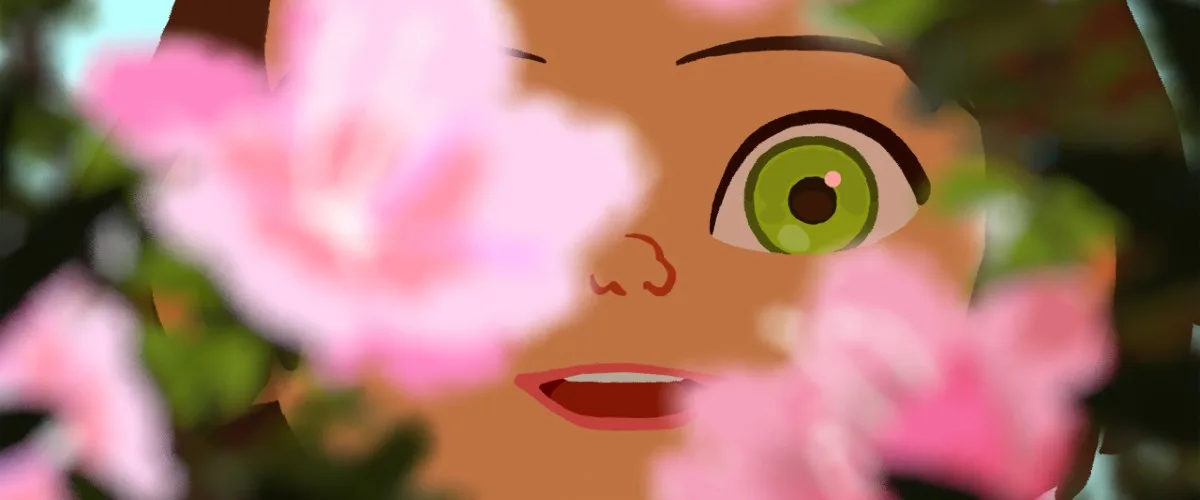
The film’s 2D animation is gorgeous in its restraint all warm tones and generous lines, evoking a Japan filtered through the gaze of a child who finds majesty in the mundane. The visual world breathes with Amélie’s sense of awe. A vacuum cleaner becomes a mythical creature; a tantrum feels as seismic as a storm. The filmmakers remind us that for the very young, emotion and curiosity are pure forces, unmediated by reason or restraint. Watching it, you can feel the film’s tenderness tug at your own early memories the moments when the world first revealed itself as both infinite and intimate.
It’s in Amélie’s relationship with Nishio-san that Little Amélie or the Character of Rain finds its emotional core. Their connection, rendered with such understated affection, recalls the quiet grace of childhood caretakers the people who shape us in ways we might only recognize years later. You might find yourself, as I did, remembering your own nanny, grandparent, or guardian, and the cultural bridges that small acts of care can build.
Also Read: Anniversary (2025) Parents Guide
Yet, for all its charm, the film occasionally loses its balance between wonder and weight. Its sentimentality, while often sincere, sometimes curdles into sugar. And when the filmmakers reach for darkness, they hesitate. In one scene, Nishio-san cooks while recalling the war — her hands stirring rice as she speaks of explosions and rubble. The imagery is inspired, the concept haunting, but the tone feels detached, as if the film is afraid to look grief directly in the eye. It’s a moment that should devastate, yet only grazes the surface.
Kashima-san, meanwhile, is positioned as the vessel for the film’s emotional contrast bitterness to Amélie’s innocence, rigidity to Nishio’s warmth but she remains thinly sketched. We understand her perspective, but not her pain. The story hints at depth, trauma, perhaps even unspoken love, but never lets us in. We’re left to fill the gaps with our own empathy, which, while not unsatisfying, feels like a missed opportunity.
Still, Little Amélie or the Character of Rain radiates a nostalgia that’s difficult to resist. It turns Japan’s postwar landscape into a playground of wonder, viewed through the eyes of a child who still sees divinity in puddles and possibility in every corner of the house. Even when the film repeats its gestures even when its sentimentality feels overinsistent its sincerity remains disarming.
Ultimately, this is a love letter: to childhood curiosity, to cultural hybridity, to the strange holiness of beginnings. It invites us to remember the time before logic intruded, when wonder was the default state of being. And though it sometimes pleads too eagerly for your affection, it earns much of it through sheer honesty.
Little Amélie or the Character of Rain may stumble tonally, but its heart never wavers. It’s a film about innocence not the naïve kind, but the spiritual kind the fleeting moment when we still belong to the realm of gods before we learn the heavy language of the world.
Detailed Content Breakdown for Parents
Violence & Intensity: The film contains no graphic violence. However, there are scenes of emotional weight or tension: fear of separation, the undercurrent of war trauma (via one character’s flashback). Some children might feel uneasy during moments of distress (for example, when Amélie loses track of her family at the beach).
Language: There is minimal to no profanity or strong language reported in the parental guide.
Sexual Content / Nudity: None of significance. The story deals with early childhood and emotional development.
Drugs, Alcohol & Smoking: Not a notable element in the film’s focus; no indications of substance use as a theme.
Scary or Disturbing Scenes: Some scenes may feel emotionally heavy for younger children e.g., references to wartime trauma, Amélie’s existential reflections, moments of fear (lost at the beach, confronting deeper family issues). These are handled gently but are still mature in tone.
Positive Messages / Role Models: The film offers rich messages: curiosity, cross-cultural understanding, the importance of care and connection, and the idea that even very young children are emotional beings with rich inner lives. Amélie’s relationship with her nanny models affection and trust.
Parental Concerns: Some of the emotional themes are deeper than typical “kids’ cartoon” fare. Younger children (say under 5) may not fully grasp them and might feel uneasy during moments of confusion or fear. The aesthetic and narrative are gentle but contemplative, so some children used to very fast-paced animation may find this slower or less overtly “fun.”
Recommended Age Range: I would recommend the film for ages 6 and up, with children around 8–12 likely getting the most from the story’s nuance. Younger children may enjoy the visuals and the character of Amélie, but may not process the deeper themes.
