Kill Bill: The Whole Bloody Affair” is currently unrated. Considering its intense violence, frequent bloodshed, and mature themes, it would likely receive an R rating or the equivalent adult-oriented classification if formally submitted.”
Ever wondered what it would be like to watch revenge served up like a sushi platter sliced with the precision of a samurai sword? That’s essentially what Quentin Tarantino’s “Kill Bill” delivers, and now, with the release of Kill Bill: The Whole Bloody Affair, we finally get to experience the saga the way Tarantino always intended: one long, glorious, blood-soaked odyssey.
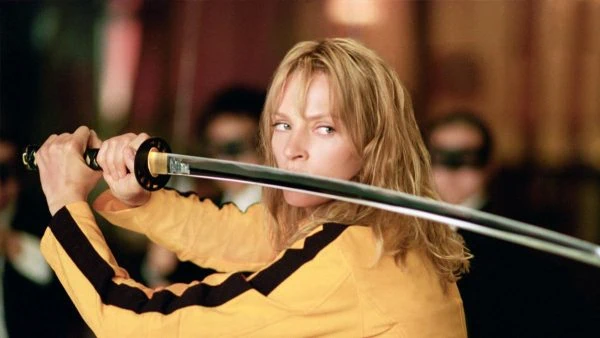
The story itself is simple in outline but monumental in execution. Uma Thurman stars as The Bride, an assassin left for dead on her wedding day, whose sole mission becomes annihilating the people who betrayed her. Among her targets are her former mentor and lover Bill (David Carradine) and his deadly squad of assassins: Vivica A. Fox, Lucy Liu, Michael Madsen, and Daryl Hannah. Seen in two parts or now as the single, unbroken film this isn’t just a revenge story; it’s a kaleidoscope of martial arts, spaghetti Western showdowns, anime flourishes, and grindhouse excess. Tarantino himself has long insisted that Volumes One and Two were always meant to be a single cinematic experience, and The Whole Bloody Affair proves him right in the most satisfying way possible.
What’s immediately striking about this definitive cut is how it reshapes your emotional engagement with the story. For instance, the early reveal in Volume One that The Bride’s daughter, B.B., is alive has been removed, allowing the shock and wonder of that moment to hit in real time with our heroine. It’s a subtle adjustment, but it transforms the narrative from a straightforward revenge tale into a meditation on love, loss, and the complicated ways people continue to care for those who’ve wronged them. Similarly, the extended ten-minute flashback to Lucy Liu’s O-Ren Ishii her trauma, her survival, and her eventual rise to power—gives her story a weight that elevates the entire saga. It’s as if a prequel has been stitched seamlessly into the present-tense grind of The Bride’s mission, and it works beautifully.
Tarantino’s obsession with pop culture is fully on display here, but it’s never merely decorative. The film is a love letter to kung fu epics, Yakuza thrillers, Sergio Leone’s spaghetti Westerns, and even the most lurid 1970s grindhouse films. At times, it feels almost like a graphic novel in motion, with numbered chapters, split screens, and stylistic flourishes that echo both the Old and New Testaments, Greek and Roman myths, and gothic poetry. And yet, despite its operatic ambition, the pacing in this restored cut feels deliberate and steady. The Bride’s journey once fragmented across two theatrical releases now unfolds with a relentless, almost mythic logic. Every fight, every quiet moment, every surge of emotion lands with full impact.
And then there’s Uma Thurman. If you thought her performance in the original Volumes was impressive, this version cements it as a career-defining, potentially iconic achievement. She is at once a Bruce Lee-Clint Eastwood-style force of nature, slashing through enemies with jaw-dropping physicality, and a deeply vulnerable, human presence. The scene in Bill’s bathroom, where her grief and exhaustion break through her steely exterior while her daughter sleeps nearby, is devastating. It’s a moment of pure cinematic power that lingers long after the credits roll. Thurman embodies every contradiction of her character with perfect precision ferocious, yet tender; mythic, yet achingly human.
The visuals deserve a standing ovation, too. From the radiant, almost hyper-real colors to moments of slate-somber black-and-white, from geysers of crimson blood to delicately choreographed fight sequences, every frame is alive. Tarantino’s audacious blend of genres and styles never feels gimmicky; it’s aggressively playful, operatically violent, and emotionally grounded all at once.
For all its gore and bravado, The Whole Bloody Affair is more than a revenge movie it’s a study in obsession, trauma, and resilience, wrapped in the most stylish, kinetic, and joyful filmmaking you’re likely to see. It’s not just a film for Tarantino fans, or martial arts aficionados, or devotees of pulp fiction; it’s a film for anyone who appreciates cinema as a fully immersive, sensory, and emotional experience.
In short: if you loved “Pulp Fiction” for its audacity, “Inglourious Basterds” for its operatic tension, or “Django Unchained” for its unflinching style, prepare to have your mind and your eyeballs blown. And if you’ve never been a Tarantino devotee, The Whole Bloody Affair might just convert you. For all its bloody chaos, extended sequences, and larger-than-life characters, it’s undeniably one of the most rewarding cinematic experiences of the 21st century. A masterpiece? Quite possibly.
Content Breakdown (for Parents)
Violence & Intensity: Extremely graphic and stylized violence. The film is built around vicious, often bloody confrontations, martial-arts violence, gunplay, and vengeance-driven brutality. Expect intense fight scenes, visible blood, and some scenes that could feel shocking or disturbing, especially for younger or sensitive viewers.
Language: Frequent strong language profanity and harsh expressions are part of the film’s tone. It’s unlikely to include hate-based slurs, but the overall tone is raw, uncompromising, and adult.
Sexual Content / Nudity: There is no focus on romantic or family-friendly affection; sexual themes revolve around betrayal, exploitation, and trauma. Nudity is minimal or implied rather than the focus, but the film’s emotional cruelty and context make some of the relationships and backstories deeply disturbing.
Drugs, Alcohol & Smoking: These are not central to the story’s core themes the film focuses on revenge, violence, and trauma. Substance use is not a major element of the narrative.
Parental Concerns / What Might Surprise or Worry Parents
- The sheer and graphic level of violence not cartoonish, but visceral, bloody, and prolonged.
- Themes of exploitation, trauma (especially in backstory flashbacks), and emotional suffering that are heavy and possibly disturbing.
- The film’s length (over 4 hours) and its emotional intensity may be overwhelming.
- It is not suited for children or younger teens; even many older teens might find the content difficult.
