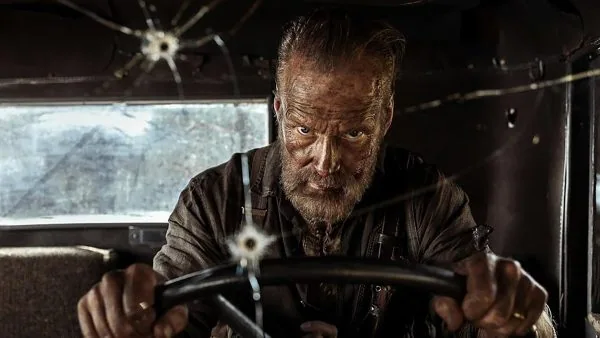
Sisu: Road to Revenge is Rated R by Motion Picture Rating (MPA) for strong bloody violence, gore and language.
“Sisu: Road to Revenge” is to “Sisu” what “Evil Dead 2: Dead by Dawn” is to “Evil Dead” a sequel that doesn’t just replicate the original but magnifies it, leaning fully into chaos, humor, and jaw-dropping action. Jalmari Helander has taken everything that worked in the first film and amped it up: bigger stunts, crazier set pieces, and a willingness to flirt with silent-film style physical comedy that makes the violence feel almost balletic. It’s a thrill ride from start to finish, and Jorma Tommila returns as Aatami Korpi, the stoic, near-mythical hero whose silent determination drives the story forward. This isn’t just a revenge story it’s a showcase of Helander’s growing mastery over action choreography and inventive storytelling.
The movie opens in the aftermath of World War II. Korpi has returned to a home that has been stripped of joy his wife and child are gone. In a sequence that’s simultaneously symbolic and absurdly entertaining, he dismantles his house piece by piece, loading massive planks of wood onto a vehicle that will become the centerpiece of the film’s relentless chase. This is the kind of visual storytelling that signals to the audience: anything can happen, and you’re about to witness it. Even imagining what comes next would undersell Helander’s inventiveness.
The legend of Sisu has grown, and word of this near-invincible Finnish warrior reaches Russian command. A cruel general, played with relish by Richard Brake, decides only one man can match Korpi: Igor Draganov (Stephen Lang), the ruthless officer who killed Korpi’s family. Tasked with hunting him down, Draganov becomes the centerpiece of the movie’s mounting tension. From here, the story becomes a chapter-based series of escalating action set pieces a chase film in miniature. Korpi must get his lumber-laden vehicle to safety while Draganov and successive waves of soldiers attempt to stop him. Each chapter like “Motor Mayhem,” where masked motorcyclists swarm Korpi, or “Incoming,” a planes-versus-car set piece rises in scope and spectacle, creating an unbroken chain of adrenaline.
Helander and cinematographer Mika Orasmaa inject the film with kinetic energy that owes as much to silent-era slapstick as it does to modern action cinema. There’s a standout sequence where Korpi must sneak past a room full of sleeping soldiers, executed with the timing and precision of a Buster Keaton gag, but with lethal consequences. Every kill and stunt feels carefully designed; the film never feels like a cheap action flick, but rather a meticulously crafted homage to chaotic spectacle. The escalation from foot soldiers to motorcycles to planes, trains, and tanks is relentless, yet the film never becomes repetitive the absurdity only becomes more exhilarating. Korpi using his cargo to down a plane is physically impossible, yes, but the film never asks you to pause and question it, and that’s precisely why it works.
Lang and Brake elevate the story with strong performances. Brake is delightfully villainous, but Lang dominates when he’s on screen, particularly in a chilling monologue recalling his murder of Korpi’s child. His calm, almost nostalgic reflection makes him terrifyingly human while reinforcing the stakes for the final showdown. The audience knows this villain will meet his comeuppance, but the journey there is pure tension and inventive action.
At its core, “Road to Revenge” thrives because it understands its hero. Korpi is practically immortal, and Helander saves his most brutal triumph for the villain. The story becomes less about “who will win?” and more about the obstacles that Korpi must overcome to reach his goal. Every hurdle soldiers, vehicles, entire battalions feels like an existential test, transforming Korpi from a man into legend. Tommila’s performance, scarred and battered, emphasizes the physical toll and mythic nature of his journey. Each challenge is a trial that builds the legend of a man capable of achieving the impossible.
“Sisu: Road to Revenge” doesn’t just meet expectations it obliterates them. From the opening shot to the final showdown, it’s a nonstop, audacious spectacle that mixes humor, heartbreak, and breathtaking action. The film expands on the first “Sisu” in exactly the way an action sequel should: bigger, bolder, and smarter. While one can only hope to see Korpi return for a third installment, this one is a high bar that may prove almost impossible to top.
Detailed Content Breakdown for Parents
Violence & Intensity:
This is a very violent movie. There’s a high body count, brutal fight scenes, lots of blood, and creative but gruesome kills. The action is relentless from hand-to-hand combat to chase sequences and it’s staged very physically, with practical stunts that feel visceral and real.
Language: There’s some profanity. The MPAA rating notes “language” along with the gore. It’s not primarily a dialogue-driven character drama, but strong language does appear, fitting the tense, revenge-driven tone.
Sexual Content / Nudity: There’s no prominent mention of sexual or romantic subplots in the reviews or synopsis. The focus is squarely on action and revenge, not on relationships.
Drugs, Alcohol & Smoking: There’s no strong evidence these are central themes. Most commentary centers on war, violence, and survival, rather than on substance use.
This review was filed from the world premiere at Fantastic Fest on September 21. “Sisu: Road to Revenge” opens November 21, 2025.
