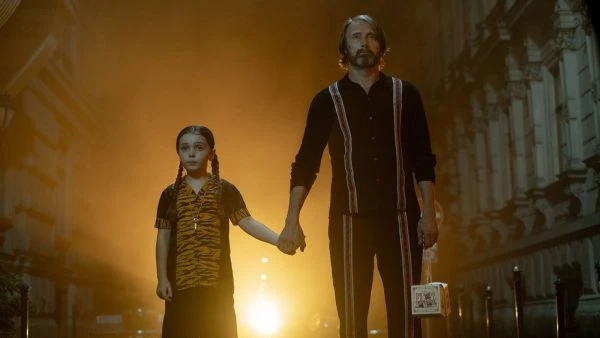
Dust Bunny is Rated R by Motion Picture Rating (MPA) for some violence.
Ever wonder what would happen if your childhood fear of the monster under your bed wasn’t just in your head… and you had to hire a hitman to deal with it?
Yeah that’s the kind of wonderfully twisted fairy tale Bryan Fuller brings to life in Dust Bunny, and honestly, it’s as charming as it is deeply, delightfully messed up.
If you know Fuller’s work, you already know he has a thing for mixing the sweet with the sinister. This is the guy who gave us Dead Like Me (dark, hilarious, and secretly emotional), then the candy-colored heartbreak of Pushing Daisies, and later the artsy nightmare banquet that was Hannibal. So naturally, when he shows up with a new “fairy tale,” you can expect magic just not the Disney kind.
Aurora lives in an apartment building that looks like it was decorated by someone with a pattern addiction and absolutely no sense of restraint. Every wall, chair, curtain, bedsheet all of it swirls with flowers, stripes, curlicues and overgrown motifs that feel less whimsical and more like they’re trying to swallow her whole. Her bedroom, a migraine palette of swampy greens and sickly pinks, is a place any kid would fear at night even without a monster lurking beneath the floorboards.
Her parents tired, distracted, hanging on by threads hardly notice how their daughter flinches at creaks and shadows. They dismiss her fears with cliché comfort. “There’s no such thing as monsters, sweetheart.”
But Aurora knows better. She’s heard the growls. Seen the dust shift. She’s watched the boards bow ever so slightly, like something massive is breathing below.
Then comes the night everything changes.
THE MONSTER INTRODUCES ITSELF
It doesn’t drag its victims away quietly. The floorboards crack open like jaws, splinters snapping like bones. A shape hulking, furry, impossibly wide lunges from under the bed and swallows both parents before Aurora can scream. All she sees are teeth made of broken debris and fluff, and a body like a hoarder’s nightmare given life.
She’s frozen in place, shaking. The monster retreats, dragging her parents’ shoes across the floor. When the room is silent again, she packs whatever small belongings she can find and leaves, numb and trembling.
So begins her mission.
THE HITMAN DOWN THE HALL
Every building has That One Tenant nobody talks to the man who pays rent on time but never speaks, never smiles, and never seems to age. In Aurora’s world, that’s the neighbor at the end of the hall, a man who moves like he’s rehearsed every step and sees everything without looking. Mads Mikkelsen plays him with the stoicism of someone who’s spent years burying both emotions and bodies.
Aurora stalks him for days before asking for help.
We watch her follow him through the city a grimy, fantastically stylized maze of deep red shadows, teal alleyways, and mustard-yellow street lamps that flicker as if unsure whether they should stay alive. She hides behind dumpsters, stacks of newspapers, plaid-kilt-suited gang members… always watching this man who seems invincible to a world falling apart around him.
Then comes the offer.
She sits across from him in his apartment which, in contrast to the rest of the building’s visual chaos, is eerily tidy. A chicken-shaped lamp separates them like a referee.
She places her money on the table (earned in a way too good to spoil), clears her throat, and says:
“I want to hire you to kill the monster under my bed.”
The hitman doesn’t laugh. He simply denies.
“Monsters aren’t real,” he says, with the same tone you’d use to say, “This meeting is over.”
But Aurora doesn’t move.
She stares him down until it becomes… uncomfortable.
THE HANDLER, THE HIT, AND THE UNWELCOME TRUTH
The hitman brings the matter to his handler (Sigourney Weaver, velvety and venomous). She’s the type of woman who could order a murder and critique your posture in the same breath. She listens, bemused, and concludes the obvious: Aurora’s parents weren’t eaten they were murdered. Probably by another assassin.
But the uncertainty gnaws at the hitman in a way he doesn’t like. A child so sure she saw a monster… doesn’t that mean something?
When assassins begin popping up dead chomped, crushed, torn Aurora’s story becomes harder to dismiss.
Especially when the crime scenes include piles of dust and floorboards split open like rib cages.
THE PARTNERSHIP THAT SHOULDN’T WORK BUT DOES
Slowly, begrudgingly, the hitman agrees to investigate. Not because he believes in monsters, but because something dangerous is clearly hunting in Aurora’s orbit.
Their dynamic is the heart of the film two serious, intense people treating each other like equals despite the absurdity of the situation.
No jokes.
No softening.
Just two predators circling a problem.
Aurora shows him the room where her parents were killed. The boards still groan under unseen weight. Dust swirls unnaturally. The air feels wrong.
He still doesn’t believe not fully but he’s rattled.
FIRST CONTACT
The first time they see the monster together is a masterclass in suspense.
Aurora sits on the bed, legs dangling. The hitman stands at the door, gun drawn, brow furrowed. The only sound is the faint scraping beneath the floor.
Then crack.
A long, splintering line tears across the wood. Another. Another. Dust puffs like breath. The monster rises a massive creature made of fluff, teeth, drywall scraps, hair, fabric, and nightmares. It moves like a shark through water, but the “water” is the floor.
The hitman fires.
It vanishes back into the darkness beneath the boards.
For the first time, he whispers:
“…Okay. Monsters.”
THE CITY SWALLOWS ITS OWN
Once the hitman believes, the story becomes a twisted buddy-horror adventure.
They hunt the monster; the monster hunts the assassins hunting them. Bodies pile up in morbid punchlines stylish killers gobbled mid-monologue, swallowed whole as if the monster is developing a taste for irony.
A social worker tries to intervene (Sheila Atim, dryly hilarious), suspecting the hitman is a terrible influence on Aurora. She’s half right but she has no idea what’s slithering beneath the floors. Her scenes feel lifted straight from Pushing Daisies, all precision and patterned suits and obliviousness.
Meanwhile, Aurora grows fiercer. The hitman grows softer but only by a millimeter.
ENTER THE FINAL ACT: UNDER THE FLOORBOARDS
To save Aurora and themselves they descend into the creature’s lair: a subterranean labyrinth made of dust, lint, debris, and personal items stolen from its victims.
It feels like a memory graveyard.
Aurora’s parents’ belongings are there. Their voices echo faintly in the dust, as if the monster absorbs more than bodies it absorbs stories. Lives. Fear.
The monster reveals its full form bigger, stranger, almost pitiful. It’s a creature born from neglect, fear, and the rot that fills Aurora’s world. A fairy-tale metaphor with a mouth full of splinters.
The final showdown is part battle, part emotional reckoning. Fuller leans into surrealism: shadow puppets flicker across the walls; dust swirls like enchanted snow; memories replay as if projected from the debris.
Aurora is the one who ends it.
Not with violence but with the kind of courage fairy tales are supposed to teach.
The monster crumbles, collapsing into a soft, harmless heap of dust.
THE AFTERMATH
The lair collapses behind them.
The city exhales as if relieved.
Aurora is placed in the care of someone who (surprisingly) isn’t trying to kill her. The hitman walks away, but not with the typical cool detachment there’s something changed in him, as though Aurora’s stubborn belief has cracked a floorboard somewhere inside his chest.
She watches him go, head held high.
The world is still strange, still patterned, still rotting but she’s not afraid anymore.
**FAIRY TALE ENDING?
NOT EXACTLY.
BUT A FULLER ENDING? DEFINITELY.**
The movie closes with Aurora returning to her room. The floor is repaired. The boards don’t creak.
She kneels down anyway, whispers:
“I’m not scared of you anymore.”
Silence.
Then the faintest rumble beneath the wood.
Just enough to make you question what you believed.
Content Breakdown for Parents
Violence & Intensity — High
Scenes of characters being eaten by a monstrous dust creature, sometimes offscreen but often implied with sound and environmental destruction.
Later in the movie, deaths become more graphic. We see bodies swallowed, limbs snapping, and blood shown in stylistic bursts.
A hitman takes down multiple attackers in stylized fights involving knives, guns, and shadowy silhouettes.
The tone fluctuates between darkly comedic and genuinely unsettling, but younger or sensitive viewers may find the violence intense.
Language — Moderate
The film uses adult language, including a handful of f-words and other common profanities.
No hateful slurs are used, but the tone can be sharp, blunt, and occasionally menacing.
Sexual Content / Nudity — Minimal
No sexual scenes or nudity.
A few characters wear stylish, form-fitting outfits, but nothing sexualized.
The dynamic between Aurora and the hitman is strictly mentor/protector — no romantic or inappropriate undertones.
Drugs, Alcohol & Smoking — Low
A few background characters smoke or drink casually.
Nothing glamorized or central to the story.
Scary or Disturbing Scenes — Very High
This may be the biggest concern for parents.
The monster itself is a creepy creation: all dust, clumps of hair, jagged teeth, and lumbering shape.
Scenes of it rising beneath floorboards or looming in the shadows are designed to unsettle adults, let alone younger viewers.
Themes of a child witnessing the aftermath of her parents’ death may be emotionally heavy.
The world itself with its twisted patterns and whimsical rot can feel claustrophobic or eerie.
