The traits we tend to file under the label “Nordic noir” were never owned outright by Scandinavia, but there’s a reason the region has come to feel like the genre’s spiritual home. Over time, Swedish, Danish, and Norwegian crime dramas have refined these elements with such precision that they now serve as the unspoken gold standard. You can see their DNA all over American prestige television in shows like True Detective and Mare of Easttown where damaged investigators carry personal wounds that mirror the crimes they’re trying to solve, where murder isn’t just an act but a corrosive force, where conspiracies fester quietly, and where bleak landscapes seem to reflect the moral frost of the people inhabiting them. These stories almost always unfold in small, insular towns, places where everyone knows one another and yet no one is truly safe, where choices narrow until there’s no clean way out.
It would be easy to assume that this influence has diluted Scandinavian originals, that the genre’s soul has been exported and polished beyond recognition. But the opposite has happened. Streaming platforms have amplified these stories, giving them a global audience that’s clearly hungry for their uncompromising tone. Netflix saw this firsthand with the Swedish hit The Åre Murders, which broke out early last year. Now, as 2026 begins, the streamer doubles down with Land of Sin, a title that feels less like a provocation than a quiet warning. Created and directed by Peter Grönlund, whose Beartown already demonstrated his empathy for fractured communities, this five-episode series is set in southern Sweden and embraces the genre’s familiar trappings while resisting its simpler moral math. There are no monsters here, no clean heroes either. What you’re left with are people on opposite sides of the law who are equally compromised, equally desperate, and bound together by a community that’s been overlooked long enough to start eating itself.
The story begins with a body. A teenage boy named Silas, played with aching vulnerability by Alexander Persson, is found dead along the windswept coast of the Bjäre peninsula. The official cause is drowning, but the bruises and marks on his body tell a more disturbing story — one that suggests violence, perhaps murder. His father, Ivar (Mats Mårtensson), is ailing and furious, the head of a farming family known locally more for its drinking and volatility than its stability. He demands that police officer Dani Anttila take the case. In his mind, she owes them. He’s not wrong. Dani’s life, and that of her teenage son Oliver (Ceasar Matijasevic), is tangled up with Silas in ways that are both personal and painful.
Dani is a familiar figure in Nordic noir, though that doesn’t make her any less compelling. She’s a single mother who seems permanently exhausted by the act of existing, brusque to the point of alienation, carrying herself like someone who has learned that softness invites damage. She feels responsible not only for Silas’ death, but for the widening gulf between herself and Oliver, a boy already slipping into the brutal grip of substance addiction. By any ethical or legal measure, Dani should not be anywhere near this investigation. And for a moment, her guilt nearly stops her. Then something harder takes over. Protocol becomes irrelevant once she decides that finding the truth matters more than protecting herself.
She isn’t the only one running out of patience. Silas’ uncle Elis (Peter Gantman) gives Dani and her new partner Malik a deadline: one week. Malik, played by Mohammed Nour Oklah, may be a rookie in Dani’s eyes, but he’s far from incompetent, and he proves perceptive enough to recognize the emotional armor Dani keeps pretending is professionalism. If the police fail, Elis warns, the town will step in. From there, the series fans outward, revealing a dense network of suspicions, buried traumas, and long-standing grudges. The deeper Dani digs, the clearer it becomes that the truth may not be lurking somewhere far away. It may be sitting right at her own kitchen table.
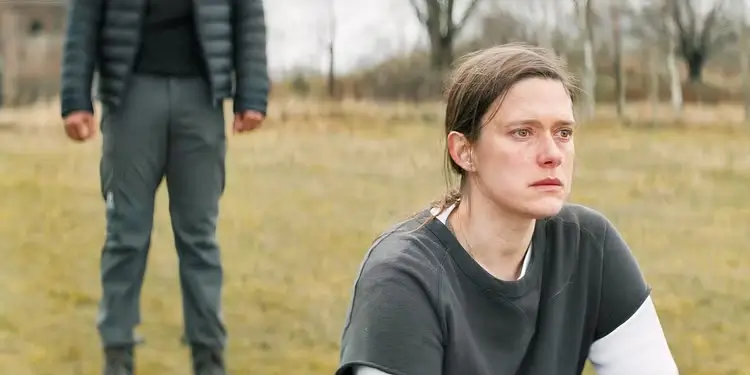
A psychological noir led by a woman lives or dies on its central performance, and Krista Kosonen more than carries the weight. Visually, Dani immediately calls to mind Sarah Lund from Forbrydelsen and her American counterpart in The Killing. The resemblance feels intentional: hair pulled back without vanity, practical, androgynous clothing, no makeup to soften the lines carved into her face by years of regret. Whether homage or coincidence, it works as an efficient shorthand. You understand who Dani is the moment you see her. She belongs to that long line of damaged women detectives, but Kosonen makes the archetype feel freshly wounded.
Grönlund’s camera knows exactly when to hang back and when to move in close. Wide shots isolate Dani against the landscape, while tight close-ups linger on her face, letting Kosonen’s restrained anguish do the heavy lifting. Dani almost never smiles. When she does, it’s a thin, dismissive half-smirk, usually reserved for men who think intimidation a hunting rifle, an invasion of personal space will make her back down. More often, she looks like someone screaming internally, every muscle engaged in the futile effort to keep that sound from escaping. Grief, loneliness, and fury ripple through her smallest gestures. You don’t just watch her suffering; you feel it press against you.
Despite its relatively brief runtime, Land of Sin manages to sketch its supporting characters with surprising economy. We learn just enough about their histories to understand what shaped them and what now traps them. Growing up in the rural American Midwest, I recognized these people instantly not just in their tired eyes, but in their cramped, overstuffed homes, buildings that bear their scars openly and stand mostly because no one has had the means or the heart to tear them down. This isn’t a sneer or a moral judgment. It’s a mark of Grönlund’s compassion. As he’s said, his aim is to portray people living at the edge and the psychology that keeps them there. Malik, unfortunately, receives less focused development than he deserves, a missed opportunity given that he’s the series’ primary character of color. The imbalance doesn’t derail the show, but it lingers as a quiet disappointment.
What Land of Sin does exceptionally well is refuse the lazy stereotypes so often applied to working-class communities. Instead, it insists on a harder truth: almost everyone is capable of harm, and almost everyone is capable of care. Characters with ugly moral compromises and fractured families still show moments of tenderness, loyalty, even grace. They are all overwhelmed, uncertain, and riddled with regret, craving forgiveness while dodging responsibility. When life offers them a rope, even one made of self-destruction, they grab it. Sometimes survival means making unforgivable choices, and sometimes it means sacrificing those who are most vulnerable. Some children inherit land or trauma. Others inherit nothing at all not even protection.
For viewers concerned about content, Land of Sin earns its reputation for heaviness. The violence is rarely explicit, but its emotional weight is crushing. Much of the tension comes from conversations about death, abuse, and the reverberations of violence rather than graphic images. When brutality does surface, it’s treated with gravity, never spectacle. Still, the accumulation of grief, menace, and unresolved anger can feel suffocating, especially as the episodes stack without much release. The language mirrors this bleakness. Characters speak in anger and despair, using profanity as a blunt instrument rather than a punchline. Sexual content is minimal and never gratuitous, though references to intimacy are often tied to trauma and strained family histories. Alcohol flows freely, less a vice than a symptom, while drug trafficking seeps into the narrative as one more sign of a town quietly rotting from the inside out.
This is not a series for casual viewing. It’s best suited for adults and older teens already accustomed to the emotional rigor of shows like Broadchurch or Mare of Easttown. Land of Sin doesn’t offer comfort or easy answers. What it offers instead is something colder and perhaps more honest: a reminder that in certain places, under certain pressures, sin isn’t an aberration. It’s a condition of survival.
