Content Breakdown for Parents
The Dutchman is rated R by the Motion Picture Association for sexual content, strong language, and brief violence.
Violence & Intensity:
There’s very little physical violence in a traditional sense, but the movie carries a persistent psychological menace. Much of the tension comes from unsettling dialogue, emotional manipulation, and confrontational racial power dynamics. Characters make disturbing accusations and veiled threats, creating a constant sense of unease. A brief moment of violence occurs late in the film, but it’s neither graphic nor extended; its impact is more emotional than visual.
Language:
Strong language is used frequently, including repeated use of the F-word. The dialogue often carries racial hostility and provocation, intentionally designed to unsettle. While explicit slurs are not tossed around casually, the verbal aggression and racially charged exchanges may be deeply uncomfortable for some viewers.
Sexual Content / Nudity:
The film includes sexual dialogue, flirtation, and implied sexual situations. Some interactions involve manipulation and coercion, which may be more troubling than any explicit imagery. There is little to no nudity, but sexual tension is a constant undercurrent throughout the story.
Drugs, Alcohol & Smoking:
Characters are shown drinking alcohol socially, particularly at gatherings. No drug use is depicted.
Recommended Age Range:
Ages 17 and up. Even for older teens, this film is best suited for viewers with emotional maturity and media literacy. Parents may want to consider watching alongside teens or being prepared for discussion afterward, as the themes are challenging and intentionally provocative.
The Dutchman (2025) Review for Parents
I’ll give André Gaines’ The Dutchman credit for one thing right away: it arrives with a kind of audacity you don’t often see in January releases. The first big movie of the year is usually a horror film, but it’s rarely a supernatural remix of a famously confrontational 1960s stage play about race, identity, and psychological violence. That honor, improbably, belongs to The Dutchman. And no, unless the haunted swimming pool movie Night Swim was secretly a dissertation on American consciousness, this one stands alone.
Amiri Baraka’s original Dutchman is lean, cruel, and unforgettable, a single subway ride that becomes a pressure cooker for racial tension. Clay, a Black man trying to mind his own business, is singled out by Lula, a white woman whose flirtation is inseparable from provocation. She dissects him using stereotypes so precise they hurt, and when Clay finally explodes, the play ends not with catharsis but with horror. It’s a work that doesn’t let you off the hook, and never pretends to.
Gaines’ film doesn’t so much adapt that play as assume you already know it. In fact, it practically dares you not to. Early on, the 1966 film version starring Shirley Knight plays on a television, its shocking climax plainly visible. This isn’t an introduction; it’s a citation. Gaines is doing something closer to what Wes Craven’s New Nightmare did for Elm Street, treating the original text as a cultural object that has escaped its frame and begun interfering with reality.
If you find yourself confused, Gaines would probably take that as a compliment. The movie only works if you come in armed with context, and even then, it’s a bumpy ride.
This time around, Clay (played with intelligence and restraint by André Holland) is a man in emotional gridlock. His wife, Kaya (Zazie Beetz), has cheated, they’re in therapy, and Clay treats introspection like a personal insult. Their therapist, Dr. Amiri, yes, Dr. Amiri played by the always-commanding Stephen McKinley Henderson, suggests a book Clay might find “helpful.” It is, of course, Dutchman. Subtlety exits the building early.
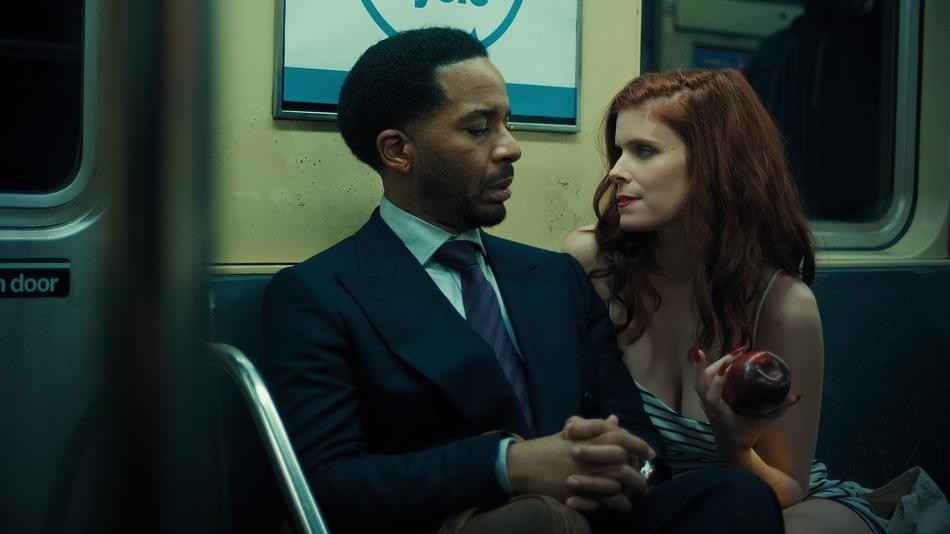
Soon, Clay is on the subway, reenacting the play almost beat for beat with a new Lula (Kate Mara). She’s playful, alluring, and casually cruel in that way that feels charming until it doesn’t. The difference is that this Lula refuses to stay put. She follows Clay off the train, into his social circle, into a party the original play only mentions, and eventually into the fragile architecture of his life. What was once an allegory starts behaving like a stalking presence.
Here’s where Gaines makes his boldest and most questionable move. He imagines the Dutchman as a literal cycle, replaying itself across decades. Lula becomes less a person than a manifestation, something like a cultural Freddy Krueger who exclusively haunts Black men struggling with their sense of self. Clay’s task, emphasized by production design that may as well carry a highlighter, is to “break the cycle.”
It’s an interesting idea, and also a very loud one. Baraka’s play was already confrontational, already symbolic, already dreamlike. Adding another layer of metaphysics doesn’t deepen it. stacks abstraction on top of abstraction until the meaning starts to wobble. At times, the film feels like a very earnest graduate thesis brought to life: smart, ambitious, and convinced it has cracked something essential, even as it struggles to dramatize that insight.
The performances keep it from collapsing entirely. Holland continues to be one of the most reliable actors working today, giving Clay an interior life that the script sometimes forgets to supply. Mara is an unexpected Lula, less immediately alarming than her predecessors, which initially makes Clay’s attraction believable. Over time, though, she’s asked to play an idea more than a human being, and no amount of commitment can fully disguise that artificiality.
What lingers after The Dutchman ends isn’t quite admiration, and not quite disappointment. It’s the sense of watching a filmmaker wrestle with a towering piece of art and refuse to back down. Gaines has more hope for his characters and for the world than Baraka ever did, and that’s not nothing. But the original play pushes back, stubborn and unyielding, and in that struggle, the film becomes cluttered rather than clarifying.
The Dutchman is messy, blunt, and frequently frustrating. It’s also sincere, ambitious, and unafraid to swing. Whether that’s enough will depend on how much patience you have for films that argue with their source material instead of listening to it.
