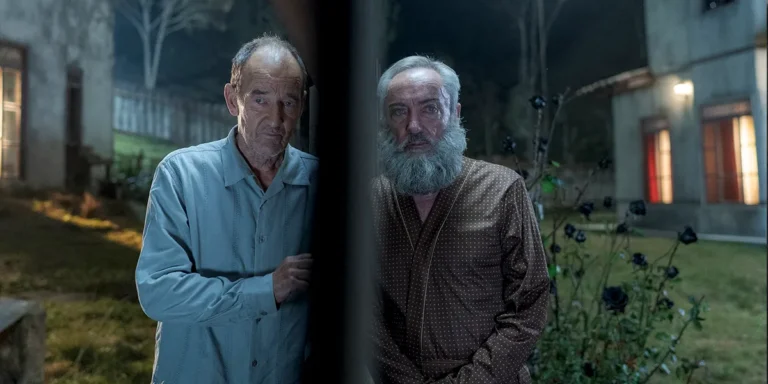
It’s hard not to feel a flicker of uneasy fascination when a stranger moves in next door, especially if you live miles from anyone else, and especially if a small, insistent voice in your head begins whispering that this man might once have ruled the Third Reich. My Neighbor Adolf opens on that unnerving premise and places us alongside Marek Polsky, an elderly Holocaust survivor played by David Hayman with a brittle, guarded weariness. Marek lives alone in the Colombian countryside, far from the world that shattered him. His days are quiet, almost ritualistic, spent tending a modest garden of black roses, flowers chosen not for beauty, but for remembrance, a living memorial to the wife he lost in the camps.
Next door sits a house that seems as worn down as its eventual occupant. A sign outside lists a phone number for prospective buyers, though it has been deliberately scratched and smeared until it’s barely legible. The message doesn’t require translation: Marek wants solitude. He wants distance. He has had enough of neighbors, of people, of history pressing too close.
That fragile isolation fractures when, under the cover of darkness, an elderly German man moves into the adjacent property. Udo Kier, in one of his final performances, gives the role an eerie composure the kind that makes you uneasy before you can explain why. Marek’s hostility sharpens when the man’s German shepherd breaks through the fence and tramples his roses. Then comes the moment that truly unsettles him: a glimpse of piercing blue eyes, usually hidden behind dark sunglasses. Suddenly, Marek can’t shake the thought that he knows this face. That he has seen it before. It’s 1960. Adolf Eichmann has just been dragged out of hiding in Argentina. And no one ever quite figured out what became of Hitler’s body, did they?
The film steps onto precarious ground here, not unlike the controversy that followed Jojo Rabbit for daring to lace Holocaust imagery with humor. My Neighbor Adolf risks similar backlash. Marek’s trauma is immense it’s etched into the tattooed number on his arm, and into the framed photograph of his murdered family that watches him from a shelf yet the film often treats his anguish with a strangely cartoonish lightness. A jaunty score and crude gags sit uncomfortably alongside that history. Before long, the escalating feud devolves into bathroom humor: urinating on cars, feces shoved through letterboxes. You can feel the tonal dissonance widening with every gag.
The central idea what if Hitler survived and moved in next door? could have sustained a tightly coiled psychological thriller. At moments, the film seems to recognize this. Marek becomes a voyeur, channeling Rear Window as he sets up a camera to monitor the mysterious visitors slipping in and out of his neighbor’s home. He catalogs the evidence obsessively: the man paints, he despises smoking, he erupts in sudden fits of anger. Yet what might have played as chilling paranoia instead comes off as something closer to a school assignment. The tension keeps deflating, punctured by jokes and an overall sunniness that never quite reckons with the gravity of what’s being suggested. There’s simply too much lightness here too much silliness to confront the weight of history it invokes.
The film’s most compelling turn arrives when hostility gives way, almost inevitably, to familiarity. The two men bond over chess, a quiet ritual that lowers their defenses. Marek softens. His neighbor introduces himself as Hermann Herzog, and while Marek’s suspicions never fully dissipate, they begin to coexist with something resembling affection. He even sits for one of Herzog’s paintings a portrait rendered with surprising tenderness, and in a style that feels uncomfortably familiar, echoing Hitler’s own artistic past. Herzog drinks heavily during their time together, offering a curious explanation for why he abstained for decades: his work wouldn’t allow it. The detail lingers.
These scenes unassuming, gentle, human are the film’s most affecting. Watching them share meals, reminisce about women, and talk into the quiet afternoons, you see two aging men easing into companionship. They are simply people nearing the end of their lives, letting their guards fall. And at least one of them, you can’t help but think, has already endured far more than anyone ever should.
Still, My Neighbor Adolf often feels like a film that sidesteps its own subject. The Holocaust, with all its moral and emotional enormity, recedes into the background, replaced by a modest, almost domestic story about a feud between two retirees. It isn’t sharp enough to be truly subversive, nor is it grave enough to fully honor Marek’s suffering. He becomes more of a quirky, meddling neighbor than a man shaped by unspeakable loss.
In the end, the film is easiest to appreciate when it abandons its paranoia and leans into moments of tenderness and reconciliation. Those scenes linger; the rest feels strangely muted. My Neighbor Adolf is worth cherishing for its gentle depiction of late-life connection and approached more cautiously for its uneasy, often underdeveloped engagement with postwar dread.
My Neighbor Adolf opens in select U.S. theaters on January 9, 2026. The film is currently available on digital and on-demand platforms in the UK, Ireland, and other international territories.
My Neighbor Adolf – Parents’ Guide
My Neighbor Adolf is not rated by the Motion Picture Association (MPA).
Violence & Intensity: Although My Neighbor Adolf does not feature conventional or graphic violence, the film carries an undercurrent of historical and emotional weight that shouldn’t be underestimated. The protagonist, Marek, is a Holocaust survivor, and references to Nazi atrocities are woven quietly but persistently into the story. His concentration camp tattoo is visible, and photographs of his murdered family appear throughout the film, serving as silent reminders of immense trauma.
Language: The film contains occasional profanity, generally mild and infrequent. There are no repeated or aggressive uses of strong language, and slurs are not a defining feature of the dialogue.
That said, the tone of the language is more complex than the words themselves. Holocaust references, Nazi history, and accusatory dialogue surrounding identity and guilt carry emotional sharpness. Even when humor is present, it often brushes up against painful historical realities. Younger viewers may struggle to understand the context or irony behind certain exchanges, and adults may find the levity troubling rather than funny.
Sexual Content / Nudity: There is no explicit sexual content or nudity in My Neighbor Adolf. Conversations occasionally touch on past romantic relationships and women, but these moments are reflective rather than graphic. The film treats intimacy as memory and companionship rather than physicality, focusing on aging, loneliness, and emotional connection.
Drugs, Alcohol & Smoking: Alcohol plays a noticeable role in the film. Hermann Herzog is frequently shown drinking heavily during his interactions with Marek, and his alcohol use becomes a recurring behavioral detail. Drinking is not glamorized, but it is normalized within their companionship, often functioning as a social lubricant rather than a problem to be examined.
Recommended for ages 14–15 and up, depending on the viewer’s sensitivity and familiarity with World War II history. Teen viewers may benefit from watching the film alongside an adult, as it raises questions about trauma, memory, justice, and reconciliation without always offering clear answers.
