From the moment The First season of the Pitt arrived, its success felt almost inevitable. A cast anchored by Noah Wyle’s quietly commanding presence, a first season structured around relentless real-time urgency, and a devastating mass shooting that reshaped both narrative and character it all coalesced into something that felt urgent, modern, and unsettlingly alive. The series didn’t just top year-end lists for 2025; it earned something rarer. Doctors and nurses recognized themselves in it. Critics respected it. Audiences trusted it. That kind of credibility buys goodwill, but it also raises a question that Season 2 can’t avoid: how do you follow something that worked so precisely without repeating yourself into irrelevance?
Season 2 answers that question not by escalating spectacle, but by recalibrating its focus. Once again, the story unfolds across a single day, a structural choice that has become part of the show’s DNA, but this time the ticking clock is set to July 4th. Fireworks crackle somewhere outside the hospital walls, and yes, the ER fills with the predictable debris of celebration: intoxicated revelers, missing fingers, catastrophic accidents. And yet, what’s striking is how ordinary it all feels. You can sense the show leaning into the idea that for an emergency department, even a national holiday is just another shift to survive.
Dr. Robby remains at the center of it all, though now he’s standing on the edge of absence. This is his final day before a sabbatical, a few months of solitude and asphalt, riding his motorcycle across the country. His colleagues aren’t thrilled. Some see it as abandonment, others as indulgence, and the tension around his departure quietly hums beneath every interaction. Meanwhile, Langdon has returned from rehab, carrying the weight of apologies that don’t land as easily as he’d hoped. Forgiveness, the show suggests, isn’t a switch you flip; it’s something you earn, if you ever do.
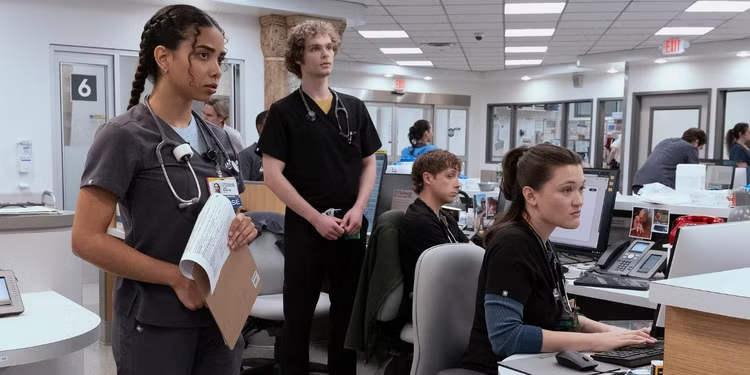
The hospital itself feels subtly altered by new blood. Medical students Joy and James arrive wide-eyed and uncertain, alongside Emma, a nurse still raw from training, and Dr. Baran Al-Hashimi, the attending physician slated to replace Robby during his leave. Almost immediately, sparks fly. Robby and Al-Hashimi don’t simply disagree; they operate from fundamentally different ideas of what medicine should be. Sepideh Moafi brings a sharp, restless energy to the role, and it’s hard not to feel how invigorating it is to watch Robby finally challenged by someone who meets him as a true equal. Their clashes aren’t petty; they’re philosophical. And as Al-Hashimi pushes back, the show invites you to do the same, to question whether Robby’s way is the way we’ve grown comfortable with, and is the only way forward.
Midway through the season, the hospital is hit with a crisis that feels mundane and quietly terrifying: the technology fails. The ER is flooded with patients just as digital systems collapse, forcing the staff into a fully analog existence. No tablets. No dictation software. No procedural cameras. Just paper charts, fax machines, memory, and muscle memory. It’s not subtle commentary; the show doesn’t pretend otherwise, but it lands with force in an era obsessed with automation and shortcuts. Watching these doctors stripped of their digital safety nets, you’re reminded that when everything goes dark, expertise isn’t stored in the cloud. It lives in people.
That idea of impermanence extends beyond the technology to the staff themselves. Samira Mohan is contemplating a major move, her hesitation tinged with fear and excitement, while Victoria Javadi wrestles with defining her specialty under the shadow of parental expectations. The Pitt resists the genre’s usual fantasy of permanence, where doctors introduced in a pilot linger for a decade. Here, people leave. Careers move on. And that uncertainty adds an ache to every interaction — a sense that this might be the last time you see someone in scrubs beside you.
If Season 1 tested viewers’ stomachs, Season 2 seems determined to push even further. The series has never flinched from the physical realities of medicine, from graphic injuries to the unvarnished process of childbirth, and the new episodes escalate that commitment with scenes that are genuinely hard to watch. There are moments involving exposed bowels, maggots, and aggressive infections that make it clear this is not a show to casually consume over dinner. Yet it never feels gratuitous. The grotesque is always tethered to character, to consequence, to meaning. The discomfort serves a purpose, even when it makes you squirm.
More importantly, the series continues to widen its lens on who ends up in the ER and why. The unhoused, the uninsured, incarcerated patients discarded by a system that doesn’t care if they survive, these aren’t side notes. They’re central to the show’s moral vision. One storyline involving a survivor of sexual assault stands out for its restraint and emotional clarity, allowing Katherine LaNasa space to deliver a performance that lingers long after the episode ends. In those quieter scenes, when the frantic pace slows, and the staff stays in the room, the show finds a different kind of power, one built on listening rather than urgency.
If you’re hoping for a bombastic return filled with outlandish disasters, Season 2 may initially feel restrained. There are no plane crashes, no cosmic twists, no melodramatic stunts designed to spike adrenaline. The early episodes move deliberately, even cautiously, as the show reestablishes its rhythms. Some of the emotional fallout from Season 1 remains, particularly for characters like Mel King and Whitaker, but the narrative largely starts fresh. That commitment to realism occasionally costs the season momentum; not every hour crackles with intensity, but it also preserves the show’s integrity.
By the time the season settles in, The Pitt remembers exactly what made it resonate in the first place. The patient-doctor connections deepen. The cases escalate. The unexpected arrives not with fanfare, but with necessity. If you’ve spent the hiatus imagining sweeping romances, you may feel let down. This isn’t that kind of medical drama. Any sparks between colleagues remain secondary, fleeting, and almost incidental. This is a workplace defined by triage, not longing. And that clarity of purpose, that refusal to drift into soap opera, remains the show’s quiet strength. As long as The Pitt keeps its focus where it belongs, on the fragile humanity beneath the medicine, it continues to earn its place among the genre’s most thoughtful offerings.
The Pitt Parents Guide
Official Rating: TV-MA
Violence & Intensity: The series depicts graphic medical procedures, severe injuries, and bodily trauma in explicit detail. Emergency situations are frequent and often intense, including scenes involving mass casualties, infections, and surgical interventions that may be disturbing for some viewers.
Language: Strong language is used throughout, consistent with a high-stress hospital environment. Profanity appears regularly but is not typically gratuitous.
Sexual Content / Nudity: Limited sexual content, though medically explicit scenes including childbirth and examinations are portrayed realistically rather than suggestively.
Drugs, Alcohol & Smoking: Depictions include substance abuse, intoxicated patients, and references to addiction and recovery, treated seriously and without glamorization.
Age Recommendation: Due to graphic imagery, mature themes, and emotional intensity, The Pitt is best suited for mature audiences and is not recommended for viewers under 17.
