Dead Man’s Wire is rated R by the Motion Picture Association (MPA) for language throughout
In 1977, Tony Kiritsis was running out of money and time. He’d fallen behind on mortgage payments for a property in Indianapolis that he dreamed of turning into an affordable shopping center for small, independent businesses. When he asked his mortgage broker for an extension, he was flatly refused. To Tony, this wasn’t just bureaucracy it felt like a setup. He became convinced that the broker and the broker’s father, who owned the firm, were deliberately letting the property slide into foreclosure so they could scoop it up cheaply. Furious and feeling betrayed, Tony went to the offices of Meridian Mortgage for what was supposed to be a routine meeting with his broker, Richard O. Hall, and instead took him hostage.
He arrived carrying a long cardboard box that concealed a shotgun rigged with a crude but horrifying mechanism: a “dead man’s wire” attached to Hall’s body. If anyone tried to rush Tony, if either of them was shot, tackled, or even stumbled the wrong way, the wire would yank the trigger and kill Hall instantly. It was desperate, messy, terrifying and it was only the opening move in a saga that would echo for decades.
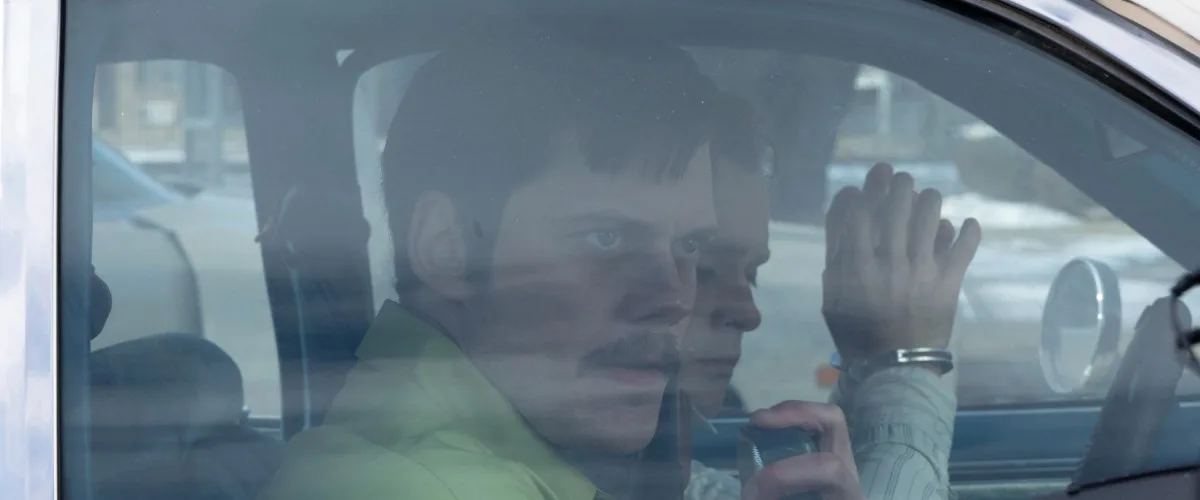
That real-life crisis has already spawned a memoir by Hall, a 2018 documentary, and a podcast dramatization featuring Jon Hamm as Kiritsis. Now it’s the foundation for what may be the best new film hardly anyone is talking about: Gus Van Sant’s “Dead Man’s Wire,” with Bill Skarsgård as Tony and Dacre Montgomery as Hall. Van Sant doesn’t just reference the great American crime dramas of the 1970s “Dog Day Afternoon,” “The Sugarland Express,” “Network,” “Badlands” he channels their spirit so thoroughly that the film feels like a lost cousin of that era, able to stand shoulder to shoulder with them rather than merely imitate their aesthetics.
From the opening pre-hostage montage, set to Deodato’s silky disco version of “Thus Spake Zarathustra” drifting out of a radio hosted by the philosophical DJ Fred Temple (played with rich warmth by Colman Domingo), the movie establishes its rhythm. It then stretches into a long, absorbing middle act that situates Tony within a dense social ecosystem a working-class community that comes to view him, fairly or not, as a kind of accidental spokesman in the ongoing conflict between labor and capital. By the time the film reaches its haunting conclusion and brief postscript, you’re left emotionally unsettled, unsure what verdict to pass on what you’ve seen, but intensely eager to talk about it. That’s not nostalgia as cosplay; it’s nostalgia as substance. Van Sant isn’t copying the surface texture of 1970s cinema. He’s reconnecting with what made those films hit so hard: their engagement with social anxieties that haunted audiences then and have only grown more suffocating since.
Tony himself is not the criminal mastermind or working-class martyr he imagines himself to be. In fact, the rickety shotgun box warped cardboard, loose tape, a strange bulge where it shouldn’t be feels like a physical extension of his psyche. He surrounds himself with counterculture books and radical ideas, yet lives in chaos. He complains loudly about his shorts riding up during a car ride. He drives with a vanity plate that reads “TOPLESS.” His rhetoric swings wildly between moments of sharp clarity and torrents of profane self-sabotage. On one hand, he nails the moral truth when he describes the mortgage company’s tactics as “a private equity trap” language that eerily anticipates the logic behind the 2008 financial collapse. On the other, he’s fueled by ego and fantasy, convinced that his dramatic act might produce “some goddamn catharsis” for the people and maybe even force the city’s financial elite to feel a flicker of genuine shame.
What he clearly enjoys, too, is the spotlight. As the standoff escalates, it relocates from the mortgage office to Tony’s dingy apartment building, now surrounded by police cruisers, SWAT units, and a swarm of journalists. Among them is Linda Page (Myha’La), a young Black TV reporter hungry for a break. Tony also inserts himself into the life of Fred Temple, the radio DJ he idolizes. Temple secretly records their first phone call, plays it for the police, and then under heavy pressure—agrees to continue the conversations and broadcast them on air. The real-life figure behind Temple was a news director whom Kiritsis trusted more than any reporter, and while changing him into a DJ sidesteps certain ethical questions about journalism, it opens up something else: a cultural space where music, commentary, community, and narrative blend together. The result feels closer to the communal voice of “Do the Right Thing” than to a conventional hostage thriller.
Even when Tony is given chances to de-escalate, he can’t get out of his own way. His insecurities constantly sabotage him. One moment he treats Hall like a cardboard cutout of elite corruption; the next, he recognizes Hall’s humanity and seems almost embarrassed by his own performance. When Hall’s father finally agrees to call in from a luxury vacation, no less Tony mocks the situation with childish cruelty: “Your daddy’s on the line wants to know when you’ll be home for supper!” Yet when he talks to Temple, he becomes needy, even clingy, repeatedly insisting, “I like you!” It lands less as warmth than as an unspoken demand. The film understands the racial tension in that dynamic, too: Temple, a Black man who has carefully built a stable life in 1970s Indiana, is in no real position to refuse cooperation when police pressure him to stay engaged.
The film isn’t interested in turning Tony into a coherent political actor any more than “Dog Day Afternoon” or “Network” were interested in making their protagonists consistent ideologues. Like Sonny Wirtzik or Howard Beale, Tony becomes a cracked mirror for the audience’s fury—an unstable vessel whose sudden media fame transforms him into a megaphone for widespread frustration. In “Dead Man’s Wire,” the institutions pushing back include police departments that are disturbingly eager for the situation to end with Tony’s death. Conversations between local law enforcement and the FBI (embodied by Neil Mulac’s chillingly robotic Agent Patrick Mullaney) revolve less around resolution than around logistics: how best to set up the kill.
A phone call from Hall’s father, who previously delegated apologies to underlings, recalls another infamous 1970s scandal: the kidnapping of John Paul Getty III, where the victim’s grandfather famously balked at paying ransom. Like Getty, Hall Sr. treats the crisis with chilly calculation. He insists he’s done nothing wrong, and regards even his own son as a disposable asset. The role is played by Al Pacino, which is both inspired casting and a sly historical rhyme: the star of “Dog Day Afternoon” now appears as the embodiment of the callous power structure Sonny once raged against. At 85, Pacino is still ferocious.
With a ridiculous gray toupee, a smug Midwestern drawl, and a grin that practically begs to be punched, Pacino crafts a portrait of a man who believes that success in one narrow arena qualifies him as a moral authority in all things. He preaches about toughness, sneers at vulnerability, and takes grotesque pride in the idea of “real men.” Watching footage of Tony crying during the standoff, he’s perversely pleased not because of the tragedy, but because Tony showed emotion while his own son did not. Kelly Lynch plays his trophy wife, visibly uneasy with her husband’s cruelty but too conditioned to challenge him.
Van Sant was in his mid-twenties when the real events unfolded, and that generational proximity seems to inform the film’s tactile authenticity. This world doesn’t feel constructed; it feels overheard. Dialogue overlaps. Background noise competes with speech. Locations look lived-in rather than dressed. Clothes hang awkwardly, like they’ve been worn for years instead of chosen by a stylist. The craft behind this illusion is meticulous Peggy Schnitzer’s costumes, Stefan Dechant’s production design, Arnaud Poiter’s cinematography, Leslie Schatz’s layered sound design—but the effect is one of effortless realism. Even the screenplay’s origin adds to the film’s credibility: it was written by Adam Kolodny, a first-time writer who drafted it while working as a custodian at the Los Angeles Zoo. That working-class perspective is baked into the DNA of the story.
What ultimately lingers isn’t just the period detail, though that’s exquisite (the phones alone deserve their own award), but the unsettling recognition of how little has actually changed. The film operates both as a time capsule and as a quiet indictment. It shows a pre-digital era when a local crisis remained a local crisis, handled by people who had to live with one another afterward, rather than being instantly converted into global spectacle and algorithmic fodder. Van Sant’s camera treats every person on screen as worthy of attention: the silent workers watching news coverage in break rooms, the minor radio employees hustling in smoky back offices, the people orbiting the main drama without ever appearing on the evening news.
Tony’s obsessive attachment to Fred Temple even anticipates what we now call parasocial relationships intense, one-sided bonds formed with media figures. The film handles this with nuance, threading in an acute awareness of race. Domingo’s performance captures the exhausting balancing act Black public figures often perform: projecting empathy and accessibility while carefully avoiding the kind of emotional license that can invite danger. Elsewhere, the film calmly observes how easily violent personalities can align themselves with police authority, especially when social familiarity shared bars, shared neighborhoods blurs professional boundaries. Tony’s early friendship with Detective Will Grable (Cary Elwes), who is later tasked with killing him, is presented with chilling normalcy.
Crucially, the film provides an economic and political context for its characters’ choices, something too many movies ignore. It doesn’t hammer home its points; it trusts the audience to notice. Van Sant and his collaborators watch these people with a blend of irony, empathy, and awe, recognizing the absurdity and tragedy of their circumstances without stripping them of dignity.
The connective tissue of the film comes together in music-driven montages, edited by Saar Klein, that trace invisible lines between people who may never meet but are nonetheless bound together by the same social currents. The effect recalls John Donne’s reminder that no one exists in isolation, that every life is part of a larger whole. Fred Temple’s recurring sign-off captures the film’s quiet thesis: “Let’s remember to become the ocean, not disappear into it.” It’s a line that resonates long after the screen goes dark, just like the film itself.
