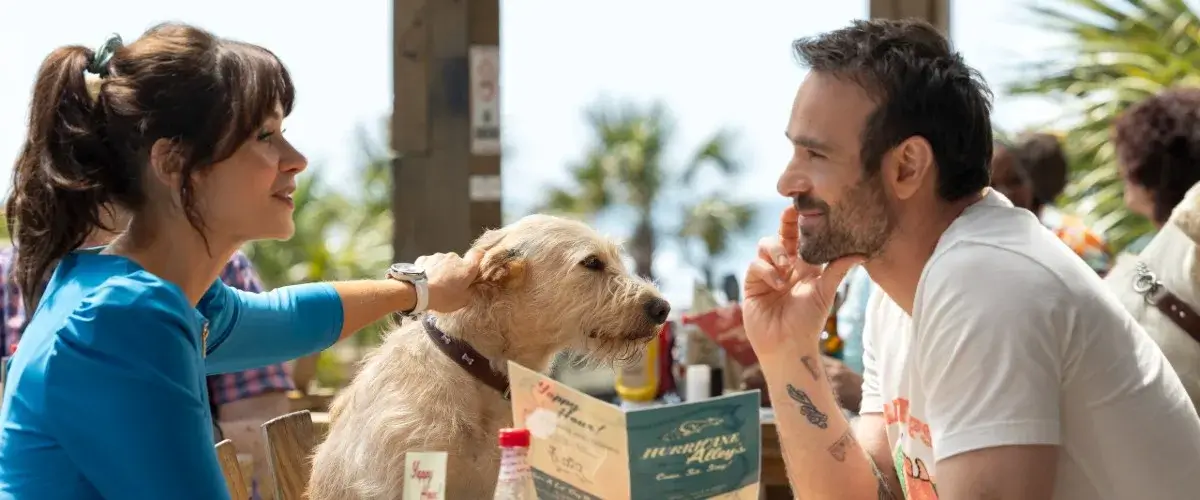
Merv is Rated PG by Motion Picture Rating (MPA) for some thematic elements, suggestive references and language.
Ever wonder what would happen if your dog took your breakup harder than you did? That’s the central idea behind Merv, a film that sounds like it should be a sweet, funny tug-of-war over love, loyalty, and maybe a little chaos. On paper, it feels like a setup ripe for comedy: two exes, one adorable terrier, and a whole lot of unresolved feelings. But Merv, unfortunately, never really uses its own potential, and instead settles into something surprisingly flat.
In Merv, we follow Anna (Zooey Deschanel), an optometrist navigating the emotional debris of a breakup, and Russ (Charlie Cox), a soft-spoken elementary school teacher who’s just trying to keep his head above water. Their relationship has fizzled out, but they can’t bear the idea of parting ways with Merv played by Gus, a genuinely charming little terrier whose face does most of the emotional heavy lifting in the film. The plan? Shared custody. One week with Anna, one with Russ. And if you guessed Merv hates it, you’d be right. He mopes, he whines, and he pulls the guilt-trip strings like only a heartbroken dog can.
The vibe the movie wants is warm, slightly quirky, lightly comedic almost like a cozy romantic dramedy about how love doesn’t always die just because a relationship does. But instead of leaning into the zaniness or emotional messiness that comes with this premise, Merv stays weirdly safe. It’s the cinematic equivalent of a lukewarm mug of tea: comforting in theory but kind of bland in practice.
And that’s the real heartbreak here, because this idea has been done before and done brilliantly. The Awful Truth (1937) practically invented the “fighting over the dog during a breakup” trope, with Cary Grant and Irene Dunne sparring so hilariously and passionately that you root for them even while they’re trying to ruin each other. Merv had the same playground, and plenty of chances to get silly or even a little chaotic: jealous dating mishaps, dog-related sabotage, emotional outbursts triggered by a wagging tail. But the film never takes those swings. It’s so hesitant, so careful, that it starts to feel like it’s actively avoiding fun.
What doesn’t help is the chemistry or lack thereof between Deschanel and Cox. The film waits until the third act to reveal why they even broke up, but honestly, the bigger mystery is why they were ever together. There’s no friction, no tension, no romantic spark, not even a playful bickering vibe. They interact like longtime coworkers who get along fine but never grab lunch together. So the film keeps insisting there’s something worth salvaging here, even as the performances suggest they’re both just politely hanging out.
Acting-wise, Gus the terrier is doing his absolute best. Deschanel and Cox, though charming on their own, are boxed into characters who never feel fully alive, partly because the script doesn’t let them be eccentric or flawed in an interesting way. Even their best friends (Chris Redd and Jasmine Mathews) exist only to nod sympathetically and spout advice. No side adventures. No comedic chaos. Just support on cue.
If Suze from the same writers felt quirky and heartfelt despite its odd setup, Merv feels like its tired cousin: same family DNA, but without the spark. Everything is technically fine, yet nothing ever rises above fine. The movie is heartwarming in theory, but only mildly warm in execution more of a gentle nudge than an emotional punch.
If you’re a fan of soft, easygoing dramedies about pets and breakups, or if you’re simply powerless against the charms of a small dog with big feelings, Merv might land as a pleasant, low-stakes watch. But if you’re looking for something with bite something energetic, funny, or romantically charged you may walk away wishing the film had taken advantage of the chaos and comedy its premise practically begged for.
A cute idea weighed down by its own caution. Merv isn’t a disaster but it’s far too timid to be memorable.
CONTENT BREAKDOWN FOR PARENTS
Violence & Intensity
There’s virtually no violence in Merv, and nothing even approaching action-movie tension. The most intense moments come from emotional conflict rather than physical danger where Anna and Russ occasionally have uncomfortable conversations about their breakup, but these scenes are subdued and never escalate into shouting matches. For some kids, the most unsettling element may be Merv himself. The dog becomes visibly sad and withdrawn after the breakup, which might tug at the emotions of young animal lovers who are sensitive to pet distress. Even so, the overall tone is gentle, and nothing frightening or threatening ever happens.
Language
The language is mild throughout, staying firmly within PG territory. Characters occasionally use light expressions of frustration such as “damn” or “hell,” but there are no harsher profanities, no slurs, and nothing said with cruel intent. Conversations tend to be warm, awkward, or emotionally honest rather than sharp-tongued. Parents can feel confident that the dialogue stays respectful and family-friendly, even when characters are hurting.
Sexual Content / Nudity
Romance is present but handled with a light, PG-appropriate touch. Anna and Russ share a few brief, chaste moments of affection when the story calls for it, but there is no nudity, no sexualized humor, and nothing intimate or suggestive. The film references dating in the general, grown-up sense new partners, awkward encounters, that sort of thing but avoids anything explicit. If anything, the romantic elements take a back seat to the emotional story of shared dog custody.
Drugs, Alcohol & Smoking
There are a couple of casual scenes where adults drink wine or a cocktail, typically during dinner or while decompressing after a long day. These moments are mild and never portrayed as reckless or celebratory drinking. Nobody gets drunk, nobody behaves irresponsibly, and there are no references to drugs or smoking anywhere in the film. The use of alcohol is understated and consistent with similar PG-rated romantic comedies.
Scary or Disturbing Scenes
Nothing in the movie is conventionally scary, but some children may find Merv’s sad behavior emotionally upsetting. There are a few scenes where the dog appears lethargic or depressed, and at one point, the characters briefly worry he might be ill. The film quickly clarifies that nothing medically dangerous is happening Merv is simply reacting to the breakup. Still, kids who are sensitive to pet distress may need reassurance that the dog’s emotions are temporary and that he remains safe throughout the movie.
Positive Messages / Role Models
The film offers several gentle but meaningful themes, especially for families dealing with change. Anna and Russ try sometimes awkwardly, sometimes reluctantly to put Merv’s well-being first, demonstrating empathy, responsibility, and cooperation even during emotional upheaval. Their approach to co-parenting, although untraditional, models healthy communication and shows children that conflict doesn’t have to lead to cruelty or blame. Themes of compassion, honesty, and learning to understand others are woven throughout.
Diversity & Inclusion
While the film doesn’t directly explore identity-based themes, its supporting cast brings a healthy amount of racial and cultural diversity to the story. Characters played by Chris Redd and Jasmine Mathews serve as voices of emotional support and offer perspectives outside the main couple’s lens, adding a sense of grounded, everyday inclusivity. Their roles are friendly and warm, even if the script keeps them from becoming fully developed in their own right.
