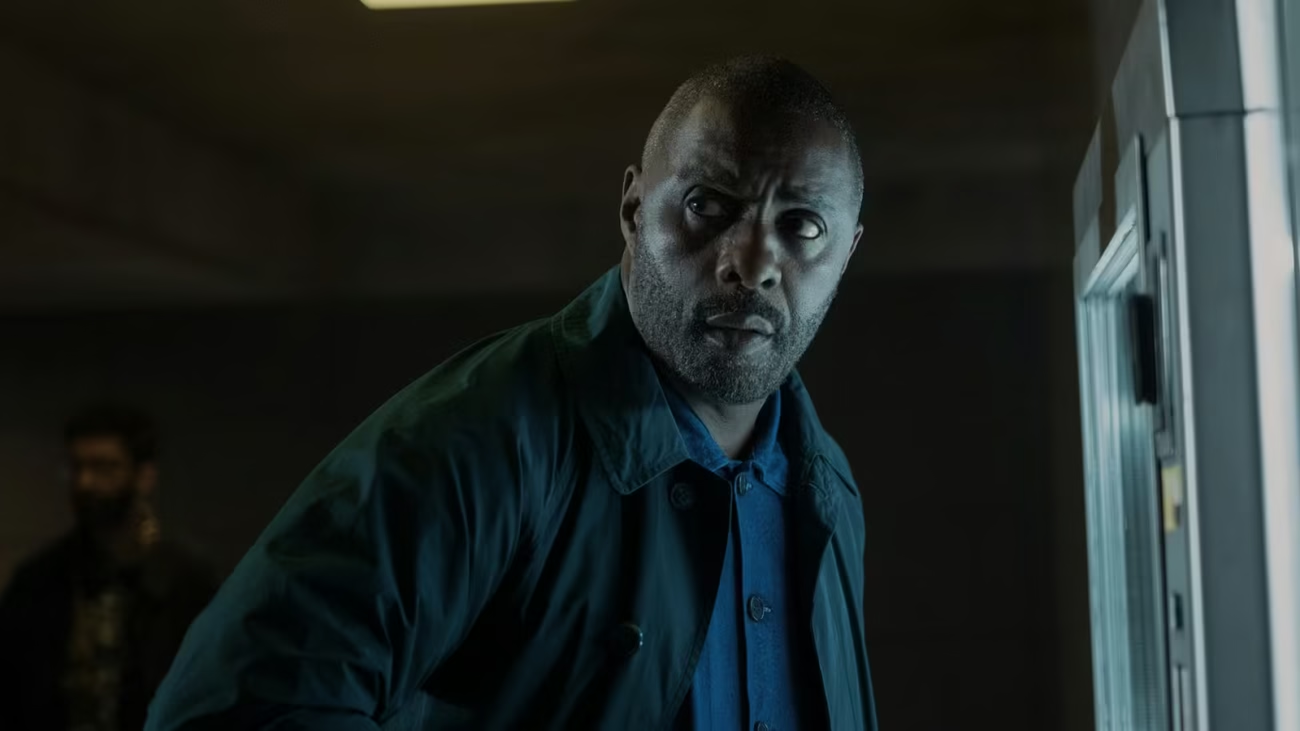
The revival of Hijack for a second season, once again anchored by Idris Elba, arrives in a space that will feel familiar to anyone who’s spent time scrolling through prestige streaming originals. It’s sleek, assured in its craft, and periodically tense but also unmistakably designed for consumption rather than contemplation. This is television that goes down smoothly in a weekend binge, less so when stretched across weekly drops. You can feel how precisely it knows which thriller levers to pull, even if it rarely presses hard enough to leave a lasting mark.
The season reintroduces us to Sam Nelson, Elba’s meticulously controlled corporate negotiator, who previously defused a hijacking mid-flight on a plane traveling from Dubai to London. The narrative hook this time is immediately more provocative. The location shifts to a Berlin subway train, and Sam’s role flips entirely: he’s no longer trying to stop the hijack. He’s orchestrating it. It’s the kind of premise that makes you lean forward instinctively, curious whether the show might finally interrogate its own protagonist rather than simply positioning him as a charismatic savior.
Set about two years after the first season, the new episodes unfold in the present day, and from the opening moments, you can sense how faithfully the series sticks to its original template. The production design is pristine to the point of coldness, every frame polished and composed. Visually, it’s impressive. Emotionally, it can feel distant. The storytelling operates less like organic drama and more like a carefully plotted strategy game. Characters enter the board, perform their function, and shift position as needed. When Sam likens everything to a poker match, it sounds less like metaphor and more like accidental confession. It’s difficult not to suspect some viewers will see through the trick.
Still, the show remains undeniably watchable. If you’re drawn to hostage thrillers and the comfort of familiar genre mechanics, Hijack delivers those pleasures with confidence. The premiere builds momentum quickly, and by its final moments, the situation has spiraled into something chaotic enough to feel genuinely unpredictable. There’s a strong case to be made that this opening episode is among the season’s best possibly the best setting the tone with abrupt reversals, nerve-fraying turns, and a kind of tension that grips you even when it occasionally irritates.
There’s intelligence at work here. You can sense the care in the plotting, the way details are layered with the expectation that they’ll make more sense later. And often they do. A second viewing reveals connective tissue that’s easy to miss the first time. But there’s also an artificial quality to the mystery. Too often, suspense is maintained not through character or situation but through strategic withholding. Scenes feel built around what the writers are deliberately not revealing, and that absence can feel less like intrigue and more like a visible mechanism humming beneath the surface.
Narrative logic, meanwhile, doesn’t always survive the pressure of constant escalation. Across eight episodes and nearly as many cliffhangers the series adopts an unyieldingly serious tone, broken up by twists that rely more on shock than substance. Instead of leaning into bold, destabilizing choices, the show tends to play it safe, offering reveals that surprise in the moment but fade quickly. It wants to be taken seriously, and it looks and sounds the part, yet it rarely commits to the kind of daring storytelling that would truly earn that gravitas.
A large portion of the season—roughly a third to half—unfolds in German, making subtitles a regular companion. That, in itself, isn’t a flaw. The issue is rhythm. When the pacing slackens, the tension dissipates, and scenes that should feel loaded with unease instead feel oddly inert. The premiere crackles with urgency, but as the season peels back the layers of the conspiracy, the momentum softens. There’s a strange irony at work: the more the show explains, the less urgent it feels.
It’s also worth noting the episode count. In a landscape where follow-up seasons often shrink, Hijack expands to eight episodes, up from seven. After watching the full arc, it’s difficult not to feel that the material would have been stronger with fewer hours—six, perhaps. Aside from a few subplots (most still tethered to Sam’s storyline), the show cycles between two dominant environments: the trapped train and the operations room, where German authorities attempt to manage the crisis and rescue around a hundred hostages. That repetition gradually erodes what should feel suffocating and intense.
Because of this structure, the series feels almost designed for bingeing. In fact, it arguably works best that way. Waiting until the finale arrives and watching several episodes in succession allows the tension to accumulate rather than dissipate. The show doesn’t quite have the emotional depth to sustain weekly anticipation, especially when contrasted with dramas that genuinely haunt you between episodes. Hijack gains strength when its individual chapters blur into a single sustained experience.
As with the first season, the show’s strengths double as its weaknesses. It’s visually striking, earnestly serious, and persistently suspenseful—but also too sleek to feel raw, too tonally intense to allow contrast, and too dependent on misdirection that fails to obscure the obvious trajectory. Both seasons hinge on vehicles—a plane, then a train—and in both cases, you can see the destination long before arrival.
After two seasons, the most accurate description may be that Hijack is impeccably competent. It fulfills every requirement of a modern thriller: glossy production, a bankable star, a high-concept premise, professional execution. What it doesn’t quite manage to generate is genuine emotional connection. We’re told these lives matter, and intellectually we agree, but the show rarely makes us feel that truth in our bones. Without that emotional anchor, everything can feel curiously hollow.
Elba, for his part, remains magnetic. He brings gravity and presence to material that often underserves him. But Sam Nelson, as written, is not a particularly rich creation. His motivations are basic, his emotional world largely inaccessible, his personality rigid. These are issues of characterization, not performance. It’s hard not to wonder whether the series would command much attention at all without an actor of Elba’s stature holding it together. Caught between retro thriller conventions and ultra-modern aesthetics, Hijack season 2 is watchable, occasionally absorbing, and ultimately disposable best experienced in one concentrated viewing once the full season is available.
Hijack Season 2 Parents Guide
Rating:
Hijack season 2 carries a TV-MA rating from the Motion Picture Association, and it’s a classification that reflects the show’s emotional weight more than its explicit content.
Violence & Intensity
The series trades graphic violence for sustained psychological tension. The central setting—a hijacked subway train crowded with hostages—creates an unrelenting atmosphere of confinement and fear. Characters are threatened, restrained, manipulated, and placed in genuine peril. The danger feels constant, and the anxiety is cumulative.
Physical violence does occur in short bursts: scuffles, moments of aggression, implied injuries. But the show largely avoids lingering on gore. The impact comes instead from the emotional pressure. You can feel the stress building scene by scene, and for younger viewers, that intensity may be more disturbing than overt bloodshed.
Language (Profanity, Slurs, Tone)
Profanity is frequent, especially during high-stress moments. Characters regularly use strong language, including F-bombs, in an attempt to ground the dialogue in realism. The overall tone is sharp, confrontational, and emotionally charged.
There are no recurring hate slurs, but the language is undeniably adult—not casual or comedic, but shaped by fear, urgency, and desperation. It carries emotional weight, not just shock value.
Sexual Content / Nudity
This is not a sexually driven series. There are no explicit sex scenes and little to no nudity. Romance exists only faintly at the margins, and sexuality is not used as narrative spectacle. At most, viewers might encounter subtle references to relationships or implied intimacy, but nothing graphic.
Compared to many TV-MA shows, this element is notably restrained.
Drugs, Alcohol & Smoking
Alcohol appears occasionally, often in social settings or moments of stress. Smoking is rare and typically used as a character detail rather than something glamorized. Drug use is not a major thematic concern and is not depicted in any sustained or graphic way. Substance use exists more in the background than as a focal point.
Age Recommendations
While the explicit content is relatively moderate, the themes and emotional tone are mature. The show centers on prolonged fear, moral ambiguity, manipulation, and high-stress psychological scenarios. These elements can be heavy, particularly for younger viewers.
Recommended for ages 17+, in line with the TV-MA rating. Some older teens (16–17) accustomed to serious thrillers may be able to handle the material, but parental discretion is advised, especially for those sensitive to anxiety-inducing situations.
