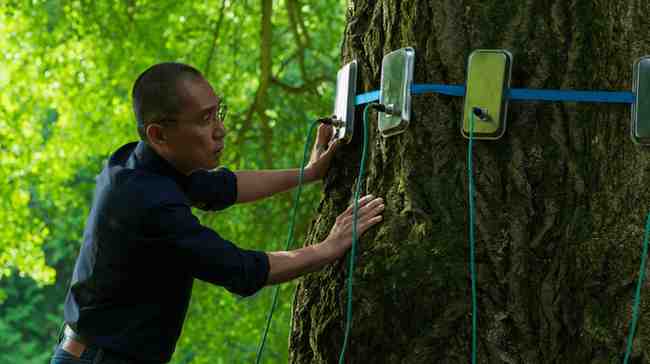
I don’t know how to describe this film to someone who hasn’t seen it. I’ve tried three times in conversation and each time the other person’s face does the thing where they’re being polite. A Hungarian art film. Three timelines. A ginkgo tree that’s been on a German university campus since 1832. Tony Leung injecting mescaline and attaching electrodes to the tree during COVID lockdown to see if his brainwaves match its brainwaves during rainfall.
Yes. That’s the film.
Ildikó Enyedi made it. She’s made eight films in thirty years, which tells you something about either her patience or her standards or both. Her debut won the Caméra d’Or at Cannes in 1989. On Body and Soul took the Golden Bear at Berlin in 2017. Silent Friend played Venice last year and won the FIPRESCI Prize and I’m embarrassed it took me until a festival screening to finally sit down with it.
The thing that I genuinely cannot stop thinking about, and I’ve been sitting with this film for weeks now is a detail from the 1970s storyline. A young man named Hannes is looking after his housemate’s geranium while she’s away. She’s a scientist running an experiment on it. Electrodes attached to the plant, feeding into something called a kymograph that records its reactions on paper. She told him not to spend too much time with the flower because his presence might affect the results. He spends too much time with the flower. And he discovers this is what the film tells us, straight, without irony that the geranium has become aware of him. That it anticipates his arrival from yards away before he enters the room.
I sat with that for a long time. I’m still sitting with it.
The film is structured in three periods 1908, the 1970s, and COVID-era lockdown each shot in a different format. The earliest period in 35mm black and white. The 1970s in grainy 16mm. The contemporary scenes in clean digital. You never lose track of where you are, which matters because Enyedi and her editor cut between the periods freely, sometimes just flashing a single image from one era before leaping to another. It should be disorienting. Somehow it isn’t. The score holds the whole thing together in a way that’s hard to explain it’s the aural equivalent of the wood wide web, the network of signals connecting things that look separate.
The 1908 story is the most conventionally satisfying of the three. Grete, played by Luna Wedler, interviews for a place in a science department dominated entirely by men who have arranged for her to draw the topic of Carl Linnaeus. This is a trap Linnaeus classified plants using explicitly sexual metaphors, stamens as male organs, pistils female, Monandria meaning one man, Polyandria meaning many men and the panel expects her to blush. She doesn’t. She cuts through them with the calm of someone who knew what was waiting before she walked in. Enyedi gives this scene just enough room and then moves on. She doesn’t linger on the victory. The film is interested in other things.
The COVID storyline is where Tony Leung appears, playing Dr. Tony Wong, a neuroscientist from Hong Kong stranded alone on campus during lockdown. I want to sit with this casting for a second because nobody seems to be talking about it enough: Tony Leung. One of the great actors in cinema. In the Mood for Love. Chungking Express. Here, in a Hungarian film about plant consciousness, spending much of his screen time alone or talking to Léa Seydoux through a laptop screen. Seydoux plays a botanist who specializes in plant behavior. She exists almost entirely as a face on a computer, maybe twenty minutes of screen time total, and she’s somehow as present as anyone in the film. There’s something about that, about connection happening across distance, across a screen, across a language barrier, between species, that Silent Friend is deeply interested in and never states directly.
The mescaline scene. Wong injects himself, attaches electrodes to the centuries-old ginkgo, and compares his opened brainwaves to the tree’s during rainfall. He finds they match. The film presents this without fanfare, which is its own kind of statement. Of course they match. What took you so long to look?
This is not a film for everyone and I’m not going to pretend otherwise. It’s two and a half hours. It doesn’t have a plot in any conventional sense. There are long stretches where Enyedi is more interested in the quality of light on bark than in advancing anything resembling narrative. Some people will find it meditative. Others will find it interminable. Both responses are honest.
What I can tell you is that the end credits list plant species alongside the human cast. Ginkgo biloba. Pelargonium. Several others. It’s a small thing. It made me laugh quietly to myself in the dark. And then it didn’t feel small at all.
Silent Friend Parental guidance
Not officially MPA rated Art film — estimated equivalent: PG-13
Violence & intensity — none: No violence of any kind. The film is meditative and contemplative in nature a triptych art film concerned with plant consciousness, human connection, and scientific inquiry. Entirely appropriate in this category for all ages.
Language: Mild: A multilingual film (German, English, Cantonese) with no significant profanity. Academic and philosophical dialogue throughout. Sexual terminology appears in the context of Linnaeus’s botanical classification system discussed in a scholarly, non-explicit register.
Sexual content / nudity: Mild thematic: A near-constant undercurrent of sexual tension runs through all three storylines, described by the filmmaker as central to the characters’ intellectual and emotional understanding of their subjects. Close-up imagery of plant growth is described as “strangely erotic.” No explicit sexual content or nudity reported. The 1908 storyline involves discussion of botanical sexual metaphors in a scholarly context. Mature in tone rather than content.
Drugs, alcohol & smoking: Notable contextual: A central sequence in the modern storyline involves a scientist self-administering mescaline (derived from peyote) as part of a scientific experiment comparing human and plant brainwave patterns. This is depicted as research rather than recreational use, but parents should be aware it is shown and discussed. Period-appropriate smoking may appear in the 1970s storyline. Social alcohol use likely in keeping with the film’s European art cinema context.
Themes & context: Intellectually demanding: Plant consciousness, scientific skepticism, gender inequality in academia (1908 storyline), isolation during COVID-19, and the boundaries of human perception are the film’s central concerns. Psychedelic imagery of brainwave patterns appears. The film spans 2.5 hours and is deliberately paced — likely to disengage younger or impatient viewers. Best suited to intellectually curious adults comfortable with experimental, non-narrative cinema.
Age recommendation: 15 and olderThematic complexity, the depiction of mescaline use in a research context, and the film’s demanding pace make it best suited to older teens and adults.
Estimated rating PG-13 For thematic content, mild sexual tension, and depiction of psychedelic substance use in a scientific context. Not submitted to the MPA.
