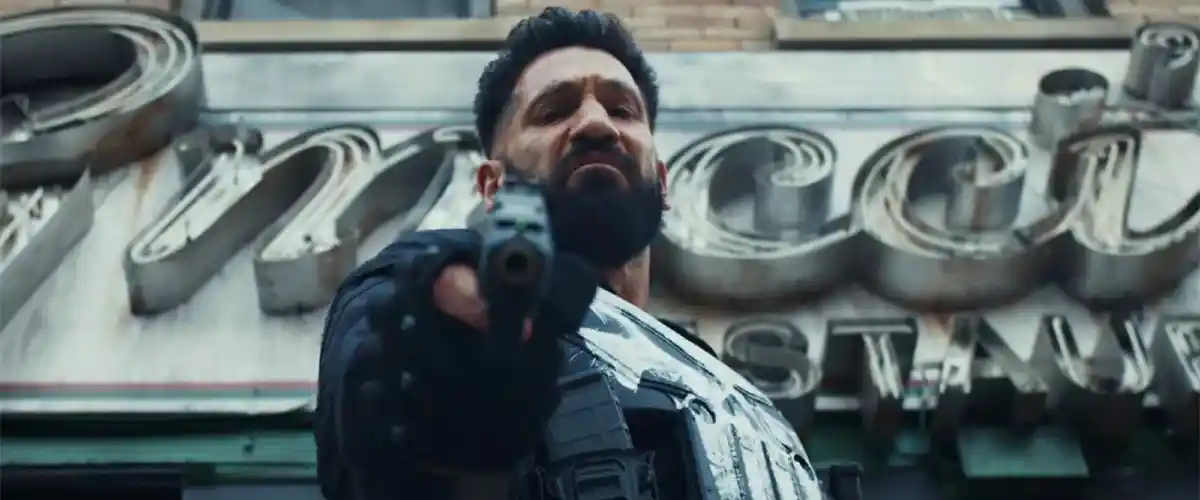
About twenty minutes into One Last Kill, Frank Castle stands at a window in his Little Sicily apartment and watches a man get beaten on the sidewalk below. Not a quick mugging. A sustained, ugly thing. And Castle doesn’t move. Doesn’t reach for anything. Just watches with his hands at his sides, like a man staring at a fire he’s decided isn’t his to put out. Bernthal doesn’t do anything actorly with the moment no clenched jaw, no meaningful swallow. He just stands there. It’s the realest thirty seconds in the whole special, and it’s over before the film seems to understand what it had.
That’s the story of One Last Kill, really. Flashes of something true, surrounded by a lot of rushing.
Hell’s Kitchen, at this point in the MCU’s timeline, has curdled into something unpleasant Fisk’s Anti-Vigilante Task Force has the streets locked down and Castle is freshly escaped from whatever makeshift prison camp Fisk had him in. He’s sleeping badly in a Little Sicily walk-up, he’s seeing his dead wife and daughter in the corners of rooms, and he hasn’t put on the skull in long enough that the neighborhood thugs are beating people in broad daylight while he watches from upstairs.
The show wants us to feel his paralysis. Fair enough. But it keeps re-explaining it the PTSD visions, the muttered monologues, the pointed camera lingers on his hollow face until you want to grab the script by the collar and tell it: we got it the first time. Bernthal got it across in that window shot without saying a word.
Then Judith Light walks in, and the air goes out of the room in the best possible way.
She plays Ma Gnucci, wheelchair-bound mob matriarch, what’s left of a family Castle apparently wiped out somewhere offscreen, and Light plays her like a woman who has rehearsed this confrontation in her head for years and is quietly delighted to finally have it. There’s a stillness to her that’s more threatening than anything the script hands her. Which is lucky, because the script does hand her this:
“I’ll be doing ‘the punishing’ now.”
I sat with that line for a moment after she said it. Then I sat with it again. Light delivers it absolutely straight, which is the only conceivable way to deliver it, and I genuinely cannot tell you whether that makes it better or worse. The rest of her setup borrows the Dredd premise wholesale, every criminal in the building, paid to hunt him down, floor by floor, but Dredd didn’t pretend to be anything other than a pressure cooker. One Last Kill keeps wanting to be something with more on its mind, which makes the borrowed architecture feel a little cheap.
Here’s the thing about Bernthal, though. He co-wrote this with director Reinaldo Marcus Green, and you can feel both of them pulling toward something they know is in the character but keep getting crowded out of reaching. The Castle they understand, and it’s the right Castle, isn’t interesting because of the kill count.
He’s interesting because the violence is the only language he has left for grief, and somewhere underneath all that machinery he’s aware of how broken that is. When the special finally lets him move, in the second half, and he clears that building with the focused purposefulness of someone who’s stopped fighting what he is, it’s genuinely satisfying. Not fun, exactly. Satisfying. There’s a difference, and this gets it right.
The editing, though, keeps getting in its own way. The action sequences are cut so aggressively that the physicality, which Bernthal has clearly worked hard on, keeps getting chopped into pieces before it can register. It felt, watching it, like someone in post got nervous and started hitting the cut button faster than the footage needed. The irony is that Castle’s thing, the reason the character works, is the relentlessness of it, the sense that he just doesn’t stop. Choppy editing is the exact wrong tool for that.
I kept thinking, across the whole 48 minutes, about the first season of the Netflix show. Which is unfair, maybe, that season had thirteen hours and nothing it needed to set up afterward. But that’s precisely the problem. One Last Kill is trying to close out one arc and hand the character off to a Spider-Man movie at the same time, and the seams show badly.
The first half drowns in trauma the Netflix show already charted. The second half lurches toward a triumphant turning point that arrives about ten minutes before the special has actually earned it. Bernthal filmed Brand New Day after this and was reportedly insistent on carrying the same characterization through, admirable, and you can feel that insistence, but what it produces here is the energy of a chapter rather than a story. A very expensive bookmark.
The strangest thing about One Last Kill is that it’s most compelling as a pitch document. Watch it and you can feel Bernthal and Green making a case, not really to you, but to whoever at Marvel decides what gets greenlit, that this character can carry a real film. They’re right. The bones of what they’re doing here, if you gave it a two-hour runtime and let it breathe, could be something. Every scene where the material isn’t fighting against its own constraints, you can see the movie they’re trying to make hiding inside the special they were allowed to make.
Bernthal has been saying the right things about Frank Castle for years, and more importantly he’s been doing them. He doesn’t play this man as someone who enjoys what he does. He plays him as someone who is very, very good at the only thing that makes the static in his head go quiet, and who has stopped asking whether that’s a sustainable way to live. It’s a specific and unsentimental performance, and it holds up even here, even when the writing around it is leaving him exposed.
The frustration is real. Not the frustration of a bad movie, the frustration of watching a character who needs space to exist get folded into the margins of someone else’s franchise. The Punisher showing up in a Spider-Man film is, to put it gently, a tonal problem in the making.
Castle doesn’t guest-star. He takes over. He’s not built for sharing a universe with quippy teenagers and flying suits; he’s built for the kind of story where the moral reckoning comes at the end and it doesn’t feel good. Asking him to be a supporting act is a category error, and One Last Kill, for all its messiness, at least makes that argument clearly.
I don’t know if Marvel is listening. But I hope they watched this and felt, somewhere in the accounting department, a small pang of recognition. Frank Castle is still in there. Waiting, like he always does. Hands at his sides.
The Punisher One Last Kill parents guide
Rated TV-MA: Equivalent to a hard R rating. Strictly for adults. Not appropriate for teenagers under 17 without parental discretion.
Violence & Intensity: Extreme. Sustained, graphic hand-to-hand and gunfight sequences with high on-screen fatality counts. Brutal depictions of street violence including civilian assault. The film’s central premise is an extended building-wide kill sequence. Not stylized in a comic-book sense, played with deliberate, visceral weight.
Language: Heavy. Frequent strong profanity throughout, consistent with prior Punisher and Daredevil installments. No notable slurs, but tone is consistently harsh and confrontational.
Sexual Content / Nudity: Minimal. No sexual content or nudity. The special is almost entirely action and psychological drama with no romantic subplot.
Drugs, Alcohol & Smoking: Moderate. Alcohol present in background scenes consistent with a crime-drama setting. No glamorization of drug use. Castle’s deteriorating mental state is portrayed through PTSD and hallucinations, not substance abuse.
Mental Health Themes: Significant. Extended portrayal of severe PTSD, grief, survivor’s guilt, depression, and hallucinations of deceased loved ones. Handled with dramatic seriousness rather than exploitation — but may be distressing for sensitive viewers.
Themes & Tone: Dark throughout. Authoritarian violence, civilian endangerment, organized crime, and vigilante justice are central themes. The moral framing is deliberately grey, Castle is neither here nor villain in the conventional sense.
Ages 18+ Recommended for mature adults only. The combination of graphic violence, psychological trauma depictions, and thematic darkness places this firmly outside appropriate viewing for children or young teenagers. Older teens (16–17) with parental guidance and familiarity with the character’s prior appearances may engage with it, but parental discretion is strongly advised.
Recommended: The Pitt Season 2 Parents Guide