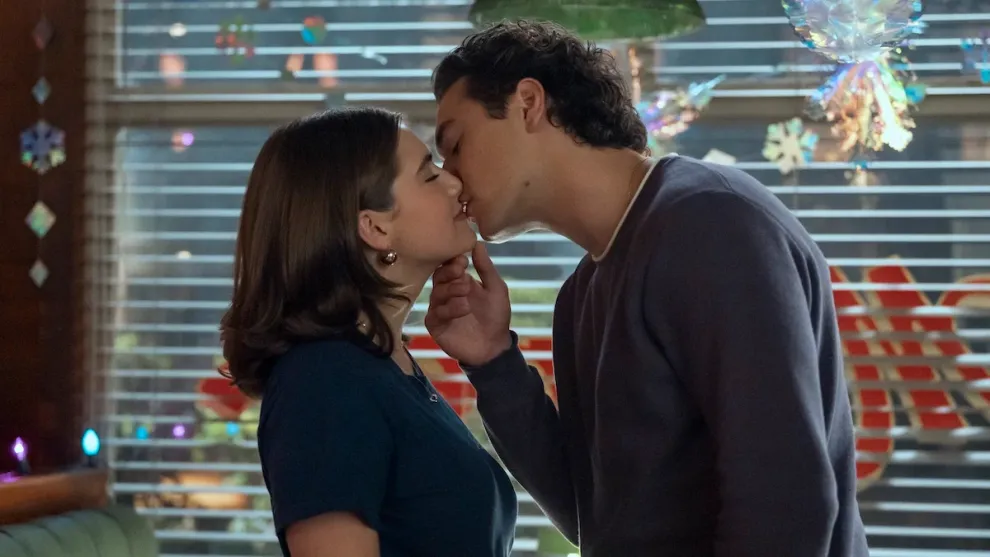
Let me tell you the exact moment I stopped fighting it. Episode three. Hannah is sitting at a piano in a practice room at eleven at night, working through something she’s written, and she doesn’t know Garrett has followed her there. He stands in the doorway and just listens.
Doesn’t interrupt. Doesn’t make it about himself. Just listens. And the camera stays on him long enough that you can see the exact second he realises he’s in trouble. It’s a tiny scene. Thirty seconds, maybe. But I’ve been in enough bad relationships to know that being truly listened to is rarer and more dangerous than most romance stories admit. Off Campus knows that. That’s why it works.
I’ll be upfront: I came into this with low expectations and a slight chip on my shoulder. Adapted from Elle Kennedy’s BookTok-beloved college hockey novels, created by Louisa Levy for Prime Video, Off Campus arrives pre-packaged as the streamer’s answer to The Summer I Turned Pretty prestige YA romance for the algorithm, built to generate fan edits and playlist discourse before the credits finish rolling.
The first episode doesn’t exactly dismantle that impression. There’s a slow-motion shirtless entrance. There are red cups. There’s a scene where our heroine, Hannah Wells, falls over a laundry cart after accidentally seeing the campus hockey star naked in the locker room showers, and I genuinely winced at the obviousness of it.
But here’s what I didn’t expect. The show earns it. Not by subverting the formula, it doesn’t pretend to be something smarter than it is, but by taking its characters seriously enough to let them be complicated people doing a silly thing, rather than plot functions wearing attractive faces.
Hannah, played by Ella Bright, is a music student working multiple jobs to stay enrolled, carrying something she hasn’t told anyone, quietly in love with a guy in her songwriting class who treats her like furniture. Bright doesn’t play her as lovably clumsy or endearingly awkward in the way the role invites.
She plays her as someone who’s learned to keep the important stuff below the surface, and the effect is that every time something real gets through a flash of want, a moment of genuine fear, it registers. There’s a scene late in the season where Hannah has to perform her own music in front of people who matter to her and the two minutes before she walks on stage are excruciating in the best way. Bright does nothing actorly. She just stands there being terrified, and it’s the most real thing in the show.
“Garrett Graham is written as the kind of guy who, in a lesser show, would only exist to be proved wrong about himself. Cameli won’t let him off that easy.”
Belmont Cameli, as Garrett Graham, has different problems. He’s the school’s star forward, NHL-bound on paper, academically skating on ice that’s thinner than anyone on the coaching staff wants to acknowledge. He needs a tutor. Hannah needs a fake boyfriend to get the attention of her oblivious crush. The deal is made. You’ve been here before.
What you might not have expected is that Garrett Graham is written as the kind of guy who, in a lesser show, would only exist to be proved wrong about himself. Cameli won’t let him off that easy. There’s a quality to his performance, an attentiveness, a habit of going quiet when conversations get real, that makes Garrett feel like someone who has always been the most scrutinized person in any room and has become very good at managing that. His scenes with Steve Howey, who plays his father Phil, a former pro carrying the specific sourness of a man who peaked at twenty-two, those scenes have a weight the show didn’t strictly need to include. It included them anyway.
The supporting cast gets more than the genre usually gives them. Allie, Hannah’s roommate, is dealing with something that doesn’t have a clean answer the question of whether you can want a career and a partnership with equal intensity and have both and the show doesn’t resolve it tidily because it can’t. The hockey players talk to each other about consent and how to support someone through something hard, and it doesn’t feel like a seminar. It feels like how some men actually talk when they think no one’s evaluating them. Levy spent time getting that right, and it shows.
The first two episodes are the weakest. Levy is still finding the temperature of the thing, there’s a party sequence that leans on every visual shorthand for “college excess” and a few exchanges between Hannah and Garrett that sound like dialogue trying to be banter rather than two people actually sparring. Get through it. By the third episode the show has settled, and you can feel the difference in the room. The actors stop indicating and start inhabiting.
I don’t want to oversell this. Off Campus is not going to reconfigure how you think about television. It’s a romance series adapted from a romance novel, and its ambitions are calibrated accordingly. What it does is execute those ambitions with more honesty and more care than most things in this lane manage. When Hannah and Garrett finally stop circling each other and say the actual thing, it doesn’t feel like the show hitting its mark. It feels like two people who got tired of being careful.
There’s a moment near the finale, I won’t say more than this, where Hannah plays something she wrote, and the show doesn’t swell the score or cut away to reaction shots. It just lets the music happen. Thirty seconds of actual silence around an actual song. In a genre that usually tells you exactly how to feel at every moment, that restraint stopped me cold. I sat with it for a while after the episode ended. That’s the whole show, really. It knows when to get out of its own way.
Off Campus Parents Guide
Violence & intensity: Minimal. Hockey games are physical but not brutal, this isn’t a show interested in sports violence. The more intense moments are emotional: a difficult conversation about past trauma, a confrontation between Garrett and his father that gets loud without getting physical. Nothing here is frightening, but a few scenes carry real dramatic weight.
Language: Frequent strong language throughout, the f-word is in regular rotation, as is other common profanity. The tone is casual college, not aggressive, but it’s consistent across all eight episodes. Parents of younger teens should know this doesn’t dial it back.
Sexual content: The clearest flag for parents. The show includes sex scenes between college-aged characters, not explicit by premium cable standards but more than implied. Partial nudity, a voyeuristic shower scene played deliberately for appeal in the first episode, and the general assumption that adult sexual activity is a normal part of college life. The show also handles a sexual assault backstory with care and sensitivity, but that content is present and should be discussed with younger or more sensitive viewers before they encounter it.
Drugs & alcohol: College drinking is constant background texture, parties, casual pre-drinks, characters drinking after hard days. It’s never the story, but it’s always in the frame. No meaningful drug use depicted.
Themes & context: The show is quietly and genuinely good on consent, not in a checklist way, but in the way it writes male characters who bring it up naturally, treat it as a given, and call each other out when behaviour falls short. It’s one of the show’s better qualities and gives older teens something real to chew on. The trauma subplot is handled with restraint but parents should be aware it’s there.
Age recommendation: 16 and up is the honest call. The sexual content and mature themes put it out of reach for younger teens without a parent making an informed decision. Mature 14–15 year olds who’ve already read Kennedy’s books will find the adaptation closely faithful, parents who were comfortable with the books are probably fine here too. The show’s values around relationships and communication are genuinely worth the conversation it might start.
A note worth making: Off Campus is one of the more thoughtful portrayals of how young men talk to each other about relationships that I’ve seen in this genre. If you’re watching it with a teenager, that’s worth pausing on.
All 8 episodes drop May 13 on Prime Video.
Highly Recommended: House of the Dragon Season 2 Parents Guide