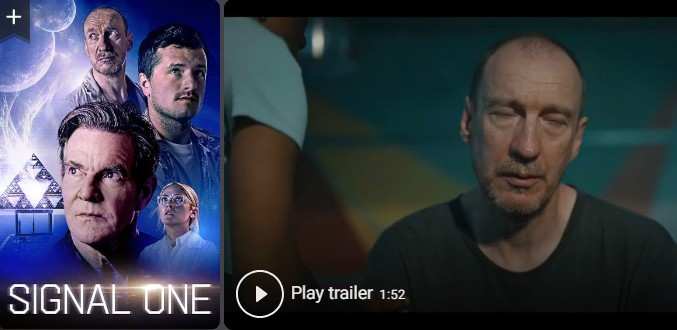
David Thewlis delivers the film’s most chilling line sitting perfectly still. His character, the reclusive, quietly unhinged creator of a machine called LITTLEMOUTH, designed to intercept alien transmissions, tells Annika, the young computer scientist who’s just arrived at his island facility, that the aliens are already talking. Have been for as long as we’ve been listening. We just can’t understand a word of it.
“We are too primitive,” he says, without drama, without malice, the way a man explains that a child can’t read Dostoevsky yet. It’s not cruel. It’s just true. And it’s the moment Signal One stops being a genre film and starts being something with real teeth.
This film follows Isabelle Fuhrman, plays Annika, and she does something most young actors in these films never manage she plays smart without performing it. She doesn’t explain herself. She doesn’t stop to deliver the exposition of her own competence. She just moves through scenes the way a good scientist moves through a problem: methodically, with a simmering impatience for people who are slower than she is.
There’s a scene where she first interfaces with LITTLEMOUTH, alone in that sterile room, headphones on, and the expression that crosses her face isn’t wonder or terror. It’s recognition. Like she’d been half-expecting this her whole life. Fuhrman doesn’t undersell that moment, and she doesn’t oversell it. She just lives in it. That’s rarer than you’d think.
“The film knows something that most alien contact movies don’t: the truly unsettling version of this story isn’t the one where they come for us. It’s the one where they simply don’t care.”
Dennis Quaid plays Sam Houston, the tech billionaire funding the whole enterprise, and Quaid is doing his most interesting work in years, which is to say he’s doing almost nothing. He’s playing a man who has mistaken access for wisdom, who built a machine to talk to God and never once stopped to wonder whether God wants to talk back. There’s a version of this character who becomes the villain of the second act, and to Quaid’s credit, he doesn’t tip his hand. He stays warm, plausible, the most reasonable man in the room right up until the moment the room catches fire. I found myself trusting him for longer than I should have, which is exactly the point.
Highly Recommended: Her Private Hell Parents Guide
The facility sits on a Caribbean island, and cinematographer Adam Swica uses the location in a way I didn’t expect, he doesn’t make it paradise. The sun is bleaching and relentless, the interiors feel sealed and airless, and the beautiful water surrounding the island reads less like freedom than like distance. These people are marooned. They just don’t know it yet.
The production design keeps everything just clinical enough to feel real, not the sleek sci-fi sterility of a studio picture, but the improvised, cable-cluttered reality of actual research. It costs the film nothing and adds considerable credibility.
Josh Hutcherson is here, reunited with Fuhrman after all those Hunger Games years, and the film mostly wastes that. They have a history on screen and off and Sobol’s script doesn’t bother to use it. Their scenes together are functional. They pass information between them. But there’s a whole other film in the unspoken weight between two people who knew each other young and ended up in the same strange room, and Signal One isn’t quite interested enough to write it.
The third act, when things begin to unravel when the project pivots from passive listening to actively talking back, and chaos follows the way it always does when the arrogant mistake ambition for permission, is handled with more restraint than the genre usually allows itself. There are no enormous set pieces. Nobody gives a speech. The dread accumulates the way it does in real emergencies: gradually, then suddenly, with the terrible clarity of having understood too late what you’ve actually done. Sobol keeps the camera close and the score low, and the result is a film that earns its tension without spending a dollar of spectacle.
It doesn’t entirely work. The screenplay has patches where the ideas run slightly ahead of the character work, where you feel the architecture of the premise being assembled around the people rather than through them.
Highly Recommended: Backrooms (2026) Parents Guide
And the ending, while honest, lands with less weight than the film deserves, not a failure, exactly, but a closing note played just below the register the preceding hour had set up. You leave wanting five more minutes. Not because you need resolution, but because you want the film to sit with what it’s done just a little longer than it’s willing to.
Still. I’ve been thinking about that Thewlis scene for three days. The quiet certainty in his voice. The machine humming in the background. The idea that somewhere out there, something has been broadcasting without expectation of reply, and that we, being us, couldn’t leave well enough alone. Signal One is not a perfect film. But it’s an honest one, which in this particular summer, in this particular genre, feels like the more impressive achievement.
Content breakdown for parents & guardians
RatingPG-13
Violence & Intensity: Sustained psychological tension rather than graphic violence. The danger escalates in the third act, with scenes of chaos and existential threat, but nothing is gory or graphically brutal. Some sequences, particularly around first contact, may genuinely unsettle younger or more sensitive viewers.
Language: Mild to moderate. A scattering of profanity consistent with the PG-13 threshold, nothing sustained or aggressive. Tone between characters can become sharp and confrontational, especially as pressure mounts in the second half, but there are no slurs or offensive language of any kind.
Sexual Content / Nudity: None. The film has no romantic subplot and no suggestive content. Entirely safe in this category across all age groups.
Drugs, Alcohol & Smoking: Incidental social drinking in a few scenes, nothing depicted as glamorous or consequential. No drug use, no smoking in any material available. A non-issue for most families.
Age Recommendation: Best suited for ages 13 and up. The scares here are cerebral, existential dread, moral consequence, the slow collapse of certainty rather than anything visceral. Younger teens with a genuine interest in science fiction will find it gripping and accessible.