There’s a moment about thirty minutes into “Never Change!” where a grown man stands in front of his old classmates, grinning like a guy in a beer commercial, and announces that they’re all going back to his place to “rage” because his parents are finally gone. He doesn’t mean on a cruise. He means dead. And he says it through gritted teeth, eyes wet, like he’s daring anyone in the room to notice he’s not okay.
Nobody laughs. Nobody looks away either. That’s the whole movie in miniature, a film that keeps finding the one true, strange, sad joke buried inside its premise, then burying it again under three more jokes that don’t deserve to be in the same scene.
I went in expecting a lark. A bunch of thirtysomethings forced back to high school because of a tornado and a legal loophole, that’s a premise with a built-in punchline, the kind of thing that writes its own poster.
What I got instead was messier and, weirdly, more interesting than that pitch deserves. Because somewhere in here, underneath the chaos, is a movie that actually understands what it feels like to be thirty-six and still arguing with the version of yourself that peaked at seventeen. It just refuses to sit still long enough to say so.
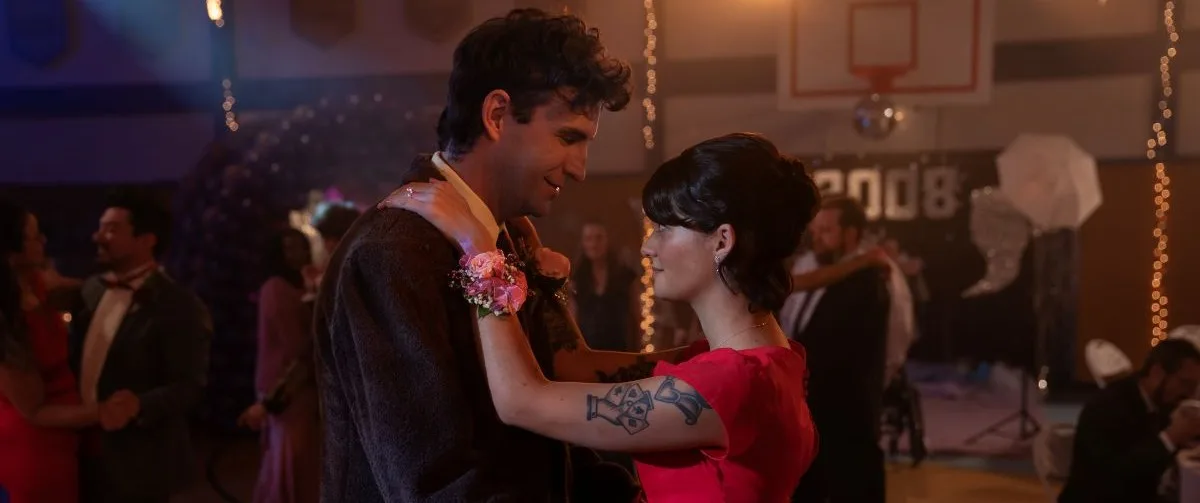
John Reynolds, who wrote the thing and stars as a directionless mess named Sunny Football, plays his character with the loose-limbed apology of a man who knows he’s the joke and has made peace with it. Watching him orbit Sofia Black-D’Elia’s Katie Cartwright, a local news anchor stuck performing competence for a town that still treats her like the prettiest girl at the dance, gives the film its only steady emotional pulse.
There’s a scene where they’re alone in an empty classroom, years of unfinished business hanging in the air between them, and for about ninety seconds “Never Change!” remembers it’s allowed to slow down. Then someone bursts in with a bit about food tasting like sewage, and the air goes right back out of the room.
Because here’s the thing this movie can’t seem to decide: is it about grief, or is it about gross-out shock value? It wants to be both, simultaneously, in nearly every scene, and the tonal whiplash is exhausting in a way that has nothing to do with how funny any individual joke is. A radio gag about Pizza Hut crust “sometimes literally stuffed with shit” opens the film before we’ve even met anyone. That’s not a one-time bit, it becomes a refrain, like the movie discovered a chord it liked and forgot you can’t just play the same chord for ninety-eight minutes.
Somewhere in the back half there’s a school-shooting joke, tossed off with the same flat affect as everything else, and I felt something close to whiplash sitting with it, not offense exactly, just the sense that nobody in the room asked whether a joke that dark earned its place next to a scene about a man crying at his dead parents’ empty house.
And yet. And yet I can’t write this off entirely, because buried in the wreckage is a subplot so deranged it loops back around to genuinely thrilling. Topher Grace, under a wig that looks borrowed from a high school production of “Annie,” plays a furious drama teacher staging a school musical that turns out to be a barely-coded confession to a string of unsolved murders. It sounds like a premise from a different, worse movie. It is, somehow, the best thing in this one, Grace commits to the character’s wounded pomposity so completely, and Patti Harrison and Zach Cherry play along with such deadpan precision, that I found myself laughing at something I couldn’t fully justify laughing at. That’s the closest this movie gets to true comic control: a bit so committed to its own insanity that logic stops mattering.
Jo Firestone, as a woman watching movers toss her belongings, including an urn into a truck after a breakup, gets maybe four seconds of screen time to register that loss before the plot moves on without her. It’s a small moment, almost a throwaway, and it’s also one of the only times the film trusts an image to do quiet work instead of shouting over it. I wanted more of that instinct and got, instead, more shouting.
Director Marty Schousboe clearly has the gentler register in him, his work on “Joe Pera Talks With You” was practically built out of stillness and patience, and you can feel him reaching for that register here, in the spaces between bits, before the script yanks him back toward anarchy. I don’t think this is a film that ran out of ideas. I think it’s a film that never said no to one. Every scene plays like the funniest version of itself in a writers’ room and not necessarily the right version for the movie surrounding it. Comedy this loose needs someone willing to cut the bit that kills in the room but doesn’t belong on screen, and I don’t think that person was in the edit bay, or if they were, nobody listened to them.
So: is “Never Change!” good? No, not really, not as a finished object. Is it nothing? Also no. It’s a swing, a genuinely strange, occasionally moving, frequently tasteless swing at something true about getting older in a town that already decided who you were going to be. I left thinking less about the jokes that didn’t land than about that one man, grinning through his teeth, inviting everyone over to a house that’s now just his. I’d take a hundred more minutes of that kind of mess over ten minutes of something safe.
Parental Guidance
Rating: Unrated at release (Hulu original); content plays at the level of a hard R.
Violence & Intensity: A recurring subplot centers on an unsolved serial-killer case, revealed through dark comic means rather than graphic depiction, no on-screen killings shown. A school-shooting joke appears and lands as genuinely uncomfortable given its real-world resonance, regardless of comic intent. Grief is a recurring undercurrent (a parent’s death played for both laughs and pathos), which could hit harder for some viewers than the film seems to anticipate.
Language: Constant and unfiltered. Strong profanity runs through nearly every scene; the comedy leans on a confrontational, improv-rooted vulgarity rather than slurs aimed at any group.
Sexual Content / Nudity: Frequent sexual innuendo and a rekindled-romance storyline with clear sexual tension between two leads; a recurring gag involves an inappropriately forward teacher character. No explicit nudity, but the humor around sex is blunt and crude throughout.
Drugs, Alcohol & Smoking: Alcohol is woven into the setting (one lead runs a bar), with casual drinking throughout; references to past substance use color several characters’ backstories without depicting graphic drug use on screen.
Age Recommendation: 17+. The high school setting is a setup, not an invitation, this is adult comedy through and through, with dark humor and language that make it a poor fit for kids or younger teens.
