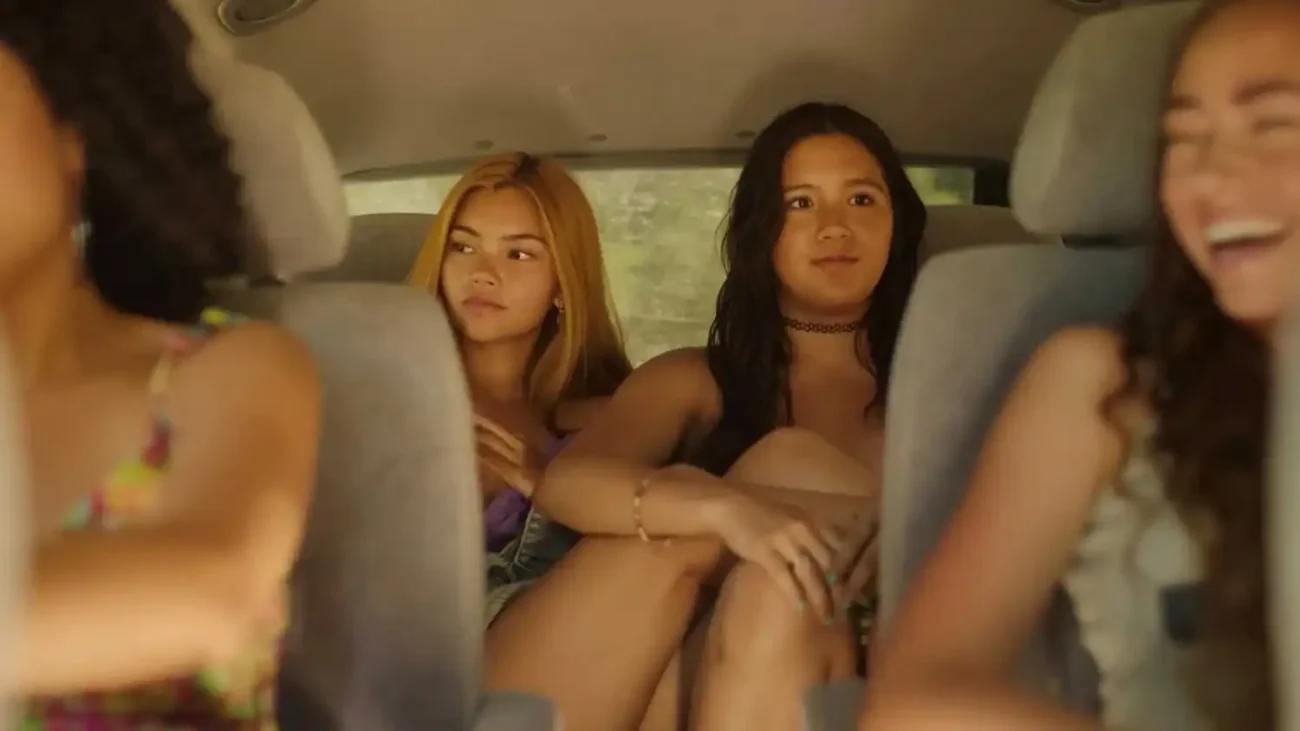
I’ll be honest with you, I went into that theater carrying a quiet skepticism, not about the story itself, because stories about teenage girls discovering each other have long earned their place in serious cinema, but about the occasion surrounding it.
When an artist builds an entire franchise out of a single music video, expands it into a novel, and finally arrives in a multiplex with a Focus Features deal behind her, the cynical reading practically writes itself: brand extension dressed as art.
Hayley Kiyoko, affectionately known as Lesbian Jesus to a devoted corner of the internet, has been tending this particular garden since 2015, and I wondered, walking in, whether she was completing a merchandise cycle or actually making a film.
She’s making a film. Not a perfect one, but an honest one, and in 2026, when so much of what passes for queer cinema is either tragedy porn or sanitized wish fulfillment, honesty matters more than I expected.
The thing Girls Like Girls understands, and this is Kiyoko’s real directorial instinct, not just her songwriting sensibility transposed onto celluloid, but is that desire between two people who don’t yet have a name for what they’re feeling doesn’t arrive in grand gestures or swelling music.
The story follows Coley, seventeen, recently motherless, newly relocated to rural Oregon to live with a father who’s been more absence than presence, puts on Sonya’s jacket and Sonya just watches her do it. The camera holds on that look a beat longer than it needs to, and you feel something in the room shift before you can articulate what or why. That’s not an accident of editing, that’s a director who knows exactly what she’s doing.
Coley is our entry point, and Maya da Costa plays her with a stillness that risks reading as blankness before gradually revealing itself as something more complicated, the particular flatness of a person who has learned to keep the volume of her own feelings turned down because the alternative has always been too costly.
She’s lost her mother, she’s in a strange town, and somewhere in the messy process of befriending Sonya, she starts feeling things that frighten her in a completely different register than grief does.
Da Costa doesn’t announce any of this, she lets you watch Coley discover it in real time, which is the only honest way to play it. There’s a moment where she’s watching Sonya laugh with someone else across a crowded backyard, and da Costa doesn’t do anything dramatic, she just looks, and somehow that nothing becomes the entire emotional argument of the film.
Myra Molloy as Sonya is the performance I’ve been turning over since I left the theater. Where Coley is withdrawn, Sonya is surface-bright: popular, pretty, seemingly in possession of all the social machinery that Coley conspicuously lacks.
She has a boyfriend, Trenton, played by Levon Hawke with the practiced self-assurance of someone who’s been told he’s charming one too many times, who dismisses her friendship with Coley by saying she “has a thing for strays,” and you watch Sonya take that line in and file it somewhere it clearly isn’t going to stay quietly. Molloy plays Sonya’s oscillation between warmth and withdrawal not as inconsistency but as the behavior of someone who knows exactly what she’s feeling and is making a daily, effortful choice to pretend otherwise. That’s a genuinely difficult thing to portray without tipping into melodrama, and she doesn’t tip once.
Zach Braff as Coley’s father arrives with limited screen time and no showboating whatsoever, which turns out to be exactly what the film needs. The scenes between him and da Costa are brief and unshowy, but they do essential structural work, reminding you that Coley’s story is larger than romantic longing, that she’s rebuilding an entire interior life from something close to rubble, and that a father trying awkwardly to be present after years of absence is its own kind of grief being quietly processed alongside everything else.
The early 2000s setting is a smarter choice than it might appear. It isn’t only about nostalgia for desktop instant messaging or Imogen Heap needle drops, though both are here. It’s that the period strips away the cultural infrastructure that queer teenagers have access to now, no algorithms surfacing community, no language pre-loaded and ready to receive what they’re feeling.
These girls have to arrive at themselves alone, in the dark, using only what’s in front of them, which makes the whole thing feel more fragile and more urgent. Kiyoko and her co-writers, Stefanie Scott, who played Coley in the original music video, and Chloe Okuno of Watcher, understood that the story needed that friction, even if the dialogue itself occasionally betrays its workshop origins with lines that sound engineered rather than discovered.
That’s the honest critique, and it deserves to be said plainly. The screenplay has joints that creak. The first act leans too hard on montage when it needs actual scenes between the characters, and some of the early exchanges between Coley and Sonya have a stilted quality, as though the script knows where it’s going and is nudging them along a little too visibly.
The second half improves considerably, because by then da Costa and Molloy have built enough genuine texture between them that the screenplay can step back and let them simply occupy the same space together, which is where the film is most alive.
Cinematographer Sonja Tsypin shoots all of it in natural light that registers as almost physically warm, the kind of summer light where everything is slightly overexposed, slightly too bright, the way memory tends to treat things you were too young to fully hold when they were happening. She keeps the camera close: hands, hair, the geography of two faces in conversation.
It’s a visual grammar borrowed from the music video that started this whole chain of work, but expanded here into something with room to actually breathe.
There’s a post-credits scene, which I’ll mention because no one mentioned it to me, and it is genuinely baffling in the way that only a well-intentioned miscalculation can be baffling. It isn’t damaging. It simply has no business being where it is, like finding a cheerful footnote at the end of a letter that was just starting to move you. Stay or leave, it won’t change what the film already did to you.
finally, this isn’t any single scene but the accumulated weight of watching two people fall toward each other in slow motion, each hoping the other will catch them, neither able to be first to say the thing that needs saying. Kiyoko closes the film on a new recording of the original song, stretched and slowed into something that sounds almost devotional
“we will be everything that we’d ever need”, a line that once read as teenage idealism and now, sung by someone who wrote it over a decade ago and spent years finding new containers for the story, sounds less like a fantasy and more like something that quietly turned out to be true.
The film is really about that belief, not just falling for someone, but the conviction, arrived at against all available evidence, that feeling something this large means it’s going to matter. Sometimes it does. Sometimes it just teaches you that you were capable of feeling it, which turns out to be its own kind of answer.
Parental Guidance
Rating: R — for language, sexual content, and teen drug and alcohol use.
Violence & Intensity There is no physical violence of any consequence. The intensity in this film is entirely emotional, rejection, grief, social pressure, the particular quiet cruelty of small-town expectations closing in on someone who doesn’t fit. Some confrontations between characters run genuinely hot, but nothing crosses into physical territory. Parents of sensitive teenagers should know that the grief storyline carries real weight and is not softened for comfort.
Language Strong profanity runs throughout, consistent with how teenagers actually communicate rather than how adults imagine they do. A handful of harder expletives appear across the runtime, though the language never feels gratuitous in context.
Sexual Content / Nudity No nudity. The romantic content between the two leads is emotionally charged but physically restrained, kissing, closeness, longing held at close range. The one scene where the line between friendship and something else finally breaks is handled with real discretion. The emotional weight of it will hit considerably harder than anything physical.
Drugs, Alcohol & Smoking Teen drinking appears in party settings, depicted matter-of-factly rather than glamorized or treated as a moral lesson. Some drug use in social contexts, similarly handled as landscape rather than editorial.
Age Recommendation Best suited for 16 and up without reservation. For a questioning teenager 14 or older, this film could land in ways that genuinely matter, there’s a particular relief in seeing your own confusion reflected honestly on a screen rather than dramatized beyond recognition.
