Late in “Leviticus,” a boy steps into a photo booth believing his crush is sitting beside him. When the strip develops, he’s alone in every frame. No trick photography, no jump scare, just an empty seat where a person should be, and the slow horror of realizing you imagined company you needed badly enough to feel it. That single image does more work than the entire opening half hour of jump-cut dread that precedes it, and it tells you something true about what writer-director Adrian Chiarella is actually building here, underneath the marketing department’s idea of what this movie is.
“Leviticus” gets pitched as horror, and it is, technically, there’s a demon, there’s a body count, there’s a deliverance healer with the dead-eyed calm of a man who’s done this before. But the engine of this movie isn’t dread. It’s longing. Chiarella, working from his own script in his feature debut, takes the oldest trick in the horror playbook, give the monster the face of what you want most, and uses it to ask a genuinely uncomfortable question: what happens to desire when an entire town has decided it’s sin? The title isn’t subtle. It’s not supposed to be.
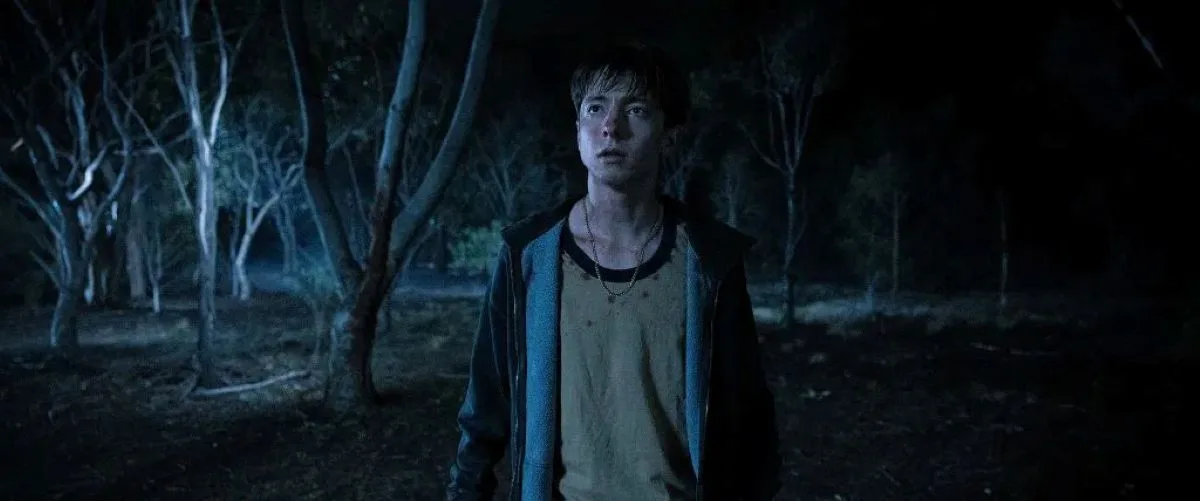
Joe Bird plays Naim, the new kid in a sun-bleached, church-shadowed corner of rural Australia, and he plays him with the kind of guarded, watchful stillness that makes you lean in rather than look away. Early on, his mother, played by Mia Wasikowska with a chill that never tips into cruelty, asks him an offhand question about a classmate, and Bird’s face does something complicated: caught, then composed, then caught again. Wasikowska doesn’t get much room in this script, which I’ll come back to, but she makes the most of what she has. You believe she loves her son. You also believe that love has a ceiling, and that Naim has already started measuring it.
Stacy Clausen, as Ryan, is the showier performance, and it works because it’s calibrated against Bird’s restraint rather than competing with it. Ryan swaggers. He flirts with girls in front of everyone and then finds reasons to be alone with Naim. It’s a performance built on the gap between what a boy performs for his town and what he actually wants, and Clausen plays that gap like he’s lived in it. Their chemistry isn’t a marketing word here, it’s the actual structural support of the film. Take it away and you’ve got a competent ghost story. Keep it, and you’ve got something that aches.
The horror itself arrives sideways, almost shyly, which I respected, almost. The film opens cold, on a woman alone in a public pool shower, steam and pleasure curdling fast into a scream and bloodied hands on tile. It’s a startling opener, and in retrospect a little bit of a cheat, the kind of “see, this is a horror movie, I promise” gesture studios like before the slower stuff starts. I’d have trusted Chiarella to earn the dread without it.
Once the actual story gets moving, the craft sharpens considerably. A sound design choice runs through the whole film, long stretches of near-silence, a held breath, before something low and wrong creeps into the mix, and it’s more unsettling than any single effect. When Naim, stung by jealousy after catching Ryan with someone else, tells their pastor what he saw, the fallout isn’t a sermon. It’s an exorcism, dressed up in the language of deliverance, inflicted on both boys by parents who’ve decided their sons are possessed rather than simply young and frightened of what they feel. Watching that machinery turn, adults mistaking love for an infection they can pray out of a body, is the film at its most clear-eyed and its most quietly furious.
Then the demon shows up wearing the face of the person each boy wants most, and here’s where the film loses some of its nerve. The metaphor is strong enough that it doesn’t need spelling out, and yet the script keeps spelling it out anyway. Characters say the theme aloud, it wants us to be afraid of one another, like a thesis statement nailed to the wall in case anyone missed it the first time. The photo booth moment proves Chiarella can trust an image to carry meaning without narration. I wished he’d trusted that instinct more often.
The bigger frustration is what happens once Ryan learns Naim was the one who told the pastor. The rift that follows makes sense on paper, betrayal is betrayal, but it costs the film its only real engine. Bird and Clausen’s chemistry was carrying so much weight that once the script pulls them apart, the back third sags. We’re left facing the demon’s terror without the warmth that made the terror mean something, and the movie, possibly without meaning to, ends up proving its own thesis: isolated from each other, neither boy nor the story around them is as alive.
I also kept waiting for someone, anyone, in this movie to get an interior life beyond their function in Naim and Ryan’s arc. Wasikowska’s character gets one fleeting flashback that promises depth and then closes the door on it almost immediately. Nicholas Hope’s deliverance healer is appropriately chilling but never more than an instrument of the town’s fear. It’s a small ensemble doing a lot of narrative labor off very little characterization, and by the end I realized I could describe what almost everyone wanted, but not who almost anyone was outside of wanting it.
None of that erases what Chiarella gets right, and what he gets right is hard to fake: two actors who feel like they’re discovering something in real time, a visual and sound language patient enough to let dread build instead of announcing itself, and a genuine point of view about the violence done to people in the name of saving them. “Leviticus” is a horror movie that ultimately believes love wins, which is either the most hopeful or the most stubborn thing a film can say right now, depending on your mood walking in. I walked out somewhere in between, moved by what worked, frustrated by what the film wouldn’t let itself trust. That tension between tenderness and machinery is, in the end, very close to what the movie is actually about.
Parental Guidance
Rating: R (anticipated, based on theatrical release context); content includes intense psychological horror, violence, and same-sex intimacy.
Violence & Intensity: Includes a graphic opening kill (a shower attack leaving a victim bloodied), supernatural stalking and physical assault by a shapeshifting entity, and disturbing depictions of an exorcism-style “deliverance” ritual performed on teenagers as a stand-in for conversion therapy. The horror is largely psychological and atmospheric rather than gore-driven, but several sequences are intense and may be distressing, particularly the conversion-therapy material given its real-world basis.
Language: Moderate; dialogue reflects naturalistic teenage and small-town speech, with some profanity, but language is not the film’s primary register of intensity.
Sexual Content / Nudity: Depicts a tender, evolving same-sex relationship between two teenage boys, including a physically intimate scene (kissing and implied further intimacy) on a bus. Handled with emotional weight rather than explicitness, but the content is clearly intended for mature teen and adult audiences, not younger viewers.
Drugs, Alcohol & Smoking: Minimal; not a significant element of the film based on available information.
Age Recommendation: 16+. The film’s themes, religious trauma, conversion therapy, supernatural violence tied to sexual identity, are handled with care and intelligence, but the emotional intensity and the conversion-therapy content in particular make this a film best suited to older teens and adults, ideally with the option to talk through it afterward.
