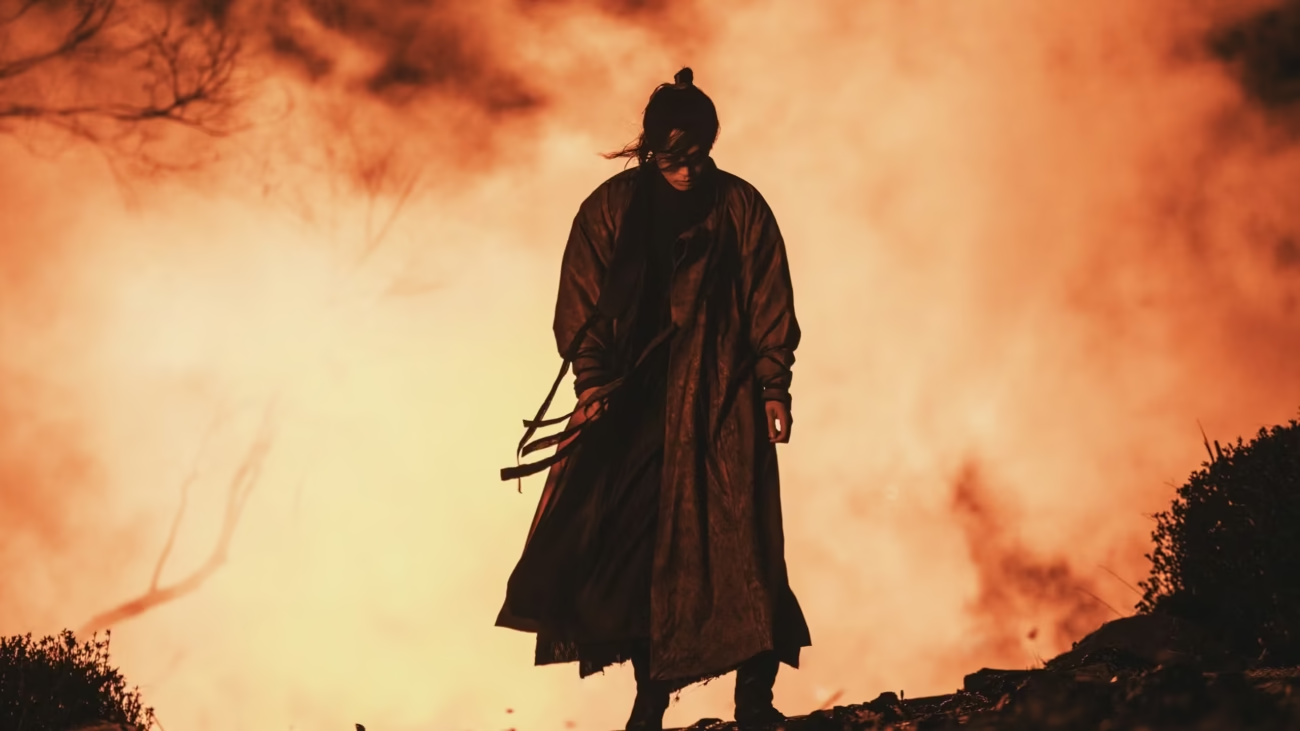
The East Palace — A First Look at Netflix’s Newest Obsession
Every K-drama season seems to produce one title that everyone’s already decided they love before it airs, and this July it’s this one. I haven’t had a chance to sit with all eight episodes myself, nobody has, outside Netflix and one advance reviewer who got early access to the first four, but that early word is specific enough, and enthusiastic enough, that it’s worth walking through honestly rather than waiting until the release date to say anything at all.
The premise sounds, on its face, like a dozen other palace dramas dressed up in ghost-story clothing: a king summons two outsiders to solve a supernatural mystery threatening the throne. What separates this one, according to that early look, is how quickly it commits to its own mythology instead of easing viewers in with palace intrigue as a warm-up act. Gu-cheon, played by Nam Joo-hyuk in his first television role since 2023, can cross into something called the World of Gwi and fight spirits there directly.
Saeng-gang, played by Roh Yoon-seo, hears the dead and has spent her whole life treating that ability as an affliction rather than a gift. The show pairs them as narrative opposites, one drained by a lifetime of seeing what others can’t, the other frightened of a power she never asked for, and by all early accounts, that pairing works because the show resists turning it into simple romance. It’s positioned instead as two damaged people who understand each other on a level neither can explain to anyone else.
What I find genuinely promising, reading through that advance coverage, is the attention paid to the show’s supernatural taxonomy. This isn’t generic ghost-story shorthand where every spirit looks and behaves the same. The mythology draws on actual Korean folklore, gwisin, spirits with unfinished business, broken into specific subtypes like the sinister gwi-mae or the energy-draining ggeomeoksali, and the writing apparently lets Gu-cheon explain these categories to Saeng-gang in a way that folds naturally into their dynamic rather than reading as homework.
That’s a small craft choice, but it’s the kind that tells you whether a show respects its source material or is just borrowing its aesthetic. A detail worth noting: Gu-cheon, lacking his own life energy by nature, is said to be more unsettled by the energy-draining spirits than anything else he faces, which is the kind of character-specific vulnerability that turns a monster into more than a set piece.
The performances are apparently where this show does its most surprising work. Nam Joo-hyuk’s comeback role gives him room for his established comic timing, but the early reaction singles out an underlying sadness in Gu-cheon that reportedly cuts against everything audiences expect from him after years of more conventional leading-man roles.
Roh Yoon-seo comes out even better regarded, after years of roles that reportedly kept her in one narrow lane, she’s said to be almost unrecognizable in this one, which is about the highest compliment you can pay an actress working against her own typecasting. Around them, Cho Seung-woo’s king is described as oscillating convincingly between warmth and real menace, and Jang Young-nam’s Queen Dowager apparently commands scenes through sheer stillness rather than volume, the kind of performance that suggests real directorial trust in an actor’s presence over dialogue.
Structurally, the advance word praises something a lot of genre dramas fumble: pacing that builds patiently without wasting time. Too many supernatural K-dramas either dawdle for episodes before committing to their central conflict, or rush the setup so badly that nothing lands emotionally once the twists arrive.
This one is reportedly the rarer thing, a show that establishes its stakes by the end of the first episode and keeps escalating cleanly from there, propelled less by cliffhangers demanding another episode than by something closer to genuine absorption. That’s a meaningful distinction. Plenty of shows are engineered to be un-pausable. Fewer are engineered to actually earn your attention rather than just holding it hostage.
None of this means the show arrives flawless, even by the account of its own advance reviewer. Some musical choices are apparently jarringly modern against the period setting, an easy trap for shows trying to make old folklore feel urgent to contemporary audiences, and some of the fight choreography is said to be shot too darkly to fully appreciate what’s happening on screen, a complaint I’ve had about plenty of prestige television lately, where moody lighting sometimes serves atmosphere at the expense of legibility.
Those are real notes, not dismissible ones, though they’re apparently outweighed by the show’s stronger instincts: gorgeous costuming, small actor choices that reward close attention, and a story built with enough hidden detail that a second viewing seems to genuinely offer something new rather than just repetition.
I want to be honest about what this piece actually is, because I think that honesty matters more than sounding certain. This is a response to one advance look at half a season, not a verdict on the whole thing. Whether The East Palace sustains its own ambition across all eight episodes, whether that slow-burn mystery pays off as cleanly as its first half promises, is something only the full release will answer.
But between the folklore grounded in something real, two lead performances apparently doing more than the genre usually demands, and a pacing sense that seems to trust its audience’s patience, this is shaping up to be the kind of show that’s easy to recommend cautiously and hard to dismiss.
I’ll know for certain in a few days. For now, count this as informed anticipation rather than a closing argument, the kind of thing a critic writes with one hand already reaching for the remote.
Parental Guidance: The East Palace
Rating: TV-MA (per Netflix’s official listing)
Violence & Intensity: Genuine horror elements are central here, creature design is reportedly a highlight, with elaborate makeup and effects work built around genuinely unsettling spirit designs. Combat sequences between Gu-cheon and various spirits carry real tension and dread; some fight scenes are shot dark enough that the intensity is more atmospheric than graphic, though the horror tone throughout is clearly intentional rather than incidental.
Language: No specific concerns flagged in available coverage; expect dialogue consistent with a TV-MA period drama rather than gratuitous profanity.
Sexual Content / Nudity: No romantic or sexual content flagged in the advance review; the central relationship between the two leads is described as an emotional partnership rather than a romance, at least through the first half of the season.
Drugs, Alcohol & Smoking: No substance-related content flagged in available material.
Age Recommendations: Best suited for older teens and adults, roughly 15 and up, given the horror elements, political menace, and genuinely unsettling supernatural content.
