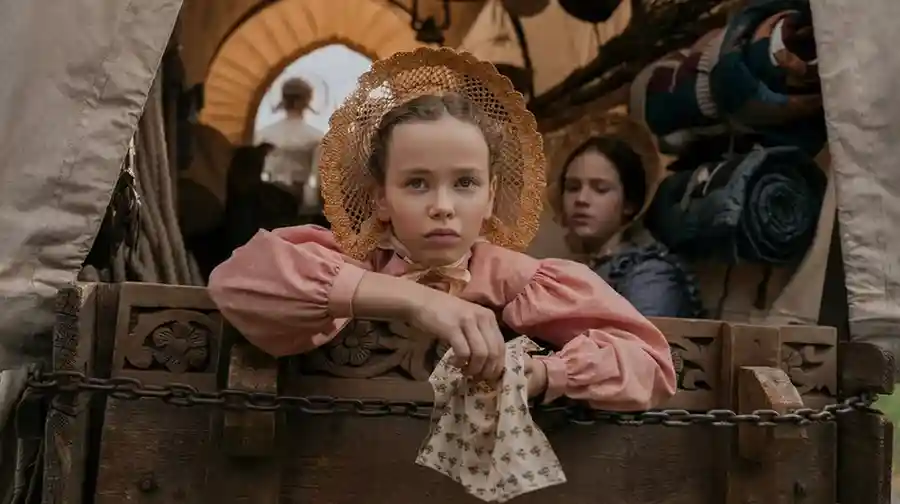
There’s a shot early in the first episode of Netflix’s “Little House on the Prairie” where the camera just sits with the Ingalls family’s covered wagon, small against a Kansas horizon that seems to go on longer than the frame can really hold. Nobody talks. Nothing happens. And I found myself thinking about how rare that is now a show willing to let a landscape do the emotional work instead of a swelling score or a line of dialogue explaining what we’re supposed to feel.
That patience turns out to be the whole personality of this reboot, and it’s the thing that convinced me it actually earned the right to use this title again.
Let’s be honest about what this show is up against. The 1970s version, with Michael Landon’s Pa and Melissa Gilbert’s Laura, isn’t just beloved it’s practically load-bearing nostalgia for a couple of generations, the kind of show that gets credited with inventing warmth as a television genre.
A remake attempt fell apart back in 2020, which tells you how nervous people were about touching this. Netflix went ahead anyway, and creator Rebecca Sonnenshine’s version doesn’t try to out-shout Landon’s ghost. It just quietly does its own thing, and by the third episode, I’d mostly stopped comparing the two.
Alice Halsey plays Laura, and I want to be careful not to overpraise a child performer just because she’s a child performer doing fine work that’s its own kind of condescension. But what Halsey does here is genuinely specific. She plays Laura’s curiosity as something closer to hunger than cuteness a kid who wants to understand the actual mechanics of the world around her, the how and why of things, not just the wonder of them.
There’s a scene with Good Eagle (Wren Zhawenim Gotts) where Laura is trying to bridge a language and culture gap through sheer persistence, and Halsey plays it without a trace of performative sweetness. She just plays a kid who wants a friend and is willing to be a little awkward getting there. That’s harder to pull off than it looks.
Luke Bracey’s Pa Charles is the other anchor, and he’s good in a way that sneaks up on you not the folksy warmth of Landon’s Pa, but something a little more grounded, a man whose charm comes from competence rather than speeches.
Crosby Fitzgerald’s Ma Caroline works in the same register, understated, watchful, never fighting Bracey for the frame but never disappearing into it either. Skywalker Hughes, as older sister Mary, has less to do in these early episodes, though I suspect that’s a first-season problem more than a talent problem the show clearly has more Mary story coming.
Here’s where the series actually distinguishes itself from its predecessor, and where I think it deserves real credit: the 1970s show, whatever its charms, kept its moral universe almost entirely inside the Ingalls family. Everything outside that family was scenery. This version folds Osage history and presence into Independence, Kansas, as something the town actually has to reckon with, rather than a backdrop the pioneers pass through on their way to a homestead.
It would have been easy to handle this clumsily an issue-of-the-week detour bolted onto a family drama. Instead the show mostly threads it through the texture of daily life, so it reads less like a lesson and more like the actual world the Ingalls family has settled into, whether they’ve fully reckoned with that or not.
I say “mostly” because the show isn’t without its soft spots. A few plotlines resolve themselves a little too neatly, problems smoothed over in ways that feel more like network-television convenience than earned catharsis. This is still, underneath its ambitions, a TV-PG family drama, and there are moments where you can feel it pulling its punches rather than following a thread all the way to somewhere uncomfortable. I don’t think that sinks it. I think it means the show has more room to grow teeth in future seasons, if it wants to.
What actually carries “Little House on the Prairie” through its slower stretches is the way it looks. Filmed in Manitoba rather than anywhere near the actual historical Midwest, the show finds a version of prairie light that feels almost tactile dust hanging in late-afternoon sun, fields that shift color as clouds move over them, the kind of images that make you understand why people who lived through actual hardship still described this landscape with something like love.
The costuming and hair work earn a mention too, not because they’re flashy, but because they’re consistent nothing here looks like a costume department’s idea of “old-timey,” it looks like clothes people actually wore because they had to.
I kept thinking, watching this, about how much easier it would have been to make this show cynical. Prestige television has trained us to expect that any revisit to a beloved, gentler property will come drenched in irony or darkness, will insist on showing us the ugly stuff the original glossed over just to prove it’s smarter than its source.
“Little House on the Prairie” doesn’t really do that. It acknowledges more than its predecessor ever did the show is honest that pioneer settlement wasn’t some clean, victimless expansion into empty land but it does that acknowledging without losing the gentleness that made people love this story in the first place. That’s a harder balance to strike than either extreme.
Is it a little slight, at times? Sure. Season one plays more like a warm introduction than a fully-loaded drama, and I imagine the stakes will sharpen as the Ingalls family’s journey continues. But there’s something to be said for a show that trusts quiet, trusts landscape, trusts a kid’s curiosity to carry a scene without underlining it three times. In a television landscape addicted to noise, “Little House on the Prairie” is confident enough to let a wagon sit still on a horizon and just watch it.
Parental Guidance “Little House on the Prairie” (Season 1)
Rating: TV-PG
Violence & Intensity: Mild for the genre. The series depicts the general hardships of frontier settlement physical labor, occasional peril tied to travel, weather, and homesteading life but avoids graphic violence. Any conflict is handled with restraint appropriate to a family drama.
Language: Minimal to none. The show maintains a clean, period-appropriate tone consistent with its target family audience; no significant profanity or slurs.
Sexual Content / Nudity: None of note. This is a family-oriented period drama with no sexual content or nudity.
Drugs, Alcohol & Smoking: Occasional incidental depictions consistent with 19th-century frontier life (period-accurate references to drinking or tobacco may appear in adult contexts) but nothing depicted as glamorized or central to the story.
Age Recommendation: Suitable for most ages, including younger children with adult guidance for some emotionally heavier or historically complex material particularly around themes of settlement, displacement, and Indigenous history that the show engages with more directly than its 1970s predecessor. A strong pick for family co-viewing, roughly ages 7 and up.
