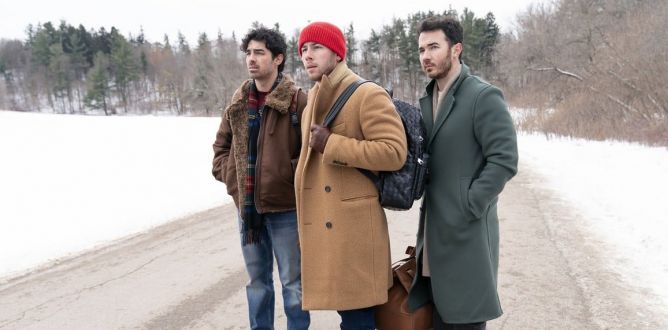
The MPAA rated A Very Jonas Christmas Movie TV-PG.
Ever wondered what it would be like to get paid to play someone else’s life for a little while? Not on stage, not on screen, but in the messy, unpredictable real world? That’s the strange, heartwarming, and at times utterly devastating premise of Hikari’s Rental Family, and it’s a film that sneaks up on you in the best possible way.
The story kicks off with Phillip Vandarpleog (Brendan Fraser), an American actor living in Tokyo for seven years, who’s about to take on a role he never expected. He’s ushered into a funeral scene, prepared to act as a grieving bystander. Only, the man in the casket isn’t actually dead. When the service ends, the man rises and thanks everyone for letting him exist, a moment that’s both surreal and oddly tender. From here, Phillip’s journey veers sharply away from anything he’s ever known.
It turns out that the company who hired him isn’t a typical casting agency. Shinji (Takehiro Hira), the enigmatic owner, runs a business called Rental Family. Instead of producing films, the agency hires actors to step into the lives of strangers to fulfill emotional needs playing a father, a groom, a companion whatever someone is missing in their life. “You don’t have to be that person,” Shinji tells Phillip. “You just have to help them connect to what’s missing.” It’s a concept that’s at once bizarre and fascinating, and Phillip, despite his limited acting experience (basically a single toothpaste commercial years ago), is intrigued.
Phillip is gradually introduced to the team: Aiko (Mari Yamamoto) and Kota (Kimura Bun), who, along with Shinji, form the backbone of the Rental Family agency. He takes on his first assignments: marrying a complete stranger in a staged wedding designed to help her navigate her own family’s expectations, stepping into moments that are small but deeply significant to the people he’s helping. Slowly, he discovers that this isn’t just acting it’s a form of human connection that actually matters.
The stakes rise when Phillip is asked to play a father for a young girl named Mia (Shannon Gorman), whose mother needs a convincing presence for a private school interview. Phillip’s initial hesitation melts as he meets Mia, a bright, captivating presence whose trust he earns quickly. In the process, he starts to genuinely enjoy the work. Realizing that these moments are shaping his life as much as theirs, he even turns down actual acting roles to spend more time with her. But the deeper he gets, the more complicated it becomes. When the job ends, the emotional consequences hit Mia’s life, like so many others he’s touched, will be forever altered. The film asks the viewer a difficult question: is it better to finish the role perfectly or to protect the hearts of the people you’ve come to care about?
Fraser is nothing short of extraordinary. He conveys Phillip’s inner life with quiet, subtle power; a raised eyebrow or a fleeting expression often says more than any line of dialogue. You feel his hesitation, joy, and heartbreak intimately. Takehiro Hira brings a steady, almost mystical gravitas to Shinji, the man orchestrating these emotional interventions. Yamamoto and Bun add a fantastic mix of warmth and dry humor, their chemistry with Fraser lifting even the most surreal scenes into something deeply human.
Young Shannon Gorman is magnetic as Mia. This is her acting debut, yet she commands the screen with a natural charm and presence that makes her scenes with Fraser particularly moving. Akira Emoto, as Kikuo Hasegawa, a once-famous actor losing his memory, adds a quiet poignancy to the story. His performance demonstrates how memory shapes identity, and how the relationships we forge even artificial ones can leave real, lasting impacts.
Writer-director Hikari, collaborating with co-writer Stephen Blahut, masterfully balances the film’s tonal shifts. One moment, the story has you laughing out loud at an awkward staged wedding; the next, it’s breaking your heart with the quiet ache of loss or the fleeting nature of trust and connection. The film never feels confined by genre; it’s a dramedy, a tender character study, a subtle meditation on human connection, and an emotional rollercoaster all at once.
Rental Family doesn’t just explore the thin line between performance and reality; it interrogates what it means to matter, to connect, and to truly live. Modern Tokyo provides a vibrant, living backdrop that mirrors Phillip’s emotional journey a city bustling with life, yet filled with lonely souls searching for meaning. The film is at once laugh-out-loud funny, unexpectedly touching, and genuinely thought-provoking. It will make you reflect on your own family, friendships, and the small but powerful moments that define your life.
Ultimately, Hikari’s Rental Family is a celebration of human connection. It’s about the roles we play not just for others, but for ourselves and how even the smallest gestures of care can change lives. This is storytelling at its most empathetic and tender, reminding us that even if something isn’t real in the traditional sense, it can still hold profound significance.
In short: Rental Family is irresistibly human, quietly brilliant, and one of the year’s most moving cinematic experiences. If you’ve ever longed for connection, wondered about the choices you didn’t take, or simply want to be reminded that love and care make life worth living, this film will stay with you long after the credits roll.
Dominant Worldview and Other Elements:
The film leans heavily into themes of family and reconciliation. The characters are driven by a relentless desire to find their way home for Christmas, highlighting the importance of facing problems head-on rather than sweeping them under the rug. Working through challenges together is at the heart of the story, making the emphasis on connection and togetherness feel genuinely heartfelt.
Language:
Expect some colorful language throughout. The film includes 16 profanities, with 12 instances of “OMG,” two uses of the “G” word, one “h-word,” and a single “what the h*ll.” Other casual exclamations and slang pop up as well, including “suck,” “stupid,” “screw,” and “sexy.” The abbreviation “BS” appears once, and “hot” is used to describe people. It’s noticeable, but it fits the playful, sometimes irreverent tone of the story.
Violence:
There’s a mix of action and tension here. A plane crashes and explodes, a man injures his head with a small amount of blood showing through a bandage, hotel fights break out, and a pack of wolves provides some genuinely tense moments. While not gratuitous, these scenes add stakes and keep the energy up.
Sexual Content:
Romantic and sexual elements are present, including multiple passionate kisses between couples. One character jokingly warns, “Don’t let your panties bunch up,” and terms like “sexy” and “sexiest” appear several times. A male character is referred to as a womanizer, further emphasizing the film’s playful approach to romance and flirtation.
Nudity:
There’s partial nudity, but nothing explicit. A woman wears a crop top, and there are multiple instances of upper male nudity. A scene in a river shows a woman in her bra and panties and a man in boxers as they swim. These moments are brief and framed within the story’s lighthearted, comedic tone.
Alcohol Use:
Bars appear, people drink beer, and a man makes a joke about whiskey. It’s casual and mostly background flavor, rather than central to the story.
Smoking or Drug Use:
None. The film avoids these elements entirely.
Miscellaneous Immorality:
While the story contains the above elements, they are presented in a way that supports the characters’ journeys and the film’s overall themes rather than glorifying bad behavior.